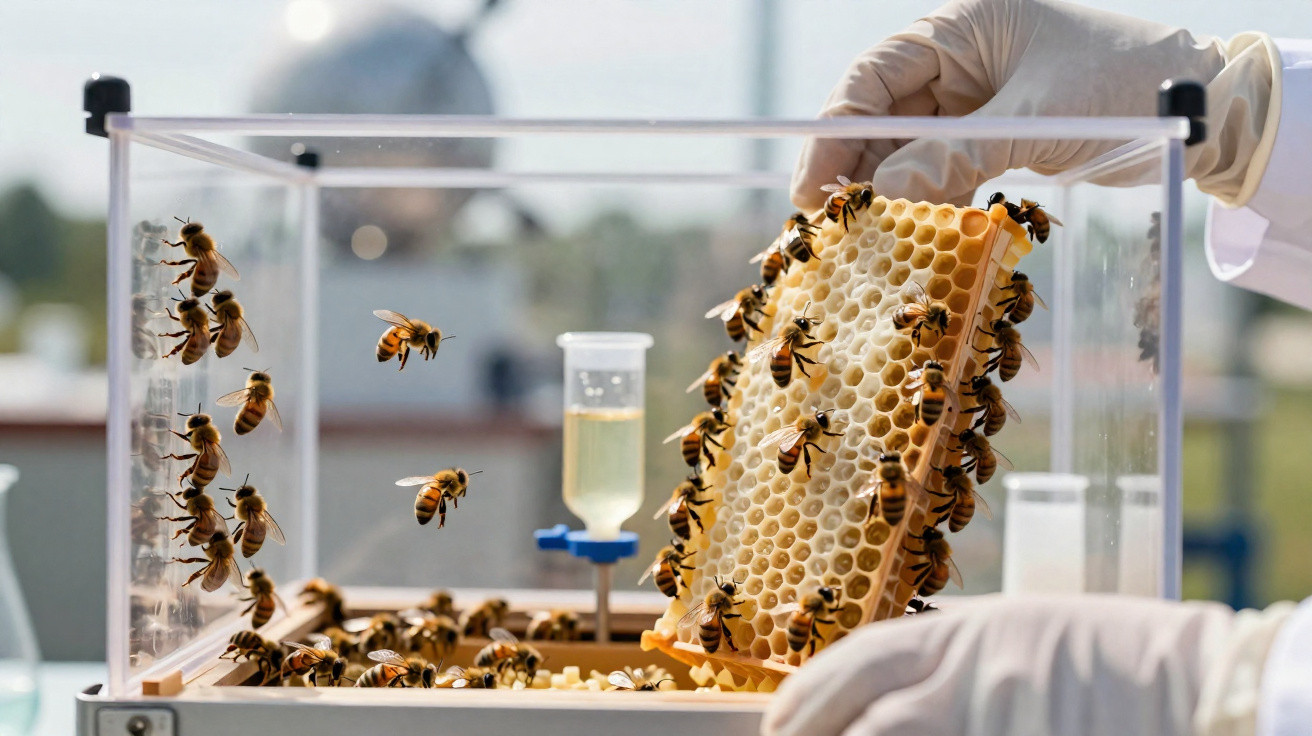
A honey-bee colony depends on co-operation at an extraordinary scale. Workers feed one another, tend the queen, regulate temperature and build wax comb in precise-looking sheets. In 1984, NASA tested what would happen when one familiar cue - gravity - was largely removed.
During the Space Shuttle Challenger mission STS-41C, 3,300 worker bees and a queen spent nearly seven days in microgravity. By the end, they had made about 200 square centimetres of wax comb with hexagonal cells. The result was not proof that bees are unaffected by space, but it did show that they could adapt and begin building without a normal sense of up and down.
A student idea sent into orbit
The experiment flew on STS-41C, which launched on 6 April 1984. It was proposed by Dan Poskevich through NASA’s Student Involvement Programme.
The question was simple: could honey bees make comb in microgravity?
On Earth, gravity is one of many influences on a colony. Bees also respond to touch, scent, airflow, temperature, light, the queen’s pheromones and the surfaces around them. Normal comb is built in vertical sheets, and its cells slope slightly upwards so nectar and honey are less likely to run out.
The space experiment did not remove every orientation cue. The bees still had an enclosure, food, water, artificial surfaces and one another. What it did remove was the usual gravitational reference that helps make “up” and “down” meaningful.
The experiment did not show that bees ignore gravity. It showed that gravity is only one of the cues a colony can use while organising itself and making comb.
A comparable bee colony was kept on Earth, allowing the experimenters to compare behaviour and comb construction.
The first challenge: moving in microgravity
The bees were housed in a specially designed container with room to cluster around their queen, feed and build. At first, microgravity made movement difficult. Bees that attempted to fly could drift or collide with the enclosure rather than landing as they would outdoors or in a hive.
Over the course of the mission, however, the colony became more settled. Workers gathered around the queen and carried out several familiar colony activities.
The workers were observed to
- cluster around the queen;
- take food and water from the supplied sources;
- move around and use the surfaces of the enclosure;
- remove dead bees from the main cluster area;
- produce wax and build comb;
- place some supplied sugar syrup in completed cells.
The queen also laid eggs. That was an important observation, but it should not be overstated: the experiment did not demonstrate a complete new generation of bees developing successfully in microgravity.
Around 200 cm² of newly made comb
By the end of the flight, the bees had built roughly 200 square centimetres of comb. That is a small amount beside the comb in an established British hive, but it was notable for a confined colony working in an unfamiliar environment for less than a week.
The cells retained the recognisable hexagonal pattern associated with honeycomb. Hexagons fit together without gaps and give useful storage space while using relatively little wax. Yet the pattern is not simply drawn to a fixed template by individual bees.
Workers hang together, deposit wax, warm and soften it, shape cell edges, and respond to neighbouring cells. The properties of wax itself also help determine the finished structure. In other words, comb emerges through many repeated local actions rather than from a single bee measuring out a design.
The space-made comb was not an exact match for typical Earth-built comb. Observations from the experiment reported differences in the cells, including relatively thick walls and a smaller cell diameter. That suggests the colony was adapting its building behaviour to the enclosure and to the unusual way materials and liquids behave in microgravity.
Why the hexagons did not disappear
It is tempting to assume that honeycomb needs gravity to stay orderly. The Challenger experiment suggests a more interesting answer: bees have several ways to maintain organisation even when gravity is no longer a reliable guide.
Cues still available to the colony included
- contact with other bees and the wax surface;
- pheromones from the queen and workers;
- light and airflow within the enclosure;
- the edges of newly made comb;
- temperature around the clustered colony;
- the container’s walls and internal fittings.
Bees can also form chains of workers, sometimes called festoons, while building. These linked bodies help create a living framework around the area where wax is being handled.
What the bees built was not a free-floating, perfectly ordinary hive. It was a workable comb structure made inside a purpose-built habitat.
That distinction matters. Microgravity changed the conditions, but it did not leave the bees without any physical reference points.
A small experiment on a busy shuttle mission
The bee enclosure was one payload among several on STS-41C. The mission is better known for deploying the Long Duration Exposure Facility and for capturing, repairing and redeploying the Solar Maximum Mission satellite.
Astronauts carried out spacewalks for the repair work, using the shuttle’s robotic arm and the Manned Maneuvering Unit. Against that dramatic backdrop, the bee experiment was a quieter test of how a social species responds when everyday physics changes.
An extension to the mission gave the crew more time than originally planned to observe the bees. The colony’s comb-building has remained memorable precisely because it was such a practical response: rather than merely surviving, the workers began to make a home.
What the mission did - and did not - establish
The story is sometimes retold as evidence that bees can live normally in space. That goes further than the experiment supports.
It showed that a small, confined colony could survive a short spaceflight, maintain some normal social behaviour and begin making comb. It did not establish that bees could sustain a healthy colony over months or generations beyond Earth.
Important unanswered questions would include:
- whether larvae can develop normally through multiple generations;
- how bees would manage waste, disease and ventilation over a long period;
- how water, nectar and honey would behave in larger quantities;
- whether the colony could regulate temperature reliably;
- how launch conditions and radiation might affect bee health and reproduction.
A spacecraft enclosure is also very different from a landscape full of flowers, weather, predators and changing forage. The experiment tells us something useful about adaptability, not everything about honey-bee biology.
Common mistakes in the bee-in-space story
Calling the container a conventional hive
The bees were not in an ordinary wooden hive with frames, brood boxes and a large established colony. They lived in a compact experimental enclosure designed for spaceflight.
Saying the comb was completely normal
The workers made hexagonal cells, but observations noted differences from typical terrestrial comb. It was an adaptation, not a perfect duplicate of a garden hive.
Assuming microgravity meant no orientation at all
Gravity was no longer the usual guide, but the bees still had surfaces, light, scent, airflow, wax and contact with other workers.
Treating egg-laying as proof of successful reproduction in orbit
The queen laid eggs, but the experiment did not establish a self-sustaining new generation raised in space.
The practical lesson for bee keepers
For bee keepers in the UK, the useful takeaway is not that a colony can be managed without gravity. It is that honey bees are flexible builders which respond to conditions around them.
A colony still needs a stable, well-ventilated home, adequate forage or supplementary feed when appropriate, protection from avoidable disturbance and careful management of pests and disease. Anyone new to bee keeping should seek practical guidance from an experienced local association before obtaining bees.
Take sensible precautions around hives: wear suitable protective clothing, keep visitors and pets away while inspecting colonies, and avoid opening a hive unnecessarily in cold or wet weather. Disturbing a colony too often can chill brood and make bees more defensive.
The Challenger bees did not make space bee keeping routine. Their achievement was smaller and more revealing: in less than seven days, they turned wax, co-operation and the remaining cues in their environment into the beginnings of an organised home.











Comments
No comments yet. Be the first to comment!
Leave a Comment