Insurers can see it, and satellite operators can too.
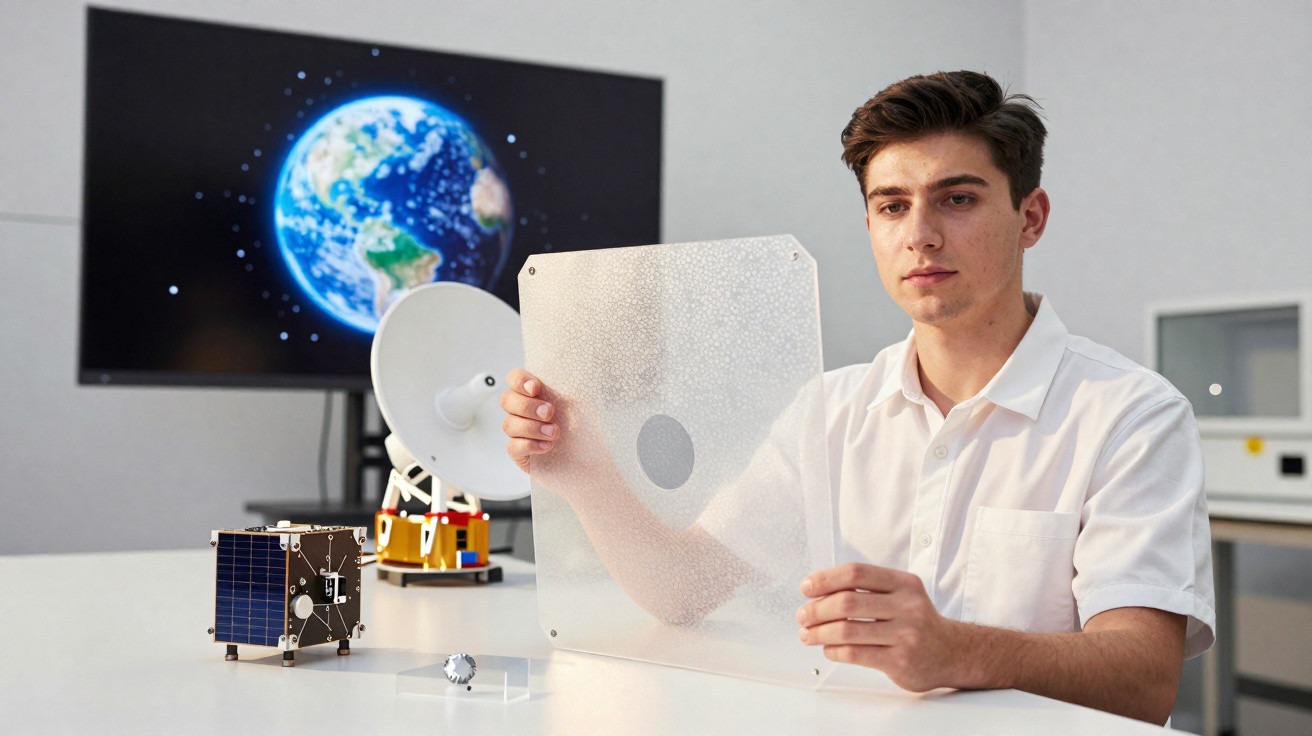
This danger once belonged in footnotes and scientific journals. It now features in boardroom presentations. A US-made armour tile claims it can absorb an impact, maintain communications and avoid adding further debris to an already congested orbital environment.
A crowded orbit is approaching
More than 100,000 satellites may be operating by 2030. At present, roughly one tenth of that number is in service. Every launch introduces more mass and surface area into the narrow orbital shell above Earth. Relative velocities in low Earth orbit are hypersonic. Even a fleck of paint can strike with the force of a bullet. A 3 mm fragment can penetrate a battery, sever a satellite bus or end a mission entirely. Tracking systems fail to detect the smallest pieces, yet those pieces can still hit spacecraft.
LEO collision risk now lives in the millimetre scale. That is where most fragments hide, and where most damage starts.
Estimates supported by the United Nations suggest that tens of millions of untracked objects orbit the Earth. Travelling at about 7 km/s, they present a growing concern. The direction of travel is clear: orbital traffic is increasing, manoeuvring propellant is diminishing, and opportunities for safe operations are becoming narrower.
Why conventional shields reach their limit
The Whipple shield workhorse
For many decades, spacecraft have relied on layered metal bumpers, commonly known as Whipple shields. Their principle is straightforward: a thin external layer breaks up an incoming projectile, while the spacing and internal layers absorb the resulting debris cloud. The approach works, but it carries a substantial weight penalty. Operators pay for that additional mass during launch and throughout every manoeuvre.
Metal armour creates two further difficulties. In unfavourable impacts, it may produce secondary fragments inside the satellite. It also prevents radio-frequency energy from passing through. Cover an antenna with metal and the satellite's own link budget suffers. Engineers therefore have to cut openings in protective shielding for signals to pass through, leaving vulnerable areas behind.
| Feature | Layered metal shield | Composite RF-transparent tile |
|---|---|---|
| Typical thickness | Multi-layer, variable, bulky | ~25 mm per tile |
| Mass impact | High | Low to moderate |
| Radio transparency | No | Yes (radio-opaque version optional) |
| Secondary fragmentation | Possible | Designed to minimise |
| Target debris size | Case by case | Up to ~3 mm (light), ~12.5 mm (reinforced) |
| Installation | Integrated structure | Modular, tile-on placement |
Atomic-6 Space Armor: an American tile with a clever approach
Atomic-6’s composite approach
Atomic-6, a company based in Georgia, has created a modular “Space Armor” tile using a proprietary polymer composite. The precise formulation has not been disclosed, although it combines high-performance fibres with a tailored resin system. Each tile measures roughly 30 by 30 centimetres and is approximately 2.5 centimetres thick. The company states that it withstands impacts exceeding 7 km/s without producing a cloud of dangerous shrapnel.
A shield that keeps fragments out and radio waves in changes how you design antennas, radomes and sensor fairings.
The range comprises two versions. The lighter tile is intended for sub-3 mm debris, which accounts for most known threats by mass. A reinforced tile is designed for larger impacts, up to around 12.5 mm in diameter. That equates to the energy of a steel marble travelling at artillery-like speeds. Both types use a peel-and-stick integration method suited to both newly built satellites and retrofit work.
Radio transparency is the standout feature
Where metal armour stops RF signals, composite armour need not. This material remains transparent across commonly used communications bands, allowing operators to protect antennas, transmitters and sensitive sensors without leaving gaps in their shielding. It removes the long-standing compromise between survivability and link budget.
Atomic-6 also supplies a radio-opaque version for missions requiring shielding, emissions control or intentional RF masking. That alternative offers defence and intelligence customers another capability to deploy.
Why this matters in 2025 and beyond
Orbital politics have become more strained in recent years. Close passes prompt diplomatic objections, while anti-satellite tests have generated debris fields that continue to cross operational orbits. The risk of a Kessler cascade has shifted from classroom diagrams into operational planning. In that environment, passive protection is no longer a luxury; it becomes a basic requirement for service continuity when manoeuvring options are exhausted.
- Reducing secondary fragments decreases the risk of subsequent collisions.
- RF-compatible armour lessens the need for exposed antenna cut-outs.
- Modular construction can shorten integration timelines and simplify in-field repairs.
- Lower mass reduces launch costs and retains delta-v for avoidance manoeuvres.
Key numbers operators care about
- Relative speed in LEO: often 7 km/s, sometimes higher, always unforgiving.
- Threat size: sub-centimetre debris dominates counts and risk hours.
- Tile footprint: ~0.09 m² per module eases placement over antennas and panels.
- Debris classes addressed: up to ~3 mm (light) and ~12.5 mm (reinforced).
Design and operational implications
Antennas and payloads
Engineers can treat an antenna surface as they would any other area requiring protection. This means RF teams no longer need to negotiate armour openings. The tile can also act as a protective fairing, helping to make thermal and contamination conditions around RF equipment more consistent.
Mass budgets and thermal paths
Compared with thick aluminium bumpers, composite armour reduces structural mass penalties. However, designers still need to confirm heat-transfer paths, because composites conduct heat differently from metal. Batteries, reaction wheels and star trackers are all affected by those thermal gradients. Detailed modelling and several carefully positioned thermal straps resolve most issues.
Retrofit potential
Numerous satellites still have years of useful service ahead, but lack protection against emerging debris environments. Modular tiles offer programme managers a route to improve survivability during servicing missions or at late stages of manufacture. Adhesives and fasteners require thorough ageing tests, as outgassing and ultraviolet exposure can weaken bonds over time. Qualification programmes must account for this.
What this does not solve
No passive shield can disregard a direct impact from a large object. Conjunction warnings will still require avoidance burns. Ground-based networks must still detect more and smaller fragments. Standards also need stronger enforcement. ISO 24113 and agency requirements provide help, but compliance is inconsistent. Debris-removal missions and drag sails remain necessary elements of the wider solution.
Armour buys time and tolerance. It does not replace tracking, manoeuvring, or debris removal.
Costs, testing and the fine print
Actual performance depends on test evidence. Hypervelocity test facilities can examine impacts from 3–12.5 mm projectiles at orbital velocities. Results must show both the crater and the debris plume. Operators should request ballistic-limit curves, angle-of-attack data and multi-hit performance. They should also establish how the tile performs after thermal cycling, atomic-oxygen exposure and repeated micrometeoroid impacts.
Cost per square metre becomes significant when large satellite buses and solar-array yokes are being covered. Lead time matters as well. The worldwide satellite boom is putting supply chains under pressure. Resin, fibre and high-temperature adhesives can become bottlenecks. Planning for spare tiles and repair kits will prevent difficulties later.
Signals and spectrum considerations
Radio transparency must be tested rather than presumed. Dielectric behaviour changes with frequency, temperature and incident angle. Ka-band links are more demanding than S-band links. Payload teams require insertion-loss figures, phase-stability data and polarisation effects across the operating band. The radio-opaque version must likewise demonstrate effective shielding without becoming a thermal hot spot.
How teams can use this now
- Conduct a debris-flux simulation for the planned orbit and mission duration, then identify exposure hotspots across the bus.
- Map tile coverage over antennas, batteries, tanks and avionics bays, protecting the highest-value areas first.
- Assess thermal, RF and charging behaviour with the tile fitted, then confirm results through chamber testing.
- Include multi-hit inspection and repair procedures in the operations handbook.
Related risks and additional benefits
Composite facesheets may also cushion impacts from docking contact and ground-handling incidents. They reduce the likelihood of generating flakes during micro-impacts, which is positive orbital neighbour behaviour. Conversely, composites can accumulate surface charge, and plasma environments expose inadequate grounding. Bleed paths should be incorporated and validated early.
The bigger picture
The space economy depends on uninterrupted services. Earth observation supports farmers, insurers and emergency responders. Orbital broadband connects remote schools and clinics. As constellations grow, tiny objects in orbit become a major risk in financial models. A tile that dampens hypersonic impacts while allowing signals to pass can shift that risk profile in a valuable direction.
This armour should be combined with improved tracking, more intelligent conjunction filters and fuel-efficient manoeuvres. Debris-mitigation design should be incorporated from the outset. Kessler risk must be addressed as a systems challenge rather than an afterthought. Companies that take this approach will keep their spacecraft communicating as the sky becomes more crowded.










Comments
No comments yet. Be the first to comment!
Leave a Comment