
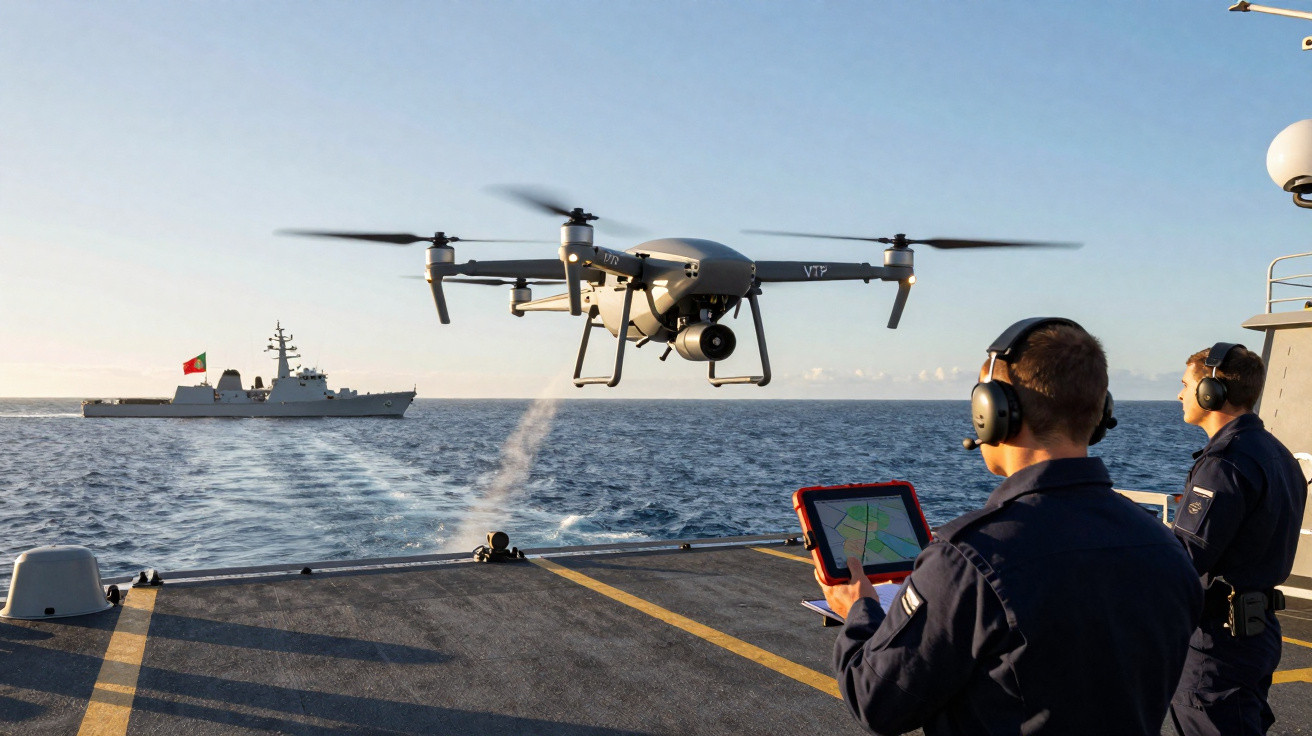
Following the start of a new phase of experimentation with embarked uncrewed systems, the Portuguese Navy has tested a VTOL drone from the Vasco da Gama-class frigate NRP Álvares Cabral (F331). The trials were carried out by the specialist X31 unit while the vessel was deployed on the Open Sea Initiative 2026 mission, aiming to validate operational procedures, safety measures and interoperability in demanding naval conditions.
VTOL drone trials aboard NRP Álvares Cabral
The system used was a VTone vertical take-off and landing uncrewed aerial system (UAS). Operating this type of aircraft from a warship involves coordinating more than launch and recovery: it also requires management of flight-deck safety, airspace, communications, command-and-control links, and the flow of information to the ship’s command team.
In this respect, the activity conducted aboard NRP Álvares Cabral helps turn an experimental capability into repeatable operating procedures, while also identifying limitations before uncrewed systems are used on extended patrols or multinational missions. X31 has a central role in this process, with responsibilities covering operational readiness, operator training and the development of uncrewed aerial, surface and underwater systems.
Open Sea Initiative 2026 operational setting
The frigate’s deployment on the Open Sea Initiative 2026 also provides an operational environment in which to assess these capabilities. The mission focuses on maritime security, co-operation and engagement with partner nations in the Atlantic and West Africa. In this setting, an embarked UAS can extend a frigate’s surveillance range and enable its crew to investigate contacts at distance without immediately deploying a helicopter or boarding team.
Future integration with NRP D. João II
The experience is also linked to the forthcoming entry into service of NRP D. João II, a Damen-built multi-purpose vessel designed from the outset to operate crewed and uncrewed aircraft, as well as uncrewed surface and underwater systems. Launched in April 2026, the ship has a 96-metre flight deck, a hangar and facilities for operating various uncrewed aerial systems, including a UAV launch catapult positioned to starboard ahead of the bridge. Its design also accommodates maritime surveillance and support duties, oceanographic research, environmental monitoring, humanitarian assistance, and logistics or amphibious operations.
The trials aboard NRP Álvares Cabral therefore represent one step in the gradual integration of uncrewed systems into the Portuguese Navy. Rather than immediately establishing a drone-carrier capability, the activity allows personnel, procedures and technologies to be tested under real sailing conditions, generating experience that may subsequently be applied to NRP D. João II and other fleet operations.





Comments
No comments yet. Be the first to comment!
Leave a Comment