
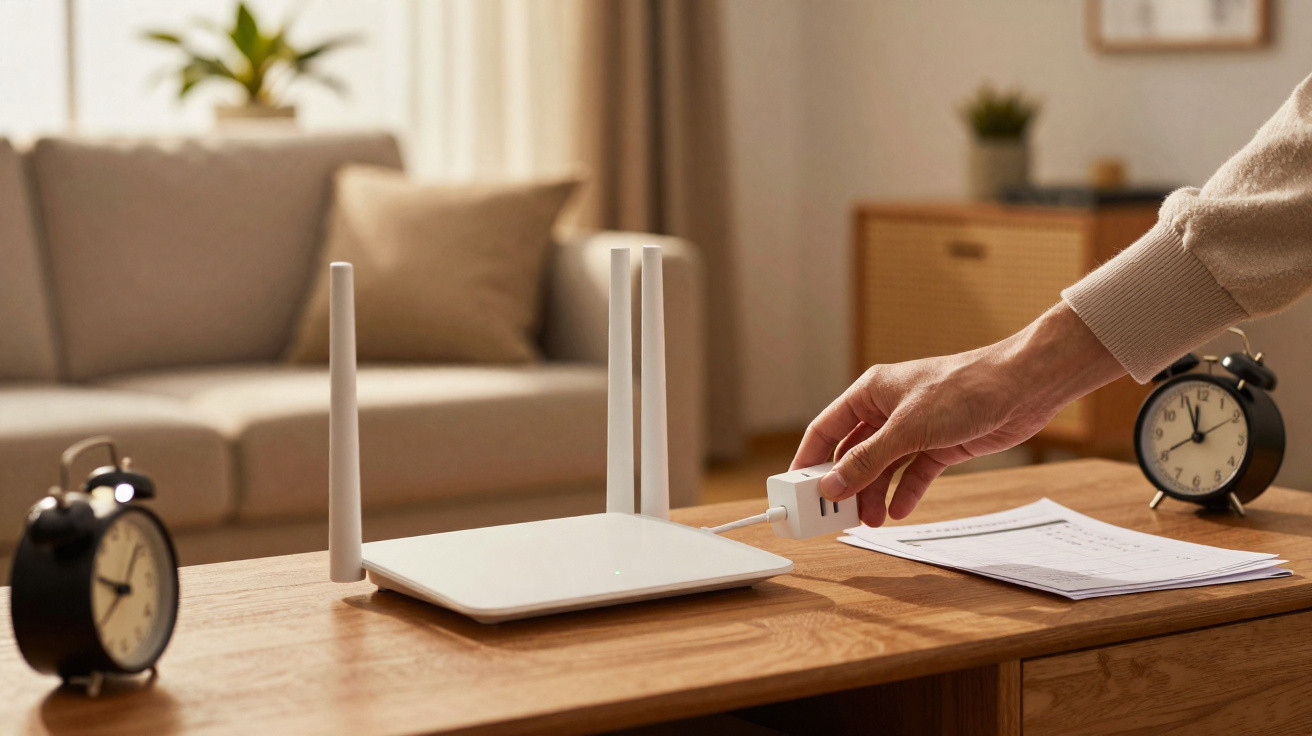
It is 23:47, the house is finally quiet, yet a small line of indicator lights is still blinking in the living room: the internet box, the TV decoder and perhaps a Wi-Fi extender in the hallway. We have all wondered whether that blue light left on all night is needlessly increasing the electricity bill. The instinctive solution seems clear: unplug everything, sleep peacefully and save money. However, with overnight updates, a connected alarm, tomorrow’s remote working and devices that rely on Wi-Fi, the answer is less straightforward than it appears. Keeping an internet box on does cost something. The question is how much, and how much convenience is worth paying for.
A small light that uses electricity all year round
In many homes, the internet box blends so fully into the surroundings that it is barely noticed. It works continuously: providing Wi-Fi, keeping the telephone line active, sometimes powering connected television services and allowing household devices to communicate with one another while everyone is asleep. A recent internet box generally uses between 8 and 15 watts in normal use, while a more comprehensive set-up with a TV decoder can reach 20, 25 or even 30 watts. That may seem negligible over one hour. Across 8,760 hours in a year, though, the calculation looks rather different.
At an average consumption of 12 watts, an internet box left running day and night uses roughly 105 kWh a year. At a regulated electricity rate of around €0.25 per kWh, that amounts to approximately €26 annually, excluding the TV decoder and any additional equipment. In a household with an internet box, a TV decoder and two Wi-Fi extenders, the cost may come close to €60 or €70 a year. It is not an amount that will transform a family budget, but it could still pay for a few meals, a music subscription or part of a water bill.
Actual electricity use is mainly determined by the equipment you have and how you use it. Older internet boxes are often less energy-efficient, as are TV decoders kept ready to start instantly while downloading data in the background. Standby mode is not always deep standby: some devices continue drawing almost as much power as they do during light use. The most useful habit is therefore to check what is genuinely plugged in, rather than focusing solely on the internet box light. A crowded extension lead often tells a far more expensive story than the modem itself.
Turning off your internet box at night: sensible, but not for everyone
Rather than guessing, the easiest way to measure consumption is with a wattmeter, a small device plugged between the socket and the appliance. It lets you record power use during an evening and while the equipment is idle, then compare the figures with the internet provider’s technical specifications. If your internet box continuously draws 10 watts, switching it off for eight hours each night would save about 29 kWh over a year, or roughly €7. The saving is real and measurable, but it remains modest across an entire home.
Switching it off overnight works very well for some families, especially where no one relies on a connected device and the landline is no longer used. A simple switched extension lead or programmable socket can then handle the task without requiring you to remember it every evening. In reality, hardly anyone does this every day, particularly after a long day or when the internet box is hidden behind furniture. Scheduling it to turn off between midnight and 6:00 can prevent this small oversight, provided it is set to restart early enough before everyone wakes up.
Before cutting the power, it is worth checking what depends on the home network, because an internet box that is switched off can disrupt far more than Netflix. Some equipment will remain unavailable until morning, and that can matter in a home with children, an older person or a remote worker.
“A useful saving is one that does not create a problem more costly or more stressful than the expected gain.”
- A connected alarm or cameras may lose remote access.
- Smart-home devices, such as controlled heating or smart plugs, may become unreachable.
- Internet box and TV decoder updates are often carried out overnight.
- An internet landline will no longer work in the event of an urgent call.
The best internet box compromise is often found elsewhere
Turning off the internet box every night is neither unreasonable nor compulsory: it is a decision about convenience, security and budget that should be adapted to the household. People with an alarm, a camera or connected medical monitoring have good reasons to keep it running, whereas a student living alone who uses no remote services could easily schedule a shutdown. The real aim is to avoid unnecessary electricity use without making everyday life needlessly complicated. Unplugging a rarely used TV decoder, disabling guest Wi-Fi, removing unused chargers or replacing an old Wi-Fi extender can sometimes save as much as turning the internet box off overnight.
There is also a practical consideration: an internet box restarted every day may take several minutes to restore a stable connection, and some providers interpret repeated shutdowns as line faults. This is not a major problem, but it can be irritating when a video call begins at 8:30 or a child has to submit homework before school. Keeping the internet box powered while reducing the related uses may be the calmer option. Every household has its own routine, constraints and unobtrusive habits-the ones that really matter when making this choice.
Ultimately, the question is better framed differently: what are we leaving switched on, why, and what does it truly cost? The difference between an internet box alone at €25 per year and a complete ecosystem costing several tens of euros is significant. Discussing these habits with others also helps move beyond assumptions: switching off an internet box is not always the perfect environmental gesture, but leaving every connected device running without ever checking its consumption is not inevitable either.
| Key point | Detail | Benefit for the reader |
|---|---|---|
| Annual cost of an internet box | Around €20 to €35 a year for an internet box alone, depending on its power rating and the price per kWh. | Makes it possible to assess the real saving before changing habits. |
| Overnight saving | An eight-hour shutdown can represent around €5 to €10 per year for a standard internet box. | Helps you decide whether to use a programmable socket without expecting unrealistic savings. |
| Checks before switching off | Alarms, cameras, landline telephony, smart-home devices and updates may be affected. | Prevents a saving from disrupting household security or comfort. |






Comments
No comments yet. Be the first to comment!
Leave a Comment