
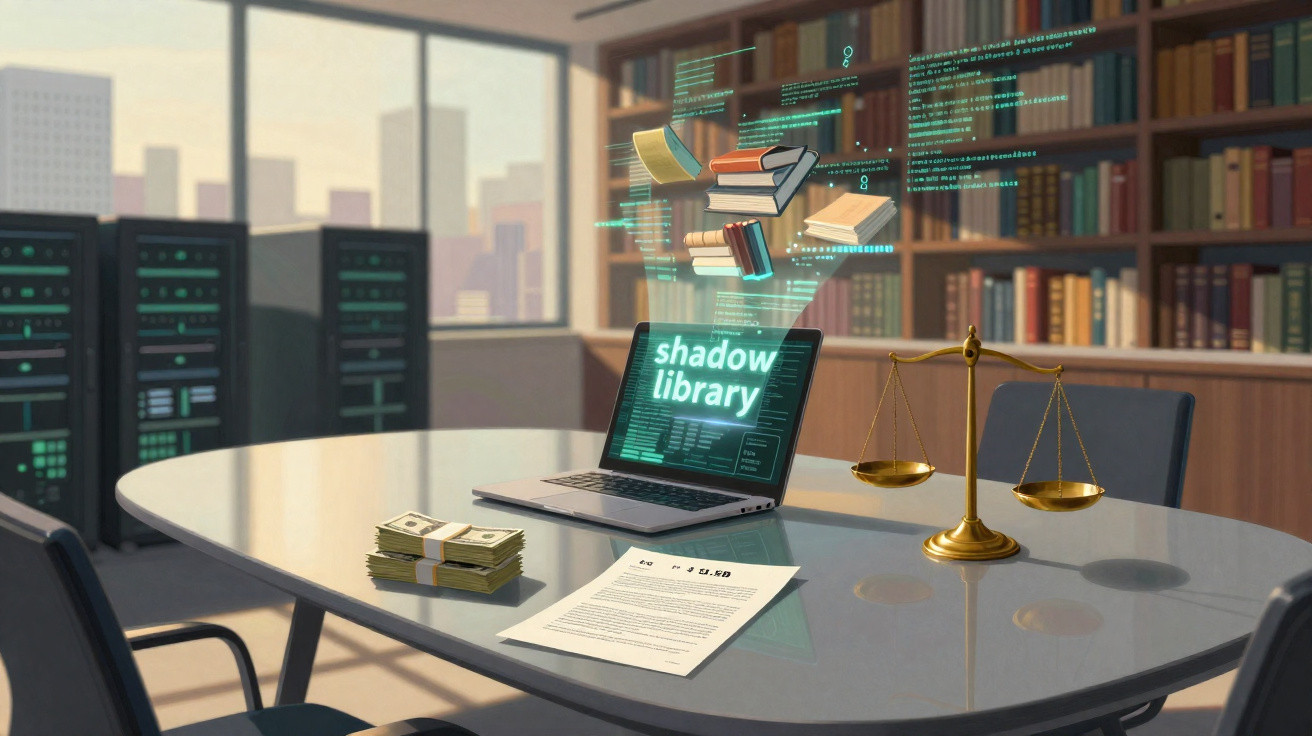
For a company that set out to build an ethical chatbot that benefits humanity, this is a deserved and stinging rebuke. A federal court has just imposed the largest copyright-infringement penalty in US history. Claude, raised on pirated literature, would almost certainly not exist in its current form had Anthropic complied with the law.
Anthropic’s executives have been on something of an emotional rollercoaster. On Wednesday 22 July, AMD said it would inject $5 billion into the company, alongside the deployment of 2 gigawatts of chips to train its models. That good news was overshadowed by a ruling from a San Francisco federal judge issued two days earlier: to train its flagship chatbot Claude - whose Opus 4.7 and exceptionally powerful Mythos versions have just been released - it brazenly appropriated the work of thousands of authors whose books had been pirated. The company must therefore pay them $1.5 billion in compensation. In under 24 hours, Anthropic went from the red carpet to the dock.
AMD’s $5 billion investment and Anthropic’s copyright ruling
The punishment had been expected. Anthropic must surely have realised that the sword of Damocles hanging over it since 2024 would eventually fall. That year, novelist Andrea Bartz, joined by two other writers, sued Dario Amodei’s company. Their accusation was that it had downloaded more than seven million books from Library Genesis and Pirate Library Mirror, two illicit digital libraries, to assemble a huge training dataset without paying a penny to the people who wrote them. Had the case reached trial, that practice could have cost it hundreds of billions of dollars; it has got off remarkably lightly.
Claude’s shadow library
At the heart of this legal battle is the concept of “fair use”, a feature of US law with no direct equivalent in France. Under certain circumstances, this legal doctrine permits the use of copyrighted works without their creators’ permission, provided they are sufficiently removed from the original material that they do not compete with it. In June 2025, Judge William Alsup, who has since retired, concluded that training Claude on copyrighted books fell within this framework: rather than reproducing the books stricto sensu, the model draws out linguistic patterns to learn how to generate text.
However, he found that downloading seven million of those books from pirate platforms and keeping them in a permanent archive that Anthropic called its “central library” could not be excused. Under US law, this amounts to clear-cut piracy, for which the consequences can be severe: up to $150,000 in damages for every work deliberately infringed, amounting to hundreds of billions in total.
The $1.5 billion settlement for pirated books
Anthropic therefore chose to settle rather than face a jury at the trial scheduled for December 2025. While $1.5 billion is a substantial hit to the wallet, it is vastly less painful than the penalty a court could have imposed had the case run its full course.
On Monday, Judge Araceli Martínez-Olguín approved the settlement, rejecting objections from authors who considered the compensation inadequate. Its terms are as follows: the $1.5 billion will form a common fund, shared among the rights holders of more than 482,000 works identified as pirated.
Every title qualifies for an equal share of that fund, or roughly $3,000 once court costs and legal fees have been deducted. That sum may look modest per book, yet 91% of rights holders have nevertheless come forward to claim what they are owed. Justin Nelson, the plaintiffs’ lawyer, described the agreement as the “largest copyright recovery in history”.
The illusion of punishment
Aparna Sridhar, Anthropic’s deputy general counsel, welcomed the case’s outcome and the fact that the fair use doctrine worked in the company’s favour. She even stated: “We are pleased that [the majority] of authors and publishers covered by the agreement have claimed their share of the payment, and we look forward to finally closing this matter.”
It is a performative smile - and, frankly, a hypocritical one - because in the end, Anthropic will emerge from this dispute with barely a scratch. It will have to pay out some money, certainly, but it will not have to empty its coffers entirely. The pirated files must be destroyed, yet Claude has already been trained on them; Anthropic will retain all of its models unchanged and can continue selling them.
What a fine outcome for the company that portrayed itself as the “white knight of ethical AI” when it was founded in 2021. To top it all off, the ruling will not even set a precedent. Because Anthropic opted to negotiate rather than allow the case to proceed on appeal, fair use was recognised by only one district judge, a decision that does not require any other court to follow it. OpenAI, Google and Meta, all facing dozens of similar lawsuits, will have to argue their own cases before judges who could quite legitimately reach diametrically opposed conclusions. The AI industry has dodged its first major bullet, but it is its competitors who will be left holding the hot potato.






Comments
No comments yet. Be the first to comment!
Leave a Comment