
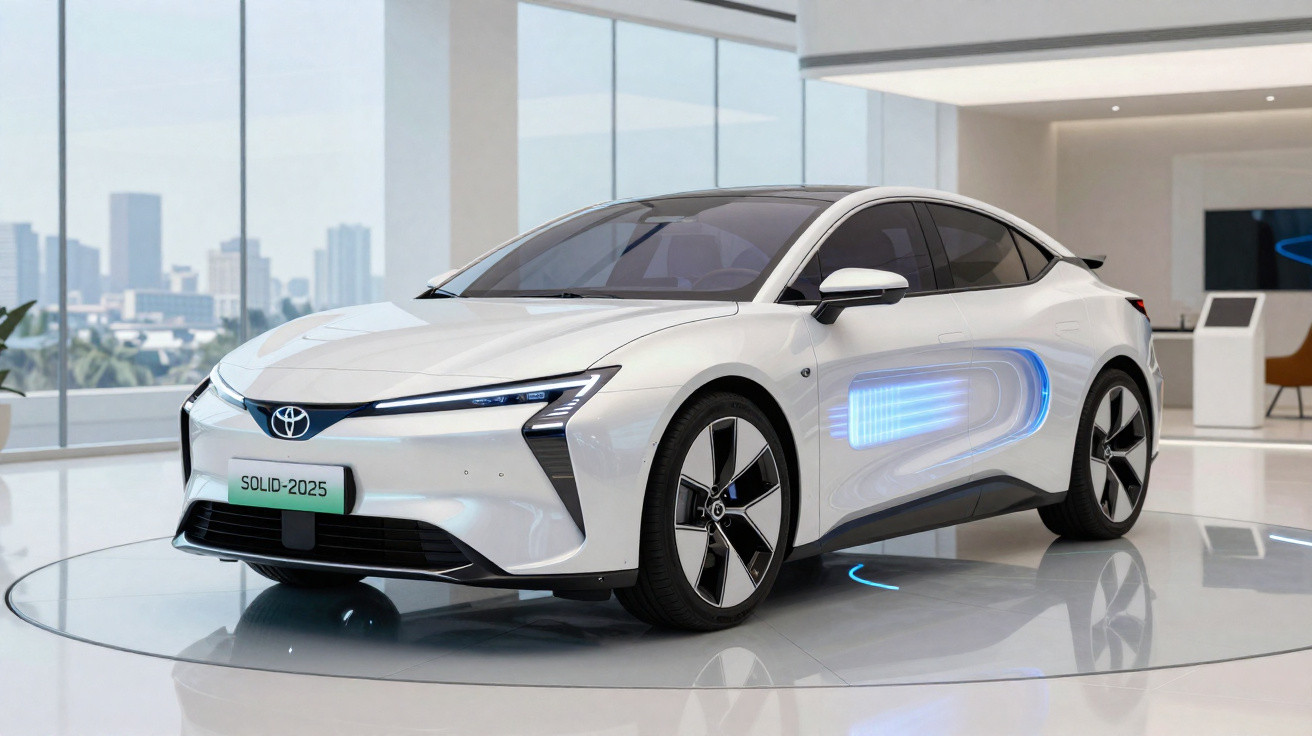
In fact, there would have been no need to wait until 2025 to see a Toyota electric vehicle equipped with solid-state batteries. Had everything gone to plan, the first working prototype would already have been unveiled.
Blame Covid-19. Toyota had intended to reveal and use its prototype at the Tokyo Olympic Games, which were scheduled to take place during this very period, from 23 July to 8 August. As we know, the Olympic Games had to be called off because of the pandemic.
The pandemic did not, however, bring prototype development to a halt. According to Toyota, the prototype was completed on schedule and is operational. All that remains is to set a new date to present it to the world.
Regardless of when that unveiling happens, the first Toyota electric vehicle with solid-state batteries will not go on sale until 2025. Even then, output will be restricted, and several more years will be needed before a model is available at a “showroom near you”.
Why use solid-state batteries?
They have been described as the “holy grail” for electric vehicles because they appear capable of addressing every limitation associated with today’s lithium-ion batteries.
On paper, their credentials almost seem too good to be true: they promise energy density two to three times higher while being safer and more durable; they are less affected by extreme temperatures and can be recharged far more quickly. As production is expected to increase, they could ultimately become cheaper too.
As their name suggests, solid-state batteries achieve this by replacing the liquid electrolyte used in lithium-ion batteries - the electrical conductor that carries electrical charge between the anode (negative) and cathode (positive) through ions - with a solid alternative.
There are still hurdles to overcome before they can deliver everything they promise. As Keiji Kaita told Automotive News, issues involving durability and safety must be resolved before the full energy-density potential of solid-state batteries can be realised. Kaita is Toyota’s executive vice-president for powertrains and is also responsible for its battery business.
Battery charging presents another issue. On the one hand, these batteries could support exceptionally rapid charging, going from 0 to 100% in just 15 minutes, considerably less time than is currently required. On the other, charging causes the solid electrolyte to expand and contract. It can consequently deform, disrupting the flow of ions and electrons and gradually reducing battery performance.
The challenge is to identify new materials and/or electrolyte designs that allow both high compaction under high pressure - reducing the gaps between particles to make it easier for ions and electrons to pass through - and enough flexibility to absorb the anticipated expansion and contraction without deformation.
Mass production is also a challenge
Toyota’s solid-state battery development and production are being handled by a joint venture with Panasonic, which led to the creation of Prime Planet Energy & Solutions Inc. Operations began in April, and it already has around 5100 employees, 2400 of whom work for a Chinese subsidiary.
Mass production, however, remains another obstacle. First, manufacturing sites need an ultra-dry environment with no moisture whatsoever. Second, current manufacturing methods are not at all suited to large-scale production.
Solid-state battery cells are currently made inside compact transparent chambers known as… gloveboxes. Workers access these chambers through sealed openings that only allow them to use rubber gloves. The process is slow, inconvenient and wholly unsuitable for mass production.
What will we see in 2025?
For now, Keiji Kaita says everything remains on course for Toyota’s first electric vehicle with solid-state batteries to arrive in 2025, although production will be limited.
As solid-state batteries will not be mass-produced at that point, their cost will exceed that of lithium-ion batteries during the first years. According to Kaita, costs must fall to 100 dollars (around 85 euros) per kW/h for them to compete on price with internal-combustion cars.






Comments
No comments yet. Be the first to comment!
Leave a Comment