
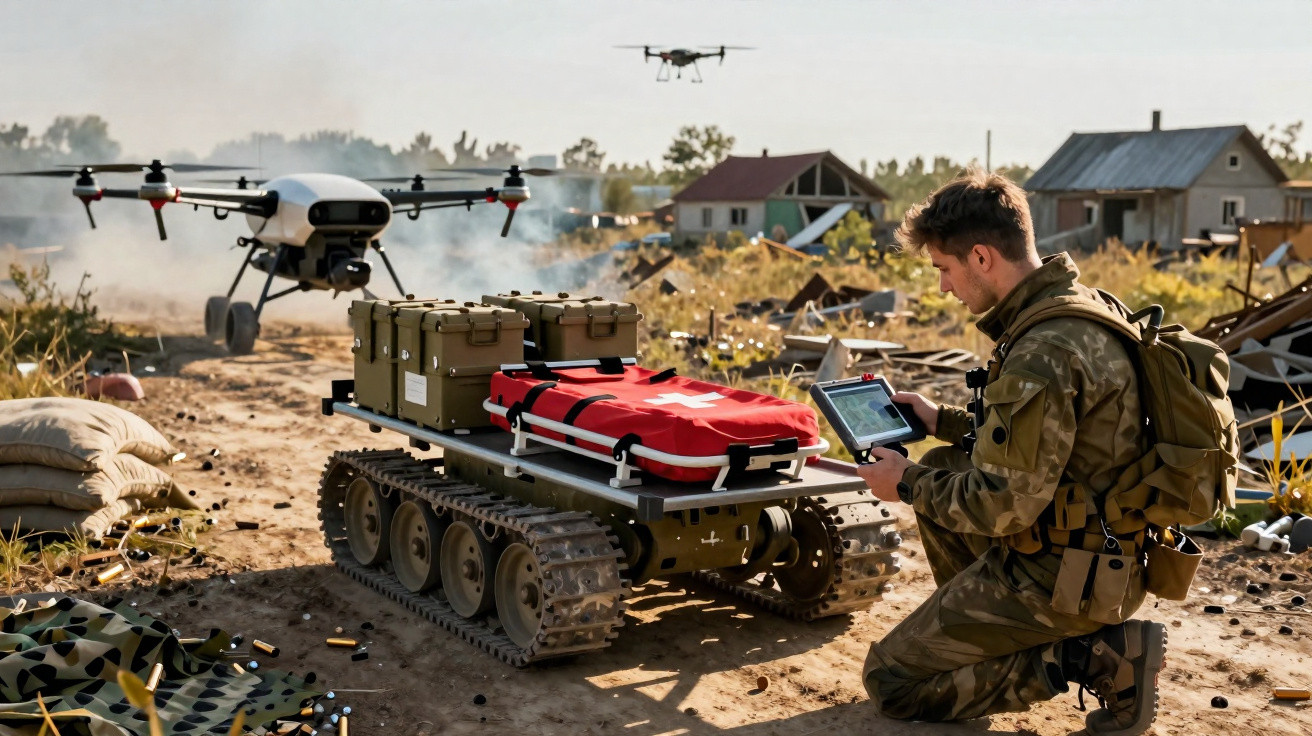
In its drive to improve and expand the robotisation of its Ground Forces through the use of UGC drones, Ukraine’s Ministry of Defence announced that its ground drones have already completed more than 100,000 missions since the start of 2026. Ground robotic systems have become established in logistics, evacuation and operational-support roles, while the Ministry of Defence continues to broaden their integration across the Defence Forces.
Every operation carried out by the ground robotic systems has been logged in the DELTA combat system. According to Ukraine’s Defence Minister, Yevhen Khmara, the adoption of these technologies is intended to lower risks for service personnel by moving numerous tasks to uncrewed platforms in the most exposed areas of the front line.
More than 100,000 logistics and evacuation missions
Since January, the number of missions conducted by UGC drones has increased steadily in every month of 2026. There were 7,511 operations in January, followed by 7,960 in February, 9,072 in March and 11,028 missions completed by these ground systems in April.
The total then rose to 14,059 missions in May and 16,664 operations in June. July recorded the highest monthly figure, with 19,969 missions, while uncrewed ground vehicles had already undertaken a further 15,729 operations between 1 and 20 August, taking the accumulated total well beyond 100,000 missions.
These platforms deliver ammunition, food and water to forward positions, where conventional vehicle movements are more hazardous. They are also used to evacuate wounded soldiers and deceased personnel, allowing many logistics operations to be carried out without directly exposing the teams responsible for resupply.
Operators become a new military speciality
The growth of ground robotic systems has also led to the creation of a dedicated speciality within Ukraine’s Defence Forces. Operators of these systems belong to military speciality VOS 129 and control tracked or wheeled ground platforms assigned to logistics, evacuation and combat-support missions.
Their responsibilities include managing the vehicles’ deployment and return, overseeing their operation and ensuring the technical maintenance of each platform. They also continuously monitor navigation, communications and data-transmission systems to maintain real-time operational continuity from protected positions.
The control station includes ground stations, remote controls, protected laptops and tablets fitted with integrated navigation systems. Teams also use batteries, charging stations, portable generators, radios, antennas, repeaters and electronic-warfare equipment to sustain reliable communications throughout missions at the front.
Ground platforms with increasingly capable systems
Ground robotic systems have developed from basic transport vehicles into platforms with far broader capabilities. Versions are now available with armoured capsules, protected communications links, day and night cameras, as well as systems intended for combat, logistics, remote mining and evacuation.
Heavy variants can carry loads of up to 500 kilograms and travel for tens of kilometres over terrain without prepared roads. The Ministry of Defence also stated that new operational roles for these platforms continue to emerge, including documented cases in which Russian soldiers surrendered to uncrewed ground vehicles during operations conducted by Ukrainian units.
To increase their availability, Ukraine significantly expanded procurement of these systems during 2026. More than 22,000 units have so far been contracted, almost twice as many as during the whole of the previous year, while military personnel placed orders worth approximately 1,900 million hryvnias through the Brave1 Market platform under the e-Baly programme.
Robotisation also extends to aerial drones
Ukraine’s development of uncrewed systems is not restricted to ground vehicles. The Ministry of Defence recently approved the Dovbush T40, an uncrewed aerial vehicle designed for deep-reconnaissance missions and attacks against personnel and infrastructure, extending the capabilities of the drone fleets used by the Defence Forces.
According to official information, the Dovbush T40 has an endurance of more than 24 hours and a range exceeding 2,000 kilometres. It also features a design intended to reduce radar detection, an electronically injected engine and a five-metre wingspan structure capable of carrying external armament depending on the selected configuration.
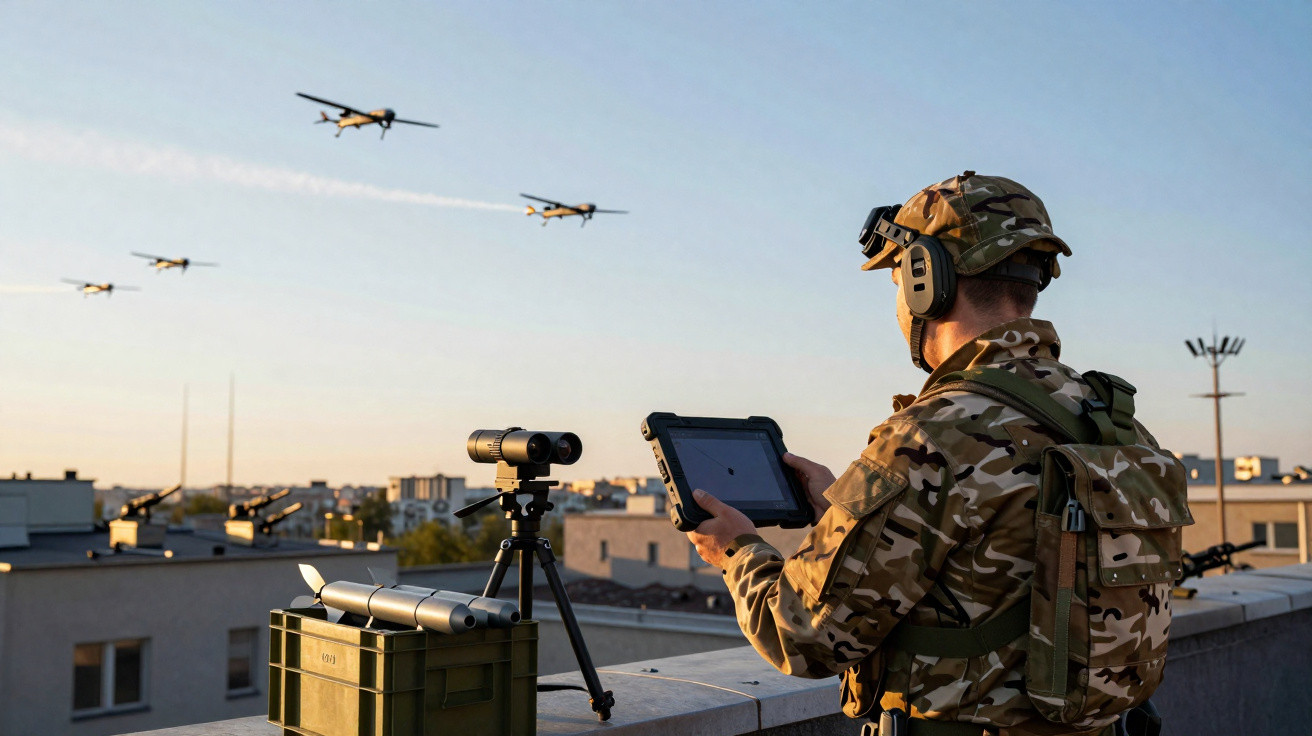
This system is joined by the Alexa Spatium, the first jet-powered drone interceptor developed in Ukraine and recently added to the national arsenal. This uncrewed aircraft was designed to destroy small aerial, ground and naval targets, with particular focus on Russian drones used in attacks against Ukrainian territory.
The Alexa Spatium employs a turbojet engine and can operate against Geran-3, Geran-4, Geran-5 and Shahed-131 drones, as well as helicopters, reconnaissance aircraft and other individual targets. During testing, it confirmed the performance claimed by its manufacturer, including high manoeuvrability, television and infrared sensors, and several guidance modes using pre-set coordinates or direct control.



Comments
No comments yet. Be the first to comment!
Leave a Comment