
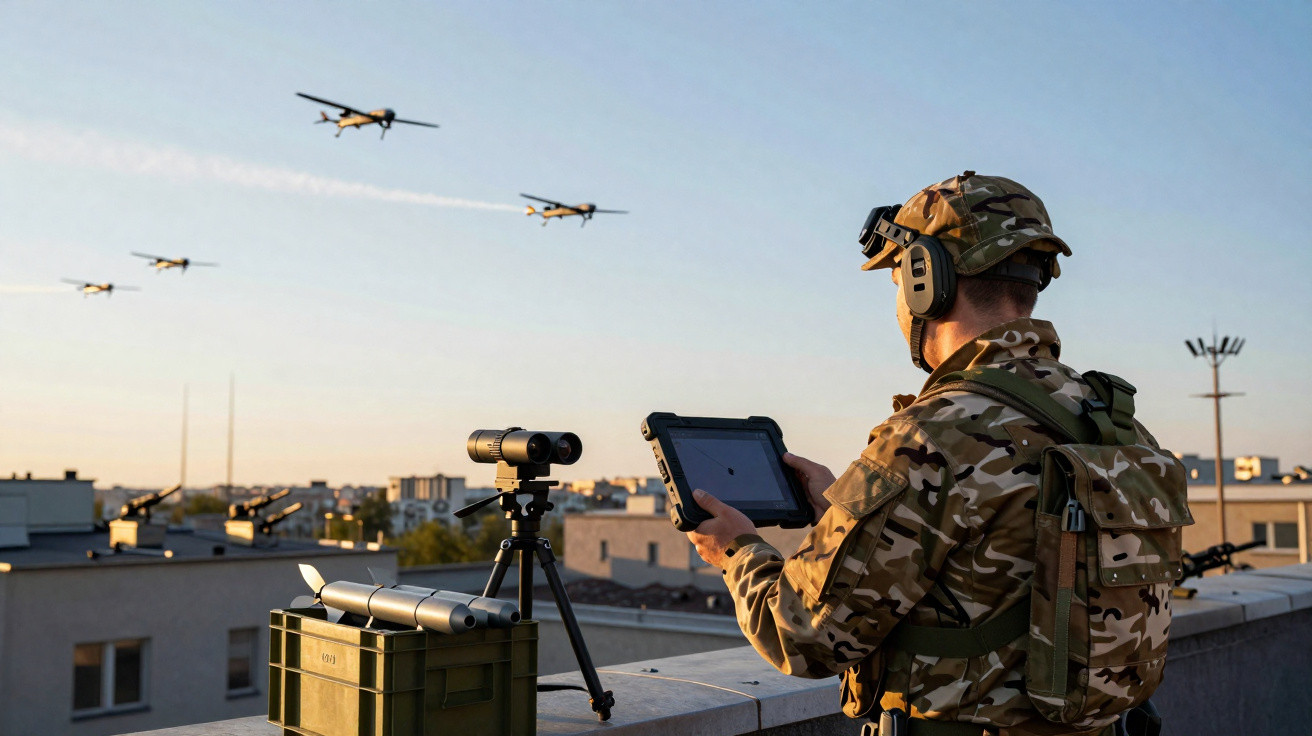
Ukraine assesses interceptors for jet-powered Shahed drones
After Russia stepped up its use of jet-powered attack drones against targets deep inside Ukrainian territory, Ukraine’s government has accelerated its assessment of new interception capabilities. Ukrainian authorities have currently identified four systems that could potentially bring down the new jet-powered Shahed drones. Their higher speed compared with conventional variants shortens the time available for detection, tracking and neutralisation, placing fresh demands on air defence.
Ukraine’s Defence Minister, Yevheniy Khmara, confirmed the information, stating that all four prospective interceptors have already undergone field trials. Although no technical details have emerged concerning their specifications, configuration or guidance systems, the minister said that the immediate task is to bring these solutions up to the necessary operational standard and expand production to thousands of units. This underlines how the large-scale availability of interceptors has become a core requirement in response to the volume of attacks and the evolution of the drones used by Russia.
Faster Geran-4 and Shahed drones raise air-defence demands
The introduction of jet propulsion substantially changes the tactical challenge facing air-defence assets. According to previously released information, Russia appears to have reserved faster platforms, including the Geran-4, for strikes against targets in Ukraine’s rear areas, while conventionally configured Shahed drones continue to be used mainly in areas near the border and the line of contact. In this shift, the Geran-3 is thought to have become less important, as its speed would no longer be enough to overcome the interception capabilities developed by Ukraine.
Pressure on Ukrainian defences has grown since the night of 27 August, when Russia reportedly began maintaining almost continuous attacks on the Kyiv region using small groups of drones, including a significant proportion of jet-powered platforms. Unlike conventional models, whose subsonic speed provides a wider response window, jet-powered drones reduce the interval between detection and their arrival in the target area. This makes it necessary to optimise not only the destruction systems themselves, but also sensors, tracking equipment and the command-and-control architecture responsible for allocating interceptors.
Ukraine’s layered response to mass drone attacks
In response to this development, Ukraine has already been building a defence architecture specifically intended to counter mass drone attacks through solutions of varying cost and complexity. These include the Ukrainian Alexa Spatium interceptor, while Mi-8/Mi-17 and Mi-24 helicopters, training aircraft, and a modified An-28 aircraft have also been used as drone-hunting platforms. The latter configuration is fitted with electro-optical/infrared sensors, tracking systems and a 7.62 mm M134 Minigun, illustrating the effort to employ comparatively low-cost platforms while retaining expensive missiles from systems such as NASAMS and IRIS-T SLM for threats requiring greater performance.
The assessment of four new interceptors therefore marks a further stage in the technological adaptation of Ukraine’s defences. Regardless of the eventual characteristics of these systems, the aim is to field platforms that combine rapid reaction, effective detection and tracking, and a sufficiently low cost to allow their use in large numbers. The evolution from conventional Shahed drones to new jet-powered drones such as the Geran-4 points to a technological race in which Russia is increasing the speed and variety of its attack vectors, while Ukraine seeks to develop a new interception layer capable of responding to this threat at a scale matching the volume of attacks.




Comments
No comments yet. Be the first to comment!
Leave a Comment