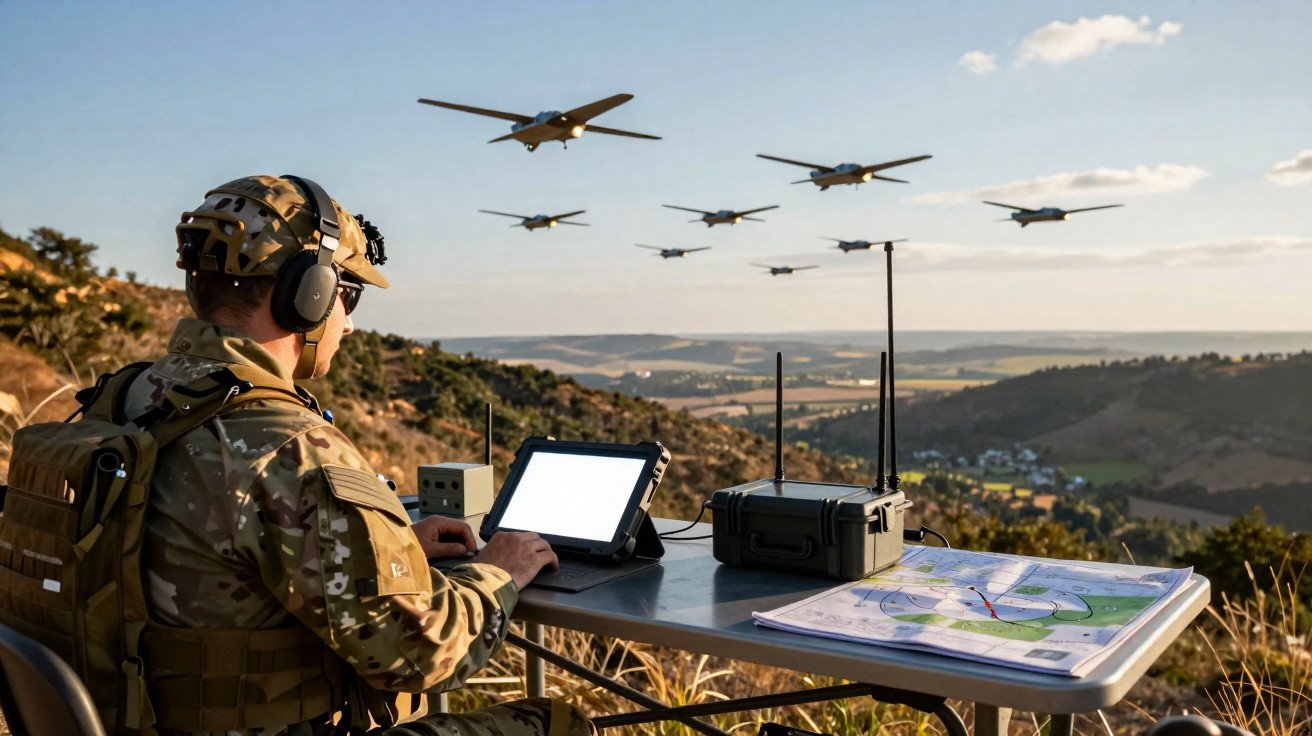
A few days ago, Baykar, Turkey’s leading drone manufacturer, unveiled its new K2 artificial intelligence-assisted loitering munition. The unmanned system was tested in Turkey in trials centred on autonomy, formation flying and swarm operations. Described by the company as the K2 kamikaze unmanned aerial vehicle, the development forms part of Baykar’s strategy to introduce lower-cost defence solutions suitable for serial production.
According to details released by the company, five K2 aircraft carried out flight tests yesterday and today. Taking off from the Keşan Flight Training and Test Centre, the trials were intended to demonstrate the performance of the platform’s advanced artificial intelligence algorithms, autonomous capabilities and coordination between multiple systems.
K2 swarm flight and artificial intelligence tests
During sorties over the Gulf of Saros, the five systems flew in “right echelon”, “line” and “V” formations. Baykar said the aircraft relied on sensors, software and artificial intelligence to establish their positions in relation to the other systems in the swarm, hold their allocated places and successfully complete the tasks set out for each scenario.
The manufacturer also stated that the K2 can operate in further configurations, including “Turan” and “wall” formations, as part of an artificial intelligence-assisted swarm-synergy concept. Baykar added that the research and development programme includes a future phase focused on variants able to return to base after releasing their munition on the target, allowing the platform to be reused.
The project is intended to field high-impact systems that can be built in large numbers and at low cost, thereby reducing reliance on more expensive munitions. Through this approach, the company aims to provide an option for striking critical enemy targets with a more favourable cost-effectiveness ratio in high-intensity combat environments.
K2 navigation and strike capabilities
The manufacturer also highlighted the K2’s navigation architecture for electronic warfare conditions in which global navigation satellite system (GNSS) signals are unavailable or subject to heavy jamming. The platform can estimate its location by visually scanning the terrain using its gimbal camera and a lower camera system with night-vision capability. This would enable it to continue navigating and autonomously progress towards the target even when GNSS signals are entirely absent.
For identification and attack missions, the system features a gimbal-mounted electro-optical/infrared (EO/IR) camera, providing reconnaissance, surveillance and visual target lock-on capabilities. Baykar said the K2 also offers coordinate-based precision-strike capability, alongside line-of-sight (LOS) and beyond line-of-sight (BLOS) satellite data links, broadening its operational flexibility.
The company said the K2 is the largest kamikaze platform in its class, and specified that it can take off and land from short runways, offering logistical flexibility in the field. According to the published figures, the system has a maximum take-off weight of 800 kilograms, can carry a 200-kilogram warhead, has a range exceeding 2,000 kilometres, flies at more than 200 kilometres per hour and can remain airborne for over 13 hours. With these specifications, Baykar intends to position it for long-range strategic missions.
Baykar’s recent unmanned systems developments
The K2 presentation follows other recent Baykar developments in the unmanned systems sector. After signing a Memorandum of Understanding (MoU) with Italy’s Leonardo on 6 March 2025, the two companies progressed with the establishment of a joint venture to manufacture Turkish combat drones in Italy for the European market. This was accompanied by confirmation from Keşan of the first flight, conducted in February last year, of a new version of the AI-assisted Bayraktar TB2 combat drone, which is also fitted with a turbo engine to improve its performance and capabilities.













Comments
No comments yet. Be the first to comment!
Leave a Comment