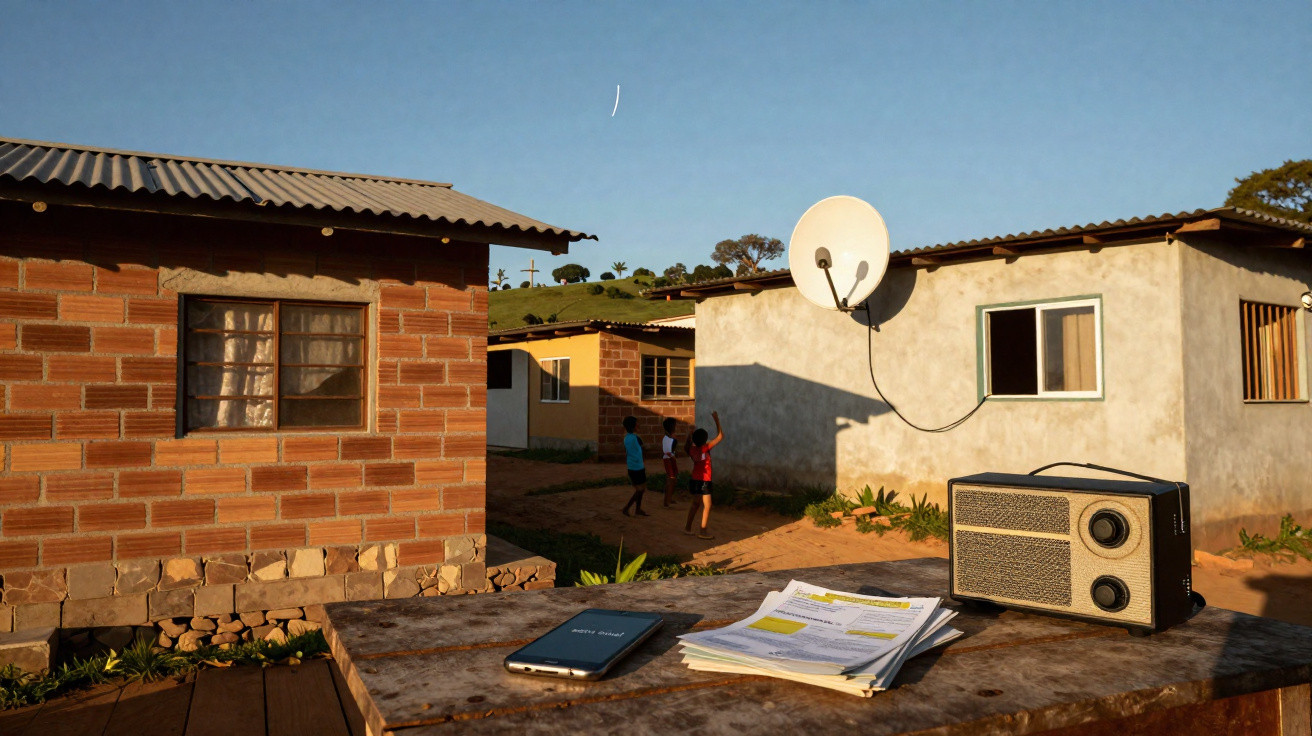
A pick-up climbs a dusty rise in rural Brazil, its headlamps slicing through the darkness like a UFO moving at walking pace. In the chilly wind, three men look down at a grey panel, roughly the size of a pizza box, resting on the bonnet. A phone chimes. One bar. Then two. Then five. TikTok clips appear immediately, and a YouTube how-to video runs in HD. They break into laughter – the sort that says “this feels like magic”.
From the doorway of her wooden home, a woman wearing a faded T-shirt observes without speaking. She asks how much it costs.
For a moment, nobody laughs.
When the sky delivers internet – but only to those who can afford it
Starlink’s mobile internet can seem lifted from science fiction. Take a dish from a rucksack, aim it more or less skywards, and fast internet appears in the middle of nowhere. That is the promise shown in polished promotional footage: campers beside Alpine lakes, sailors in immaculate coves, and remote workers sharing posts from vans in the desert.
In theory, it sounds like a way to end the digital divide.
In practice, it can make that divide larger.
The figures tell the story. Buying a Starlink “Roam” kit may cost several hundred dollars before paying a substantial monthly charge, which in many countries is more than a week’s – or even a month’s – wages. In the US, it is marketed to RV owners and people with boats. In Mexico and South Africa, however, the same service arrives in communities where people gather around one shared phone to use WhatsApp.
A rural teacher in the Philippines told me that he would welcome Starlink for his pupils, but installation by itself costs the equivalent of three months’ pay. For now, he continues producing handouts on a second-hand printer that jams every hour.
The satellites keep moving. Inequality stays put.
There is a subtle manoeuvre here: presenting Starlink as a “solution for the unconnected” makes the story appear generous, almost humanitarian. Its branding relies on terms such as “access” and “everywhere”. The celebrity billionaire speaks of assisting faraway villages.
Yet connectivity is not simply a question of “can a signal reach this spot on Earth?”. It also concerns affordability, control and who determines the rules. When premium mobile satellite internet becomes a status symbol for yachts, expeditions and technologically confident nomads, the market begins to orient itself around those buyers.
The consequence is that those who were nearly connected are pushed even further down the list of priorities.
Luxury tech, poor communities and the quiet squeeze of Starlink
To understand how Starlink can deepen the digital divide, consider what occurs when one villager acquires it. Usually, it is an entrepreneur or official able to pay for the kit: the mayor, a major landowner, a lodge proprietor or a mining contractor. They fit the dish to a roof and begin charging people for access.
A few dollars buys a password. A modest amount pays for an hour. Businesses face a higher charge.
Internet access in that village is suddenly no longer a public utility or shared good. It becomes a restricted service controlled by someone with both the capital and the signal from above.
In northern Kenya, a small eco-camp installed Starlink for tourists staying there. Its owners soon found that they could sell Wi-Fi passes to nearby NGOs and affluent local residents. A public school several kilometres away, meanwhile, still relies on a single 3G hotspot that fails whenever the wind picks up. The camp streams Netflix across the savannah while children wait for web pages to appear line by line.
We have all experienced that point at which a poor connection feels like a minor personal disaster. Now imagine that sensation spread across an entire childhood.
The gap is no longer between “connected” and “unconnected”; it’s between fast, rich, mobile internet and everyone else trying to catch crumbs.
The straightforward reality is that Starlink is primarily built for people who can travel, already own devices, already pay subscriptions and expect everything on demand. It addresses the “I want broadband in my RV” problem before addressing the “my village school has never had Wi-Fi” problem.
When a product is framed as aspirational technology, it also influences the public policy built around it. Governments begin discussing deals with SpaceX rather than funding community networks, fibre backbones or affordable 4G in low-income areas. Funds that might provide thousands of low-cost local connections are channelled instead into a small number of prominent satellite schemes.
As a result, the very tool that might connect the last billion instead indulges the top 10% of the first billion.
Resisting the hype: what genuine inclusion could look like
This technology can be used differently, without being treated as a futuristic luxury plaything. Starlink and similar services could be viewed as infrastructure for last-resort situations rather than lifestyle gadgets. Applied properly, one dish in a remote town could supply a community network: a single rooftop connection distributed through inexpensive local Wi-Fi and managed by a co-operative or local authority.
The approach is remarkably straightforward: share the bandwidth, share the expense and share the governance.
Technology is not the difficult element. Politics is.
Instead, a familiar and frustrating pattern often emerges. A well-intentioned NGO or influencer pays for a Starlink dish as a “pilot project” in a deprived area. Images are uploaded and speeds are measured. Then the monthly invoice arrives. Donors turn their attention elsewhere, leaving residents to choose between internet and fuel, or connectivity and medicine.
Let’s be honest: nobody really does this every single day – sit down and calculate long-term subscription sustainability for the world’s poorest users. The hype moves faster than the spreadsheets.
If Starlink is not to become an emblem of digital inequality, there must be unsparing clarity about the total cost of ownership, who holds the contract and what happens once funding disappears.
“We were told this would connect our village to the world,” a community organizer in rural Peru told me. “In the end, it just connected the tourists to their Instagram.”
Ask who benefits first
Trace the money: camper vans, yachts, remote villas, mining camps, oil companies and military bases. When these are the primary customers, the claim of “connecting the poor” becomes marketing rather than a mission.Look for shared models
Community-managed hotspots, municipal networks and school-based hubs can make satellite a backbone rather than a private toy. This is where pressure from citizens and journalists can make a real difference.Defend public investment
Fibre, 4G/5G and local ISPs may be less glamorous than rockets, but over time they connect more people for each dollar spent. When a government promotes Starlink, ask what is happening to the unglamorous infrastructure.
When billionaires own the sky, who owns your connection?
Starlink is more than a gleaming dish with a quick ping. It is a private business gradually assuming control of part of the world’s infrastructure – an area once handled slowly and cautiously by states and public bodies. A single company decides where terminals are sent, what each country pays, which areas receive priority coverage and which armed forces obtain battlefield broadband. Advertisements do not reveal that authority.
For wealthy customers, this can feel freeing: internet anywhere, with no questions asked. Poorer countries face another reality. They may exchange reliance on sluggish national monopolies for reliance on a foreign orbital monopoly. A different sky, but the same leash.
Once people become accustomed to space internet being reserved for the privileged, moreover, it is harder to make the case for internet as a basic right.
| Key point | Detail | Value for the reader |
|---|---|---|
| Starlink is priced as a luxury service | High hardware and monthly charges are aimed at affluent users rather than low-income communities | Helps you understand why “connects the unconnected” is often merely a marketing slogan |
| Local power dynamics shape access | People who can pay for the dish decide who connects and at what cost | Provides a framework for reading stories about “satellite internet for villages” more critically |
| Alternatives and safeguards exist | Community networks, public investment and shared satellite models can limit harm | Suggests ideas you can support, request from officials or discuss in your own circles |
















Comments
No comments yet. Be the first to comment!
Leave a Comment