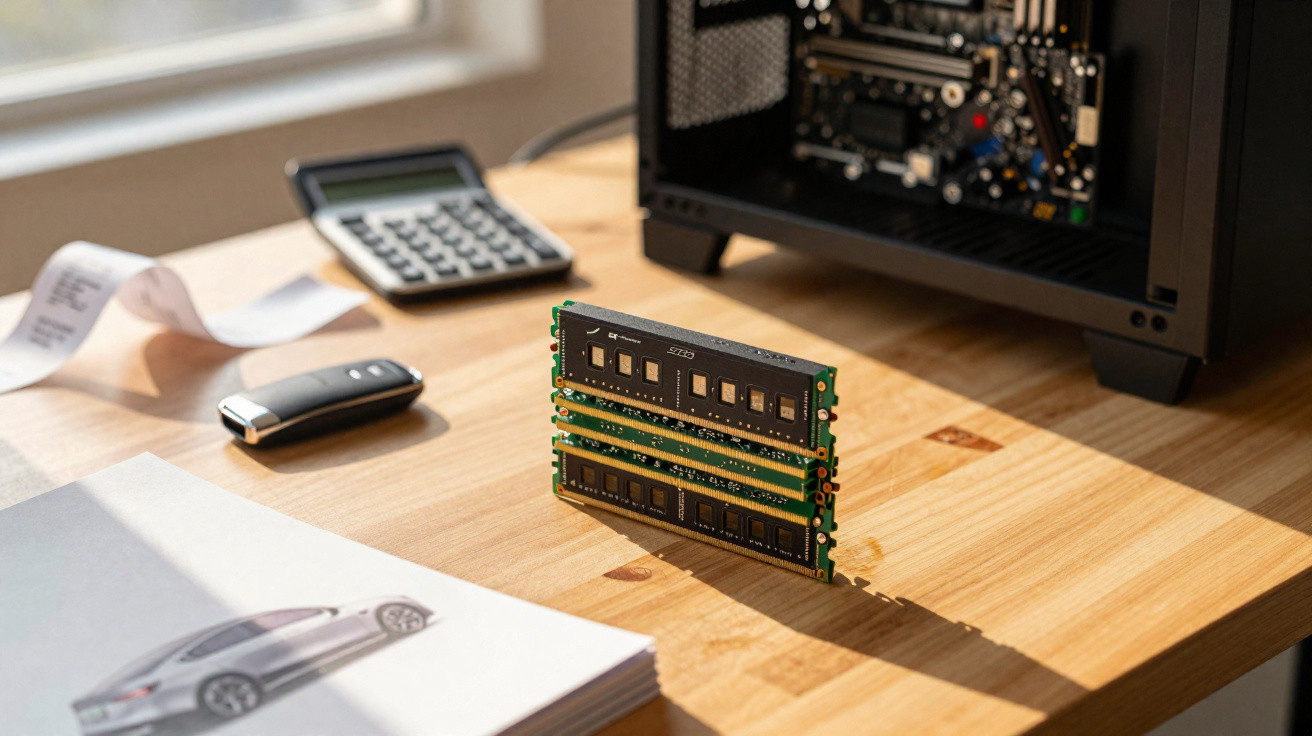
The assistant in the computer shop barely reacted. He studied the list on his monitor, lifted an eyebrow and read it back: “80 sticks of 32 GB DDR5… That’s… wow.”
I watched the figure appear at the bottom of the quotation. My mind tried to make sense of that intimidating row of numbers. A house deposit? Twelve months’ rent? Neither. It was equivalent to the cost of a new Tesla Model 3. For RAM. Not graphics cards, and not complete servers: simply memory modules small enough to hold in both hands.
The salesman gave a quiet laugh. “You know you could just buy a car instead, right?”
At that point, it no longer felt like a joke for tech enthusiasts. It felt like a warning sign.
When memory costs as much as metal and wheels
There is something deeply strange about a small collection of green PCBs costing roughly the same as a polished electric car with Autopilot and an enormous touchscreen.
Picture 80 32 GB RAM sticks arranged across a desk: a miniature woodland of silicon and gold contacts. Then picture a Tesla outside in the car park. One gets slipped silently into an anti-static bag; the other can change lanes on a motorway unaided.
But on the invoice, both belong in the same price bracket.
This is where technology stops feeling abstract and starts becoming an economic fact. You are no longer merely “upgrading a rig”; you are making spending choices that look remarkably similar to deciding whether to buy a vehicle.
This is not just a theoretical scenario. Major AI laboratories, 3D studios, trading companies and even certain universities are already running into this limit.
A data team may order a high-memory server that seems perfectly reasonable to them: 2.5 TB of RAM for in-memory databases. The quotation arrives, and the RAM alone is approaching the list price of a new EV. The finance department does not dispute its performance; instead, it asks: “Why does the memory cost like a company car?”
Most of us have experienced the moment when a straightforward technology requirement suddenly resembles a lifestyle decision. You set out to purchase “only what is needed”, only to discover that you have entered an entirely different spending category.
There is no mystery behind these prices. They reflect manufacturing constraints, surges in demand and a market that remembers previous collapses all too well.
DRAM manufacturing requires huge investment and cannot be adjusted quickly. When AI, gaming, workstations and cloud providers all expand simultaneously, supply gets squeezed. Manufacturers would rather sell fewer units at healthier margins than overwhelm the market and trigger the kind of price collapse seen in earlier cycles.
High-density, high-speed DDR5 modules are not ordinary laptop memory sticks, either. Production yields are lower, specifications are stricter, and much of the cost comes from the premium attached to leading-edge hardware.
The outcome is a headline that sounds ridiculous but remains true: 80 sticks of 32 GB DDR5 can equal, or even exceed, the price of a new Tesla.
How to avoid spending car money on a RAM problem
The first protective step is almost brutally straightforward: find out what you genuinely use.
Before ordering additional memory, monitor RAM usage across your machines over a complete workload cycle. Do not check for ten minutes during a benchmark; observe real-world use for a week or a month. Account for spikes, idle periods, overnight tasks and everything else.
Half of the projects said to “need” several terabytes of RAM are actually being held back by inefficient software, neglected background processes or caches that have been allowed to grow unchecked.
Optimise before you purchase. Tidy up processes, reduce cache allocations and shift cold data to disk or SSD storage.
Only after that should you ask how much RAM you actually require, rather than how much would simply feel reassuringly excessive.
The next stage is more strategic: resist the instinct to “just throw more hardware at it”.
You can scale out rather than up, using several systems with moderate RAM instead of one enormous machine. Data can be streamed rather than loaded entirely into memory. Hybrid arrangements that combine local RAM with fast NVMe scratch storage may be less glamorous, but they are often sufficient.
Let’s be honest: hardly anyone does this every day when deadlines are tight and a client is waiting. You open the catalogue, select the largest configuration and hope that the problems will disappear by magic.
But that is precisely how you end up facing a memory bill that resembles a Tesla leasing agreement.
There is also a change in thinking to make: each additional gigabyte is a business decision, not merely a technical specification.
“RAM used to be the thing you maxed out by default,” a systems engineer at a cloud provider told me. “Now it’s the thing we justify line by line. Because it’s real money, not just a checkbox on a spec sheet.”
For teams managing budgets, one understated practice can help:
- Include RAM in the same internal discussion as cars, travel and major software licences. Compare the cost with purchases that everyone understands.
- Record who needs high-memory nodes and why, using plain language.
- Assess the largest memory users twice a year, rather than waiting until a server fails.
When “512 GB extra” becomes “this is worth one junior hire for a year”, people tend to pay attention in a different way.
When a handful of chips weighs more than a car key
There is something both mildly absurd and unexpectedly revealing about the comparison.
A Tesla is visible, prominent in public discussion and packed with symbolism: status, environmentalism and technological optimism. RAM is unseen and silent, just another detail on a specification sheet.
Yet, for certain configurations today, the invisible item quietly outprices the visible one. A pile of memory modules protected by plastic and foam can cost more than a machine capable of carrying a family at 120 km/h for hundreds of kilometres.
That disparity reveals how much of the real economy now sits in server racks and data centres, rather than solely on roads and in car parks.
For home users and smaller creators, the same situation appears on a reduced scale. You look at an ageing PC and consider doubling its RAM “just to be safe” for video editing, virtual machines or the latest AAA games.
Then you see the basket total and feel a small jolt: this upgrade is competing with rent, travel or children’s activities. Nobody is working out “Tesla vs RAM” at that level, but the underlying principle is identical. Memory is no longer a background expense; it is a budget line measured against everyday life.
For businesses, the consequences grow rapidly. A handful of poor buying decisions, repeated across dozens of servers, does not merely waste money. It can lock a company into a costly architecture for years.
Perhaps that is the odd benefit of this moment: absurd comparisons make us reconsider what we genuinely value.
Do we need maximum theoretical performance, or the minimum that allows ideas to progress, products to ship and teams to remain sane? Should we fixate on leading benchmark charts, or on avoiding capital being tied up in hardware as earlier generations tied it up in concrete or cars?
The next time someone says, “We just need more RAM,” consider asking something else: “Is this need worth a Tesla?”
This is not about criticising ambition. It is about giving form and weight to something that normally remains hidden in logs and invoices.
| Key point | Detail | Why it matters to the reader |
|---|---|---|
| RAM rivals the price of a Tesla | 80 high-end 32 GB memory sticks can cost as much as a new electric car | Recognise the real value of memory within a budget |
| Measure before buying | Track actual RAM use over several days or weeks | Avoid over-specifying and paying for memory that is never used |
| Think about use, not fantasy | Link every gigabyte to a defined need and a concrete alternative, such as a hire, vehicle or project | Make better trade-offs between technical performance and personal or business priorities |















Comments
No comments yet. Be the first to comment!
Leave a Comment