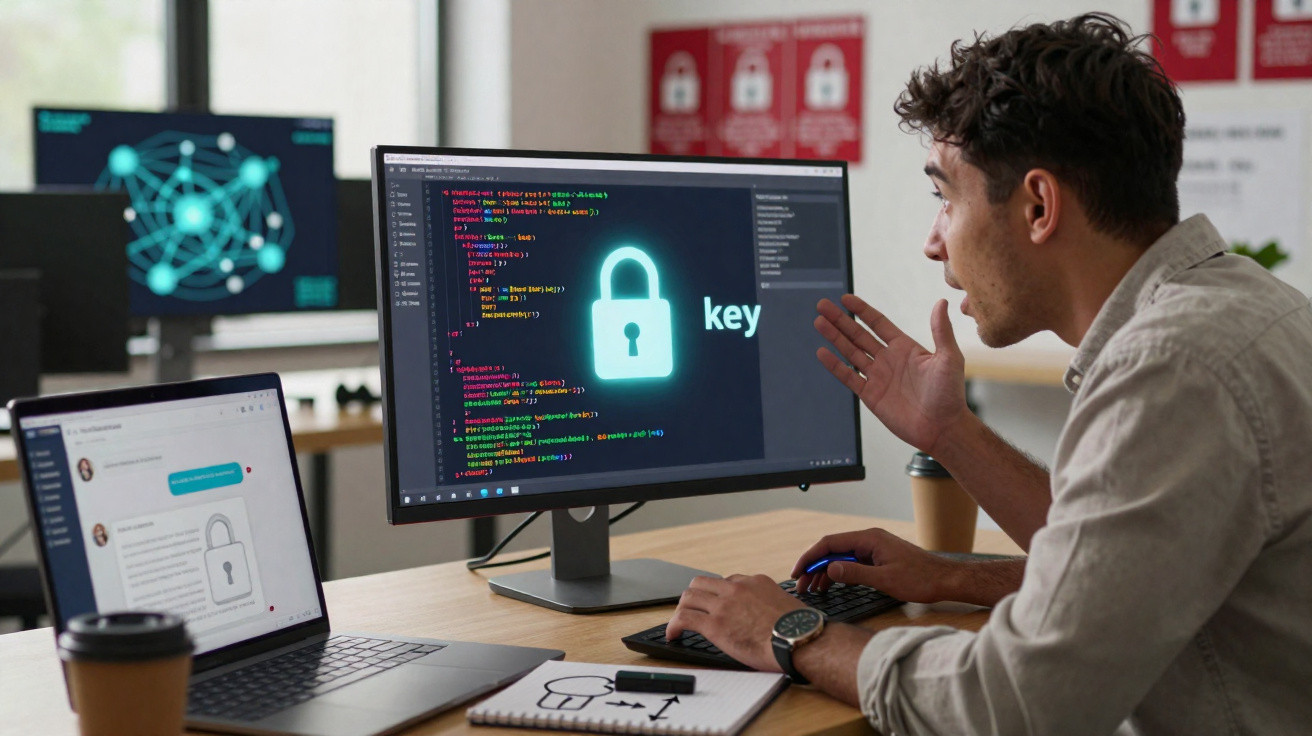
A recent incident demonstrates how one carelessly written line of code can transform supposedly “cutting-edge” ransomware into a fortunate discovery for a security researcher - and, in some cases, a way out for victims unwilling to pay.
CyberVolk’s rise and its Telegram-powered operation
Threat researchers have tracked CyberVolk, a cybercrime group operating in the space between hacktivism and financial gain, since late 2024. Its members portray themselves as politically motivated and frequently target public bodies and organisations connected to the state. They use geopolitical conflict to rationalise attacks that nevertheless closely resemble organised criminal activity.
Following several months of relative silence, the group reappeared in August 2025 with an updated ransomware variant named VolkLocker. The notable change was not in the malware’s core code, but in its delivery and administration. VolkLocker is now offered as a service that affiliates can rent, with CyberVolk managing the operation through a Telegram-based control panel.
Telegram, a platform used extensively for activism as well as criminal coordination, suits this approach. Via a bot-like interface, operators are able to:
- Create new malicious executables whenever required.
- Issue instructions to compromised devices.
- Gather system details from victims.
- Log each infection much like an order reference in an online shop.
The arrangement makes ransomware more industrialised for people with very limited technical skills. An affiliate can begin an attack without properly understanding cryptography, persistence techniques or network pivoting. This service-based approach reflects the model that has already turned phishing kits and credential-stealing tools into point-and-click products.
VolkLocker turns ransomware into something closer to a subscription product than a bespoke cyberweapon, lowering the bar for would-be extortionists.
However, the drive towards automation and simplicity also created an apparent weakness CyberVolk did not anticipate: brittle coding, hurried additions and an error that weakened the entire scheme.
VolkLocker’s single shared encryption key
Most current ransomware families use strong cryptographic designs. Usually, every victim is issued a distinct key pair, often generated for each session, while the private decryption key is kept off the victim’s device. Criminals retain it remotely and provide it only once a ransom has been paid. Without law enforcement taking control of the attackers’ servers, this approach makes broad decryption virtually impossible.
VolkLocker does not follow that pattern. Rather than producing a separate key for every victim, it contains one primary encryption key hard-coded into the executable. As a result, numerous attacks use the same cryptographic secret.
For a threat actor, that architecture already creates an obvious exposure. A security team that reverse-engineers a single sample could pull out the shared key and use it to assist other victims. CyberVolk’s operators made that risk worse by retaining a debugging feature that should never have escaped their development environment.
The overlooked debug function that revealed the key
While infecting a system, VolkLocker generates a temporary file on the victim’s machine. It stores three items of information:
- The primary encryption key used to lock files.
- A unique identifier assigned to the victim.
- The Bitcoin address used for ransom payments.
That file is left on the disk as plain text: there is no obfuscation, no local encryption and no automated removal after the malware completes its task. To incident responders who understand ransomware activity, it amounts to a cheat code abandoned in plain sight.
The same note that threatens to destroy data forever quietly shares the combination to the lock, if you know where to look on the machine.
This “logging” capability was almost certainly an internal testing mechanism. During debugging, developers commonly write keys and settings to disk, then remove those features from production releases. In this case, that removal did not occur. When CyberVolk prepared VolkLocker for its affiliates, it included the debugging evidence too.
Researchers reviewing active infections believe the group either lost control of its build process or did not consider that moderately skilled partners would continue deploying what was effectively a beta release. Regardless of the cause, the outcome is identical: certain organisations affected by VolkLocker can recover the key from the temporary file and restore data without handing over a ransom.
Why many victims still face serious harm
An exposed key may appear to be a major win for defenders, but its usefulness is far from guaranteed. Each incident develops according to its own complicated sequence of events.
Several circumstances can eliminate that advantage:
- Automated clean-up software may remove temporary files before investigators reach the system.
- Staff may restart or reinstall machines, destroying evidence of the key.
- On certain configurations, the key file might be present only in volatile storage.
- Some encrypted files may remain impossible to recover because of partial corruption.
At the same time, VolkLocker remains capable malware. It raises privileges on Windows devices, bypasses ordinary user account control prompts and goes after valuable data first. Documents, databases and shared network resources can often be encrypted before anyone detects suspicious activity.
After execution, the ransomware essentially takes control of the machine. Attackers can introduce further tools alongside the encryptor, including credential stealers and remote shells, to strengthen their access. Successful decryption does not make the breach disappear: the infected endpoint still requires isolation, forensic examination and, in some instances, a complete rebuild.
Recovering files does not erase the fact that attackers had time to roam inside the network and possibly copy sensitive data.
The CyberVolk incident also exposes a risky assumption: that ransomware groups considered “amateurish” can safely be dismissed. Although their cryptographic failure benefits some victims, the wider operating model remains damaging. Ransomware-as-a-service allows repeatable, scalable attacks to be carried out by people with little genuine hacking experience.
How ransomware-as-a-service is reshaping the threat
VolkLocker’s Telegram-based model forms part of a broader development in which the cybercrime economy is divided into specialist roles. Core developers manage encryption routines, anti-analysis methods and infrastructure. Other participants operate as affiliates, purchasing or renting access to those tools while concentrating on initial access through phishing emails, stolen VPN credentials or poorly secured remote desktop configurations.
For many aspiring criminals, the model has several attractive features:
- Low starting cost: there is no requirement to develop malware or operate servers.
- Fast updates: core teams release changes that affiliates receive automatically.
- Shared guidance: tutorials and Telegram channels, among other platforms, can direct even inexperienced users.
CyberVolk’s encryption-key mistake illustrates the consequences when this ecosystem prioritises convenience and rapid feature releases. A developer may introduce logging, easier key management or broad compatibility to simplify matters for customers. Every such shortcut can quietly open a route for defenders.
How incident responders can exploit errors like this
Security teams investigating a possible VolkLocker infection now have an additional checklist item: looking for leftover files that may contain the shared key. This should be done at the earliest opportunity, preferably before automated clean-up processes or widespread reinstallation begins.
During a standard investigation, responders may:
| Step | Goal |
|---|---|
| Isolate affected systems | Stop lateral movement and data exfiltration. |
| Preserve volatile and disk data | Keep temporary files and memory artefacts intact. |
| Scan for known key file patterns | Locate any stored encryption keys or IDs. |
| Test decryption on copies | Validate recovered keys without risking further loss. |
| Rebuild and harden systems | Remove backdoors and strengthen access controls. |
The same process is useful beyond CyberVolk. Analysts regularly reverse-engineer new ransomware families to identify defective random number generators, weak key exchanges or careless local storage. As groups treat malware as rapidly evolving software products, logic flaws and configuration errors will inevitably emerge.
Why defenders must not depend on attacker errors
Although the CyberVolk case has an almost ironic quality, relying on criminal incompetence would be a dangerous approach. Other groups continually improve their software, test it against forensic tools and employ more distributed encryption models that provide no route to recovery other than payment or seizure of command servers.
For organisations, more dependable protection still comes from other measures: backups kept offline or logically separate, rigorous patching, restricted privileges for routine accounts and robust authentication for remote access. Tabletop exercises based on a hypothetical VolkLocker incident can help teams identify shortcomings in detection, escalation and communication before a real attack demands difficult choices.
From a technical perspective, security teams can use the VolkLocker failure as a training example. Analysts who are new to reverse engineering can work with samples known to include embedded keys or debug artefacts. This practice can make them quicker at recognising comparable mistakes in later ransomware families, where the potential benefit could be considerably greater.
For policymakers and regulators, Telegram-managed ransomware-as-a-service presents a related concern: low-skilled actors can rent the means to cause disruption with striking ease. Even disorganised groups that undermine their own encryption can still close regional councils, hospitals or schools for days. Ransomware is no longer solely a rare attack conducted by elite operators; it has become an increasingly scalable disruptive threat, driven by inexpensive tooling and social engineering.
















Comments
No comments yet. Be the first to comment!
Leave a Comment