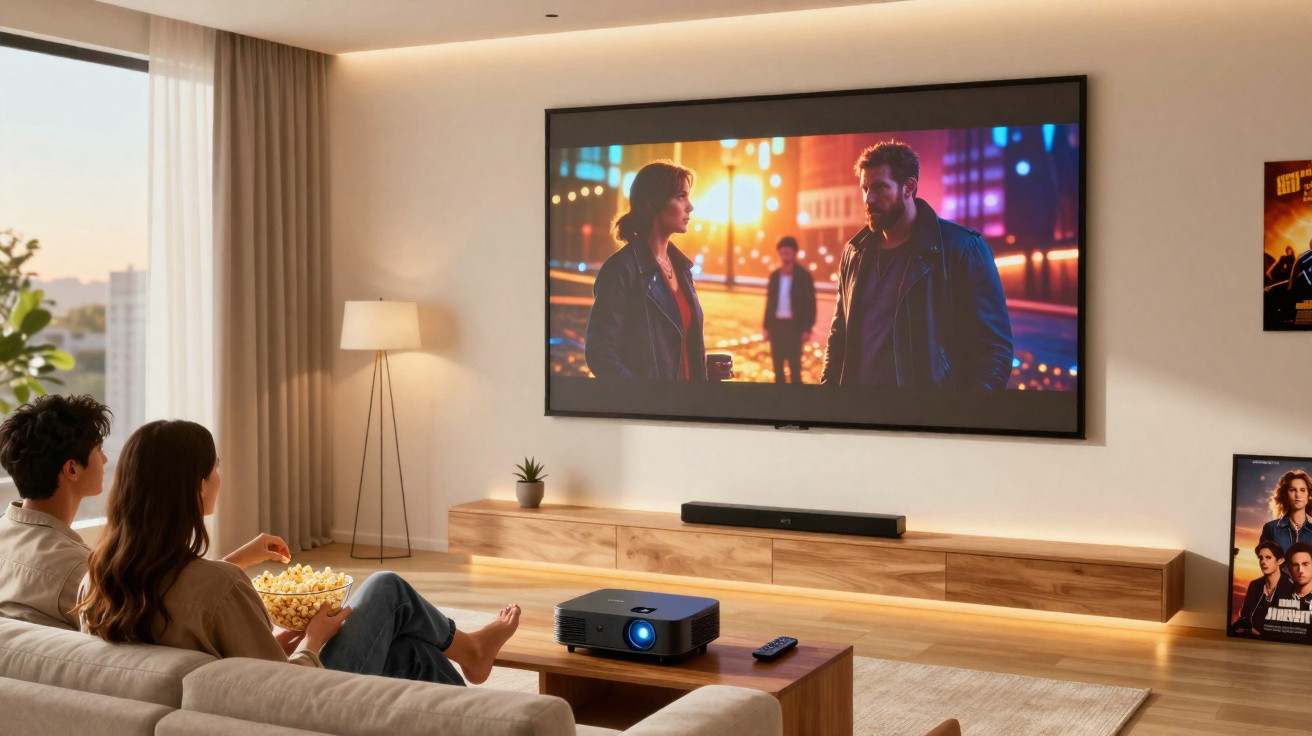
The lamps were switched off, yet the room was far from black.
A streetlight traced a faint stripe over the sofa, a phone glowed on the coffee table, but the image on the wall was bright enough to make your eyes adjust. There was no television set. No enormous black panel. Instead, an ordinary stretch of wall had become a 100-inch display.
As the film trailer played, every pore on the actor’s face was visible from across the room. Audio spread through the space, making the empty glasses tremble ever so slightly. Somebody murmured: “Wait… where’s the TV?”
A small white unit stood on the low cabinet, tucked almost flush against the wall. There was no noticeable drone or rush of fan noise. A sharply defined beam simply rose up the wall, filling it with cinema.
It is the point at which you realise that your living room may have had a hidden cinema in it all along.
What exactly is a laser TV?
Resembling a compact soundbar, a laser TV functions as a huge television that seems to vanish when it is not in use. In technical terms, it is an ultra-short-throw projector that relies on lasers rather than a conventional lamp. Positioned only a few inches from a wall or purpose-made screen, it can produce an image between 80 and 120 inches, and occasionally larger.
Its appeal lies in how little distance it needs. Rather than suspending a bulky projector from the ceiling, you can place this unobtrusive box on your TV unit. Since the light travels almost straight upwards, children, pets and accident-prone adults are not constantly casting shadows through the picture. Your wall becomes the screen, your furniture stays almost the same.
Manufacturers call it a “laser TV” because the experience is closer to using a television than a standard projector. It powers up like a smart TV, your apps are ready to use, and the picture is bright enough for an everyday room. You do not need a dedicated darkened den.
Imagine a Sunday afternoon with the curtains partly open and the dishwasher running in the kitchen. You select Netflix and a 100-inch picture appears on a grey ambient-light-rejecting (ALR) screen above the sideboard. You are not squeezed into a dark room; you are simply at home. Still, the display is larger than a typical TV could sensibly be without consuming the entire wall.
Many households reach the 65-inch limit and wonder, “Bigger would be fun, but where would it even go?” A laser TV answers that question neatly. A console-sized unit and a slim screen can provide the sort of “wow” moment normally associated with costly home cinemas. In some open-plan flats, a laser TV becomes the centre of social life: football evenings, long gaming sessions and even YouTube cookery clips can suddenly feel like events.
There is practical reasoning behind the appeal too. Laser light sources last much longer than traditional projector lamps, often for 20,000–30,000 hours. They offer richer colours, stronger contrast and brightness that remains more consistent as time passes. As the projector sits close to the wall, it is also simpler to control image geometry than with a long-throw model installed at the far end of a room.
In everyday terms, this means less adjustment, no ceiling installation and fewer leads running across the floor. Since many laser TVs include speakers and smart platforms, you do not have to assemble a system from ten separate devices. It is a single product designed to make your living room feel like a cinema without making it feel like a technical workshop.
How a laser TV transforms your living room into a home cinema
The starting point is almost ridiculously straightforward: make space on a wall. You do not need to clear the entire wall, only the central area where your current TV would normally be. Put the laser TV on a low cabinet, align it with the wall or dedicated screen, then adjust its feet until the image sits correctly. There is no ladder, drilling or debate about concealing cables.
Next, lower the lighting slightly and press play. Moving from a 55-inch television to a 100-inch picture feels tangible. Faces become life-sized, words are clearer from the sofa and panoramic scenes begin to resemble views through a window. If you have always wanted a cinema atmosphere but do not have a spare room, this is the “hidden room” you’ve been waiting for.
For a more convincing home cinema experience, many owners make two uncomplicated additions: a good soundbar or compact surround setup, plus a somewhat darker ALR screen rather than a plain white wall. Those two changes can take the setup from a “big TV” to a “mini cinema” within an evening.
One young couple living in a 45 m² city flat told me that they had promised never to attach anything to their ageing brick walls again. In a single afternoon, they replaced their 43-inch TV with a 100-inch laser TV, without drilling or arguments with their landlord. Their Friday evenings changed immediately.
Watching football with friends went from “pass me the remote” to “pass the popcorn.” Rather than going out, they began inviting people around for watch parties. The room itself had not changed: the same sofa and the same coffee table remained. Only the wall had been transformed. They also spotted an unexpected benefit: people scrolled on their phones less during films. The scale of the picture naturally draws attention back.
Sales figures reflect these small personal stories. Ultra-short-throw laser projectors rank among the most rapidly expanding home-cinema categories. This is more than a technology fad; it suggests that people want large-screen entertainment without committing a full room or their entire budget to it. These are living rooms where the screen disappears once it is switched off, instead of ruling the space all day and night.
From a technical perspective, the factors that turn a “big picture” into “home theater” are managed light and sound. Laser light sources provide substantial brightness and colour volume, allowing the image to remain effective in rooms that are not completely dark. ALR screens return light from below, where the projector is positioned, while rejecting much of the stray daylight coming from above. The outcome feels much more like a very large TV than a soft, old-fashioned projector image.
Audio completes the effect. Many laser TVs now include built-in sound developed by respected audio brands, using the wide top surface of the unit to spread stereo channels. Place a subwoofer behind the sofa and you begin to feel the low-frequency rumbles in your chest, as you would in a cinema. That is when people stop calling it a “nice gadget” and start saying “let’s stay in tonight.”
Choosing and living with a laser TV: practical tips and real-life mistakes
Before purchasing a laser TV, the most sensible step is decidedly low-tech: measure the wall and your viewing distance. Sit where you normally sit on the sofa, use a tape measure against the wall and see how wide a 100-inch diagonal truly appears. Plenty of people are surprised to discover that they can comfortably accommodate 100 or even 120 inches without the picture overwhelming the room.
After that, look at the throw-distance specifications for the model you are considering. Some require 20–30 cm between the wall and the lens, while others need less. Also plan for your other equipment, including games consoles, set-top boxes and perhaps an external audio system. Your cabinet should be deep enough for the projector itself and capable of concealing the cables.
Here is a quick check: at night, turn off your TV and use a borrowed projector, or even an inexpensive pico projector, to cast a white image from your laptop or phone onto the wall. Within moments, you will notice bumps, cracks and uneven colour that could become irritating later. This three-minute test may convince you to choose a proper screen instead of projecting directly onto the wall.
The most frequent misunderstanding is assuming a laser TV will perform like a small OLED under full midday sunlight. It is bright, certainly, but direct sunshine remains unbeatable. If your lounge is essentially a glass box, an ALR screen and a simple curtain routine for film nights will help. You do not need total blackout, only a little control over the light.
Sound is another factor people often overlook. Laser TVs include respectable speakers, but physics still imposes limits. If you are hoping for “cinema” but get “big laptop”, disappointment soon follows. Even a compact soundbar or 2.1 system makes a dramatic difference. Let’s be honest: nobody really does this every day, but it is worth pressing one additional power button on movie nights.
A further common mistake is choosing the very cheapest product with no meaningful brand support. Firmware updates are important: they address faults, enhance apps and can even refine image processing. A no-name box may save money on day one, then demand your patience every weekend.
“The day we brought the laser TV home, our living room stopped being just a room,” a reader wrote to me. “It became the place where the week slows down. Where we actually sit together and watch the same thing, at the same time.”
There is something quietly emotional in that observation. In practical terms, a few easy habits can preserve the sense of occasion without turning you into a home-cinema obsessive:
- Gently clean the lens and screen every few weeks to prevent a dusty haze.
- Set up one “cinema” picture preset with warmer colours and lower brightness for evenings.
- Use a smart plug to shut everything down completely when it is not in use.
- Keep a short HDMI cable available for visitors bringing consoles or laptops.
- Set aside one evening each week as “big screen night”, whether for a series or gaming.
On a more personal level, laser TVs work best when they become less of a gadget and more of a ritual. A small action, such as switching off the main light and leaving a side lamp on before starting a film, signals to your mind: “Okay, this is special time now.” On a Tuesday that feels like three Mondays in a row, that modest reset can matter more than every specification sheet in the world.
The subtle shift: when a screen changes how you use your home
When a laser TV arrives in a living room, the room acquires a subtle second purpose. It is no longer merely where you put down your keys and half-watch the news. At particular times, it becomes a small cinema, a stadium, a concert venue and sometimes even a classroom.
Children can turn cartoons into wall-sized adventures, teenagers can mirror TikTok dances and YouTube tutorials, and adults can revisit older films that suddenly feel cinematic again. The same four walls start accommodating shared experiences rather than three separate screens on three different laps.
We have all experienced sitting “together” on the sofa while everyone is caught in their own feed, headphones and private bubble. A 100-inch image disrupts that pattern slightly. Not through pressure, but through pure presence. You either watch it or consciously choose not to. Both options are more honest than watching halfway while endlessly swiping.
Laser TVs also challenge the familiar assumption that living better requires more space. They make it clear that a small flat can support a big life when the experiences inside become more intense rather than the floor area increasing. Your 20 m² living room can host a Champions League final with the atmosphere of the pub around the corner, without its sticky floor.
That is why these products are generating so much conversation on technology forums and lifestyle feeds: they sit at the meeting point of technology and the way we want to live. Not larger homes, but richer evenings. The sort of evenings where you discuss what you have watched as the credits roll, rather than allowing autoplay to lead you into oblivion.
| Key point | Detail | Benefit for the reader |
|---|---|---|
| Laser TV = ultra-short-throw projector | Uses laser light, sits close to the wall and creates 80–120″+ images | Understand why it feels like a giant TV without major work |
| Works in real living rooms | High brightness and ALR screens deal reasonably well with ambient light | See whether your current space can realistically become a home cinema |
| Simple setup, big impact | One box, an optional screen, better sound and minimal drilling | Assess how easily movie nights can become a genuine cinema experience |














Comments
No comments yet. Be the first to comment!
Leave a Comment