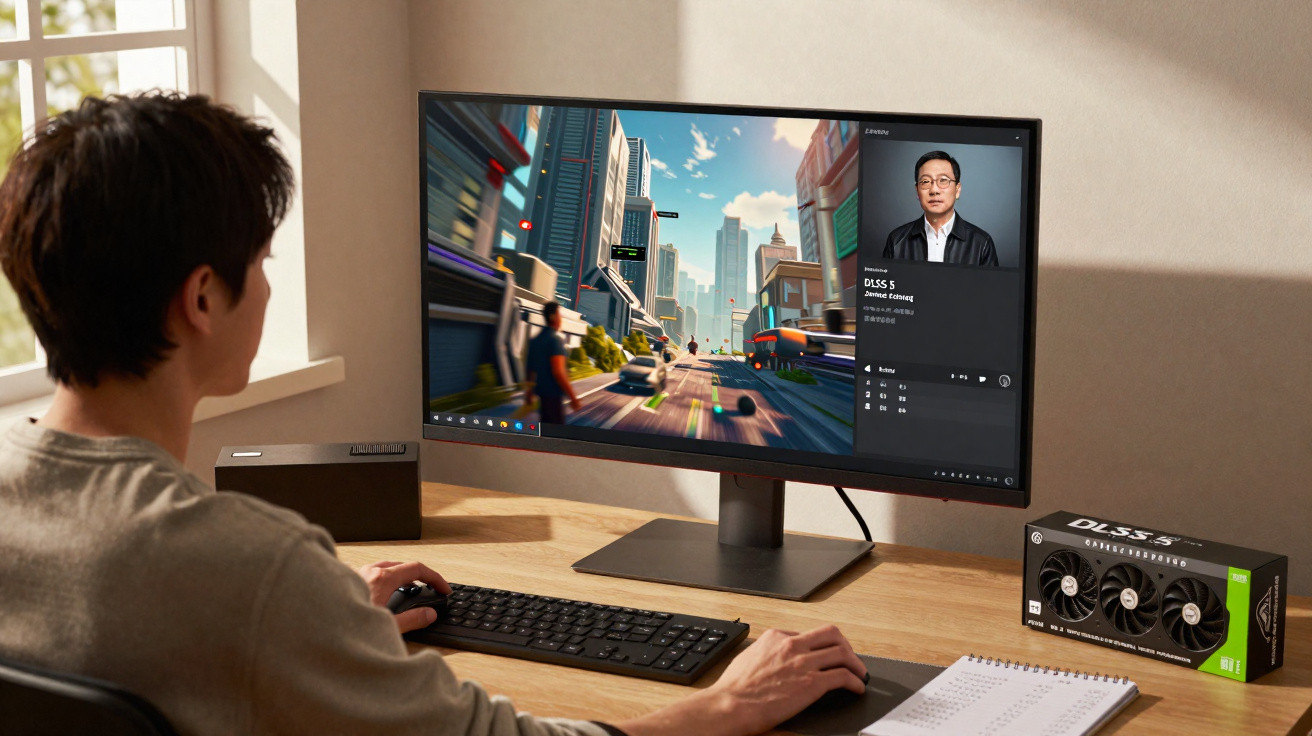
Nvidia CEO Jensen Huang has responded to the mixed reception DLSS 5 has received from players. In his view, the criticism is misplaced, and its detractors have misunderstood the technology.
On 16 March, Nvidia unveiled the latest generation of DLSS. This fifth version lets developers use artificial intelligence to handle the lighting effects and transparency of every pixel. Its aim is to create scenes that look more believable and closer to reality. Yet the results presented by Nvidia failed to win over the wider public.
Many players objected to DLSS 5’s highly artificial-looking visuals. Nvidia has therefore been accused of altering games’ visual style and of using generative AI to make images appear more realistic. This is particularly noticeable on faces. Some have even claimed that DLSS 5 betrays developers’ work, while others say it produces results similar to fully AI-generated videos. Nvidia president Jensen Huang chose to address those critics.
Nvidia responds to concerned players over DLSS 5
The CEO clarified the matter during a question-and-answer session following his GDC conference. When Tom’s Hardware asked what he would say to critical players, he did not hold back:
“First of all, they’re wrong. The reason for that is that, as I explained in detail, DLSS 5 combines the mastery of geometry, textures and every aspect of the game with generative artificial intelligence. This is not image-level post-processing; it is generative control at the geometry level.”
Put simply, the AI is not being used afterwards to alter the artistic look of an image. Instead, it only handles the textures of surfaces and the lighting effects displayed on screen. He added:
“All of this is under the developer’s direct control. It is very different from generative AI. That is why we call it neural rendering.”
As Tom’s Hardware notes, Huang also repeatedly stressed that DLSS 5 would not change developers’ artistic control in any way, and that they would need to master the tool themselves for their future games.
Should players be worried about DLSS 5?
It must be said: the examples Nvidia showed were not particularly appealing. At a time when the public is highly critical of AI, revealing visuals reminiscent of Sora or Nano Banana videos was hardly a great idea. What is more, the games highlighted were not designed with this technology in mind.
However, DLSS 5 is only a tool, and it will be necessary to wait and see how developers use it before making a proper judgement. How will it be used in a game built with it in mind from the outset? Another key point is that DLSS 5 will not transform video games. It will be an optional setting that players can enable, and it will only be available on GeForce RTX 5000 graphics cards. Console players and those with AMD graphics cards will therefore not benefit from it. At least in the short and medium term, it will remain a niche technology for well-off gamers.
















Comments
No comments yet. Be the first to comment!
Leave a Comment