
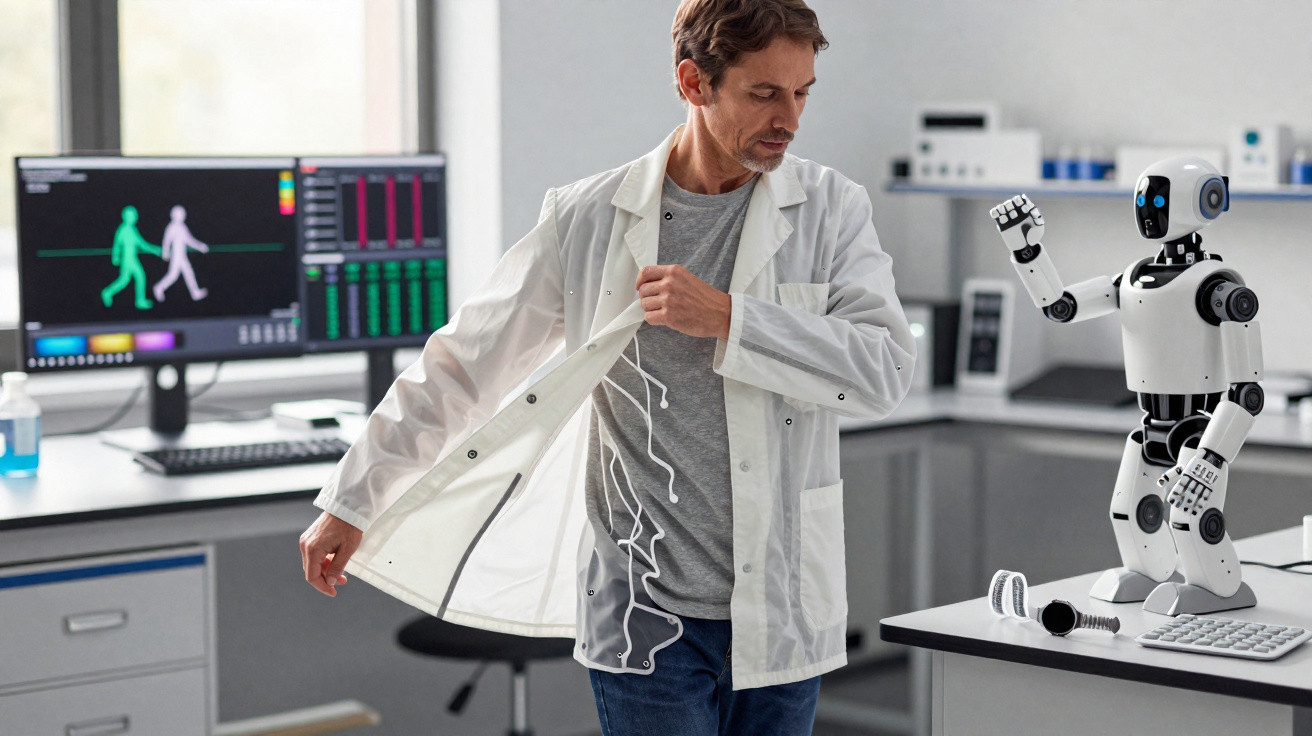
Accurately measuring how people move has typically meant fastening sensors firmly to the body. Yet new research indicates that doing the opposite - placing sensors on loose, everyday clothing - can capture motion more precisely, while requiring far less data than the tight suits, straps and skin-hugging wearables usually linked with “serious” tracking.
Scientists at King’s College London report that this approach could improve everything from health trackers such as smartwatches to motion capture used to animate CGI characters. The work could also make it more practical to monitor mobility-affecting conditions, including Parkinson’s, outside controlled laboratory settings.
Challenging what everyone assumed
For years, the working assumption has been straightforward: if a sensor is not fixed in place, it will wobble and introduce “noisy” readings, so it must be strapped down. The researchers went in expecting that logic to hold.
“When we think about technology that tracks movement – like a Fitbit on your wrist or the suits actors wear to play CGI characters – we had thought that the sensors need to be tight against the body to produce the most accurate results,” said study co-author Matthew Howard.
The prevailing view, Howard added, is that looseness makes the output “noisy” or messy.
“However, our research has proven over multiple experiments that loose, flowing clothing actually makes motion tracking significantly more accurate.”
“Meaning, we could move away from “wearable tech” that feels like medical equipment and toward “smart clothing” – like a simple button or pin on a dress – that tracks your health while you feel completely natural going about your day.”
At heart, the appeal is clear: motion tracking that feels normal, rather than like being wired up for a clinical study.
Better accuracy, less data
According to the study, sensors placed on loose fabric predicted and captured body movement with 40% more accuracy than sensors attached directly to the skin. More notably, they achieved this using 80% less data.
If those figures translate to broader, real-world use, the implications are substantial. Higher accuracy with less data could mean simpler setups, quicker model training, and reduced battery and processing demands - the kind of gains that can materially change both consumer products and research workflows.
The role of loose fabric
The question, then, is why a sensor on fabric that shifts and drapes could outperform one anchored firmly to the body.
The researchers’ explanation is that loose fabric does not merely follow movement; it actively responds to it. Small changes in posture and limb motion can be magnified by the way fabric folds, flutters and shifts.
In the study’s terms, loose clothing behaves as a “mechanical amplifier”, making the movement signal larger and easier to distinguish.
“When you start to move your arm, a loose sleeve doesn’t just sit there; it folds, billows, and shifts in complex ways – reacting more sensitively to the movements than a tighter fitting sensor,” Howard said.
Put simply, the sensor is picking up not only what the body does, but also the fabric’s response pattern - and that response can carry extra information about the underlying motion.
Testing fabrics, bodies, and robots
To check that the effect was not a one-off result, the team ran multiple experiments across different types of fabric. They also evaluated movement from both human participants and robotic subjects performing a range of actions.
They then benchmarked the clothing-based readings against standard methods, including motion sensors held in place with straps and tight garments.
Across the tests, the same outcome repeated: sensors on fabric identified movement more quickly, delivered more accurate detection, and required less movement data to make predictions.
One particularly practical finding was that looser fabric helped separate very similar motions, including subtle changes that were described as “barely detectable”. This matters because the most important signals in everyday monitoring are often not dramatic gestures, but small, early shifts that are easy to overlook.
Parkinson’s and other conditions
This is where the work moves from an interesting technical result to something with potential clinical relevance.
A persistent challenge is that tight wearables can miss small movements, leaving less reliable information for people whose motion is limited or subtle.
“Sometimes, a patient’s movements are too small for a tight wristband to catch and therefore we can’t always get the most accurate data on how conditions like Parkinson’s are affecting people’s everyday lives.”
“Through this approach we could ‘amplify’ people’s movement, which will help capture them even when they are smaller than typical abled-bodied movements. This could allow us to track people in the comfort of their own homes or a care home, in their everyday clothing.”
“It could become easier for doctors to monitor their patients, as well as medical researchers to gather vital data needed to inform our understanding of these conditions and develop new therapies including wearable technologies that cater for these kinds of disabilities.”
Comfort and realism sit at the centre of the point: people do not live in laboratories. If better data can be collected while someone wears normal clothes at home, it offers a more faithful view of day-to-day life and may also support longer-term participation.
From Fitbits to smart buttons
The study also hints at a different direction for consumer design.
Rather than prominent wearables that look and feel like devices, the researchers envisage sensors embedded into clothing in unobtrusive forms - for example, as a button on a shirt or a pin on a dress.
Such changes could make motion tracking more socially acceptable and more widely used, particularly by people who find conventional wearables uncomfortable, stigmatising or impractical.
A robotics angle
Howard also positions the results as a significant opening for robotics. Robots learn from data, but gathering large volumes of high-quality human movement data is difficult in part because existing capture tools are inconvenient.
“A lot of robotics research is about learning from human behavior for robots to mimic, but to do this you need huge amounts of data collected from every day human movements, and not many people are willing to strap up in a Lycra suit and go about their daily business,” he explained.
“This research offers the possibility of attaching discreet sensors to everyday clothing, so we can start to collect the internet-scale of human behavior data, needed to revolutionize the field of robotics.”
If vast quantities of natural movement could be collected without people feeling instrumented, it would enable a fundamentally different kind of training dataset - one that reflects how humans actually move in daily life, rather than how they move under laboratory conditions.
What stands out most is the study’s counterintuitive conclusion. Loose fabric seems like it should add mess, yet it may add information. If that continues to hold up, it could shift motion tracking away from straps and suits and towards clothing that simply disappears into ordinary life.






Comments
No comments yet. Be the first to comment!
Leave a Comment