
Fast intercontinental links in the nineteenth century relied on ingenious solutions. Once submarine cables began to span the ocean, the loss of energy turned every received signal into a puzzle that operators of modern communication struggled to interpret.
What was the biggest challenge of nineteenth-century transatlantic telegraphy?
The plan to connect Ireland and Newfoundland using underwater conducting lines exposed serious technical limits. Across thousands of kilometres beneath the surface, electrical dispersion weakened the transmitted pulses, making data reception extremely unstable and slow.
Conventional receivers with heavy pointers simply could not move under such faint currents. Faced with this enormous barrier, the Atlantic Telegraph Company needed a new approach so that urgent reports could arrive clearly at the far end of the intercontinental telegraph.
Why do we say “hello” on the telephone?
The classic telephone greeting took shape in the earliest days of telecommunications, when a dispute between inventors ended up popularising an unexpected expression… Read more
How did the mirror galvanometer amplify almost imperceptible impulses?
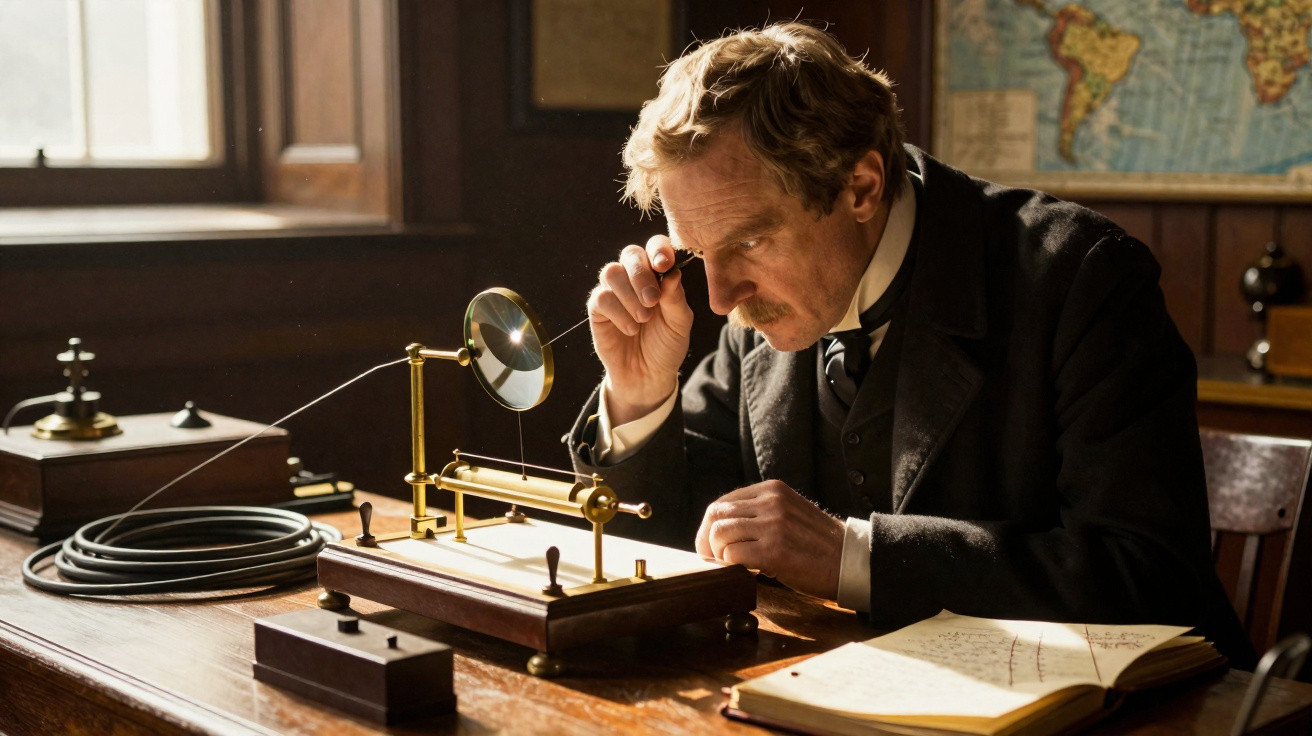
Rather than boosting the power sent through the circuit, William Thomson devised a refined optical mechanism. A tiny mirror reflected a beam of light onto a graduated scale, visually magnifying the rotations of a minute magnet driven by the delicate electricity arriving at the receiver.
This visual trick acted like a weightless pointer, removing the mechanical friction that held back other instruments. With this clever arrangement, even the slightest movement produced an obvious track in a darkened room, ensuring no code was lost during the ocean crossing.
Below, a video from the Museum of HSTM University of Leeds (YouTube) channel on YouTube presents details on how this galvanometer works:
Which elements made William Thomson’s instrument so sensitive?
The device’s exceptional sensitivity came from a well-balanced combination of structural lightness and precise magnetism. Suspended on thin silk threads inside a conducting coil, the moving element responded immediately to tiny variations in current arriving via the submarine cable.
This meticulous construction avoided the inertia that caused older meters to stick when signals were weak. Thanks to that quick response, the team could spot initial oscillations without waiting for charge to build up, maintaining a continuous and efficient reading of messages.
Fundamentals of the galvanometer
Elements of the mechanism
The main components developed by William Thomson included:
- 1
Light mirror fixed to a small magnet; - 2
Delicate suspension on silk threads inside the coil; - 3
Beam of light projected onto a distant graduated scale.
How did this technology revolutionise message reception?
Daily work in telegraph stations demanded flawless synchronisation between technicians to capture each point of light. While one person watched the graduated scale and called out the characters, the other wrote them down, turning the bright beam into understandable information.
This faster, more dynamic routine accelerated the exchange of international dispatches and set new standards of scientific precision. That direct collaboration allowed the submarine system to operate reliably, creating a secure bridge for global trade and the advance of modern diplomacy.
In practice, the method delivered decisive advantages for the telegraph sector:
- Detection of extremely subtle signals without the need for heavy equipment;
- Coordinated operation between two professionals for rapid transcription;
- Protection of ocean cables against destructive electrical overloads.
Why did the instrument’s sensitivity outperform brute force?
Early attempts to apply high voltages to the cables damaged the insulation and caused costly failures along the lines. William Thomson’s strategy showed that precision at the receiving end mattered more than excessive voltage applied at transmission.
The success of the mirror galvanometer helped lay foundations for applied physics and cemented the career of Lord Kelvin. His pioneering view proved that the delicacy of a small mirror could connect continents and steer future scientific innovation.






Comments
No comments yet. Be the first to comment!
Leave a Comment