
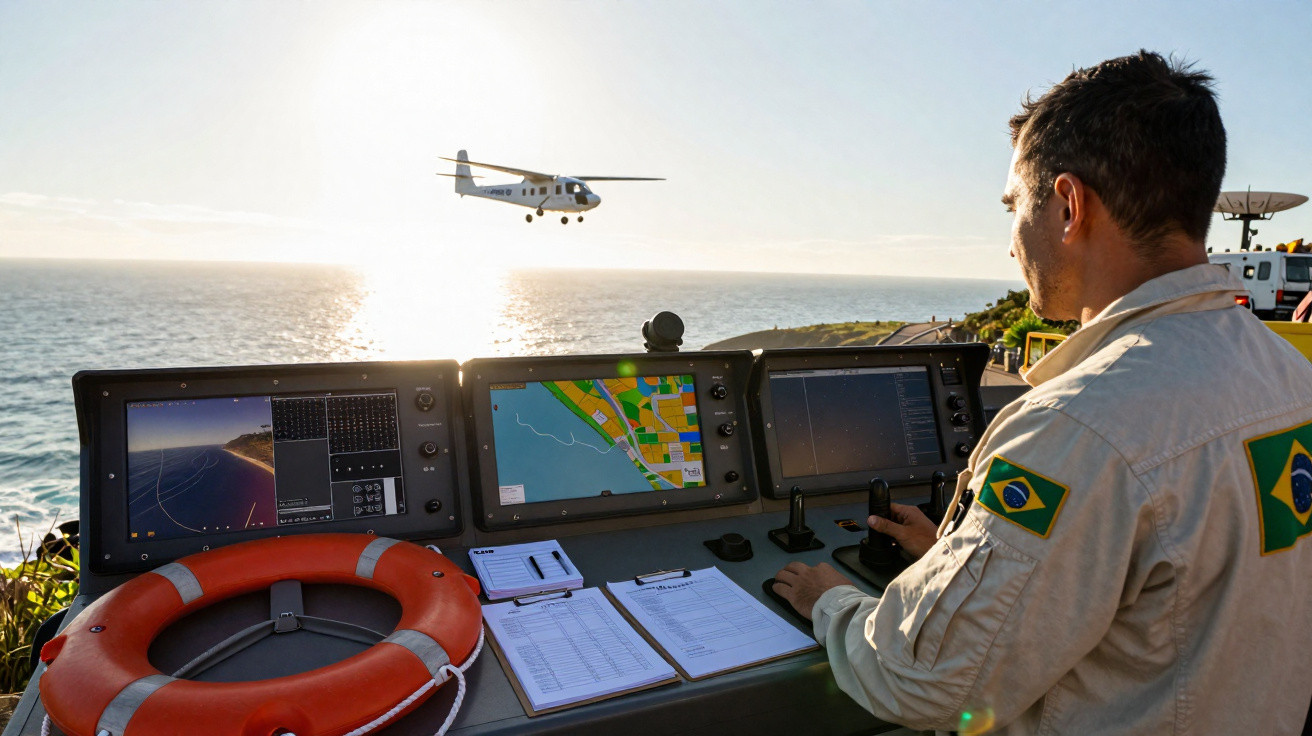
As unmanned systems continue to establish themselves as strategic tools for military operations, public security and missions supporting society, the SARP Harpia stands out as one of the most advanced remotely piloted aerial platforms developed in Latin America. Built by Brazil’s Advanced Technologies Security & Defense (ADTECH SD) in São José dos Campos (São Paulo state), the system brings together long endurance, BVLOS operation and broad operational flexibility in a solution designed around the practical realities of Brazil’s territory.
On 13 May, Zona Militar’s Brazil correspondent, Angelo Nicolaci, visited the company’s facilities to follow the manufacturing, integration and operational validation work, as well as preparations for Harpia units that would soon be deployed on a real search-and-rescue mission along the São Paulo coastline.
More than simply a remotely piloted aircraft, Harpia is now regarded as one of the most sophisticated unmanned aerial platforms produced by Brazil’s Defence Industrial Base. Fully operational and already used in real missions in Brazil, it is increasingly positioned as a national strategic capability for today’s requirements in long-duration surveillance, monitoring and reconnaissance.
SARP Harpia, ADTECH SD and Brazil’s unmanned systems industry
The visit made it possible to see not only the programme’s high level of maturity, but also the solid industrial capability ADTECH SD has established in São José dos Campos-one of Brazil’s leading technology and aerospace hubs. During the technical tour, Zona Militar followed the work from the aircraft’s structural manufacturing stages through to the final integration procedures for onboard systems.
One of the most notable elements observed was fuselage production, which uses high-performance composite materials including carbon fibre, glass fibre and Kevlar. Together, these materials deliver strong structural resistance while lowering weight, improving aerodynamic efficiency and providing the operational durability needed for extended missions.
It was also possible to see the aircraft assembly phases, electronic integration, and the installation of navigation, communications and avionics systems, alongside laboratories dedicated to operational validation and payload integration for ISTAR (Intelligence, Surveillance, Target Acquisition and Reconnaissance) missions.
From the factory floor to a real search-and-rescue (SAR) mission
During the 13 May visit to ADTECH SD, Angelo Nicolaci also observed the operational preparations to dispatch Harpia units for a real search-and-rescue effort on the São Paulo coast. The mission supported rescue teams and civil defence authorities mobilised after a young man went missing in the São Sebastião area, after entering the sea to try to save a friend.
At the time, the team followed not only static checks of the aircraft systems, engine start procedures, and validation of communications and navigation, but also the logistical preparations for the vehicle responsible for transporting Harpia’s Ground Control Station (GCS). The GCS would later be used as a mobile operating base during searches along São Paulo’s northern coastline.
The drones were formally integrated into the search taskforce on 14 May, the fourth day of the operation, within a highly demanding operating environment marked by rough seas, hard-to-reach coastal areas, and significant risk to boats and rescue personnel. Employing remotely piloted aircraft substantially increased the ability to monitor coastal zones-particularly rocky areas, gaps between cliffs, and stretches where sea conditions made it unsafe for teams to close in by boat, or even for the deployed helicopter to approach effectively.
Operations brought together assets from public bodies-such as Civil Defence and the GBMar maritime fire and rescue unit-alongside private and civilian initiatives. In Harpia’s case, ADTECH SD’s platform was used to provide prolonged aerial coverage and real-time video transmission to search teams, leveraging one of the system’s key strengths: extended on-station time of up to 12 consecutive hours and live monitoring.
Following these preparations allowed Zona Militar to see Harpia in an authentic operational context, highlighting not only the platform’s high level of technological maturity, but also its growing usefulness in missions that support society-civil defence, monitoring of critical areas, and SAR operations-along with other high-complexity emergency scenarios.
Capabilities, certification and strategic value of the Harpia system
Harpia was designed for border surveillance, reconnaissance, maritime monitoring, protection of critical infrastructure, environmental oversight, and support to public security and defence operations. Its architecture was developed with Brazil’s specific geographic characteristics in mind, including vast forested areas, long distances, hard-to-access regions, and Brazil’s extensive maritime area.
Today, the system is already operating in the states of Acre and Amazonas, where it has been used on missions tied to surveillance, monitoring and support for strategic operations in highly complex environments-particularly within the Amazon region. More recently, Harpia was also approved to operate in urban centres by public authorities, significantly broadening its potential use in public security missions, urban monitoring, protection of critical infrastructure and surveillance in densely populated areas, as well as civil defence tasks such as searching for missing people and monitoring areas affected by natural disasters.
For Bruno Cunha, ADTECH SD’s CEO, Harpia’s design began with the need to create a platform shaped by Brazil’s real operational requirements.
“Harpy was developed from a perspective of use in operations in Brazil, with the constraint of vast territorial spaces, dense forest, an immense border strip and surrounded by Brazil’s extensive maritime area. With that in mind, the aircraft was conceived to be extremely versatile,” Bruno Cunha, CEO of ADTECH SD
This operational approach enabled the platform to combine features considered essential for complex, long-duration missions. According to information provided by the company, Harpia offers endurance of more than 12 hours, BVLOS (Beyond Visual Line of Sight) capability, extended operational reach, and the option to operate in remote environments without the need for prepared runways.
Another major differentiator is its catapult launch system and recovery via parachute and airbag. This arrangement sharply reduces the need for complex logistics infrastructure and increases the system’s usability in isolated regions, border areas, jungle environments and locations with limited support infrastructure.
In addition, Harpia can fly with different payload configurations, including electro-optical sensors, infrared imagers, synthetic aperture radar (SAR) mapping or photogrammetry, signals monitoring (SIGINT), and solutions focused on intelligence, reconnaissance and target acquisition.
In an international environment shaped by the rapid expansion of drone use in modern conflicts-particularly following lessons seen in the Russia–Ukraine war-ADTECH SD says it chose to prioritise operational ruggedness, technological reliability and mature onboard systems.
“Harpia focuses on robustness and operational safety, with technologies that have already been validated and exhaustively tested for ISTAR missions, having succeeded in proof-of-concept trials and operations in Brazil and internationally,” Bruno Cunha, CEO of ADTECH SD
The company notes that, although the global market has been flooded with many different drone models in recent years, few platforms manage to combine extended endurance, reliable operations, logistical flexibility and technological maturity within a single system.
The absence of ITAR restrictions and the high level of local content make Harpia especially appealing for Latin American countries and other nations seeking to expand surveillance and monitoring capabilities without excessive dependence on major international suppliers.
Another topic discussed during the visit was the demanding certification process faced during the aircraft’s operational consolidation.
“One of the main challenges in the Harpia project was certainly the bureaucratic barriers relating to certifications. Even though they are extremely necessary for safety, the process is slow and complex, and it took almost five years for the final certification of the project to be issued.” Bruno explains.
Harpia is currently approved for BVLOS operations by ANAC and certified as a Strategic Defence Product (PED), a status viewed as essential for programmes linked to Brazil’s technological sovereignty and operational independence.
At the same time, ADTECH SD argues that national technology control is a central element in ensuring autonomy across critical defence sectors.
“Harpia is manufactured entirely in the interior of São Paulo state, in São José dos Campos, using national technology, expertise and labour, with very few imported components due to the absence of an equivalent in Brazil or the region,” said Bruno Cunha.
During the visit, it was clear that Harpia represents more than a remotely piloted aerial platform. The system also reflects the ability of Brazil’s Defence Industrial Base to deliver complex, competitive and technologically mature solutions in one of today’s most strategically important segments.
In this context, Harpia emerges not only as a high-end Brazilian technological solution, but also as a strategic alternative for Brazil, Latin America and other countries looking for effective platforms beyond the traditional United States–Europe axis. Free from political restrictions, embargoes and limitations often associated with major international manufacturers, the Harpia system combines operational autonomy, logistical flexibility and strategic independence.






Comments
No comments yet. Be the first to comment!
Leave a Comment