
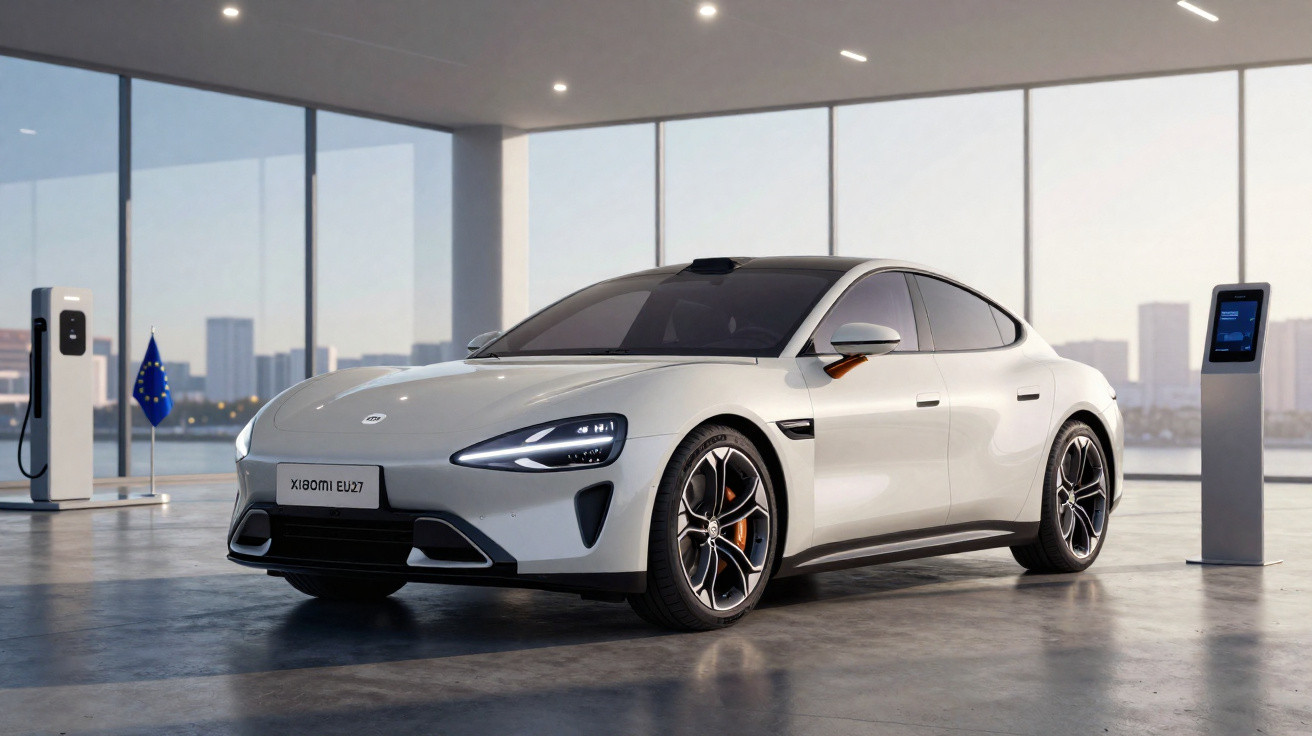
Just over two years ago, Xiaomi made its move into the automotive world, keeping sales focused on China. In a short space of time, it achieved a level of recognition that has taken some established manufacturers decades to build.
That situation is about to shift. The company has confirmed that it plans to begin selling cars in Europe in 2027, although it has not yet disclosed which countries will come first, which models will lead the launch, or how sales and after-sales support will be organised.
What is already evident is that groundwork has been underway well ahead of the first deliveries-and it extends far beyond straightforward technical tweaks.
Europe is already shaping Xiaomi’s next models
In September 2025, Xiaomi opened its first European automotive research, development and design centre in Munich, Germany. The team brings together specialists with experience at brands such as BMW, Mercedes-Benz, Porsche and Lamborghini, and is focused on technology development, design and high-performance vehicles.
Rather than simply reworking Chinese-market cars, the intention is to tailor future models to European expectations-from dynamic behaviour to software and the in-car experience.
The first tangible outcome of that approach is the YU7 GT. Xiaomi says this high-performance SUV was created with substantial input from its European team, and it also signals a clear push to compete in the premium segment.
A line-up that remains narrow
For now, Xiaomi’s car range is built around two families: the SU7 saloon and the YU7 SUV. The SU7 was the brand’s entry point into the sector and stood out for blending performance, technology and price. More recently, it received a major technical update.
The Standard and Pro versions have moved to a 752 V electrical architecture, while the Max version reaches 897 V. For the latter, Xiaomi claims up to 670 km of range recovered in 15 minutes and charging from 10% to 80% in around 12 minutes, under the Chinese CLTC cycle. Overall, depending on specification, the SU7 offers ranges between 720 km and 902 km (CLTC).
There is still no confirmation that this model will be sold in Europe, but it is hard to imagine Xiaomi’s international debut without the car that first put it on the automotive map.
YU7 GT targets the European market
With the YU7, Xiaomi steps into the SUV category-a body style that continues to dominate European sales.
The newest variant, the YU7 GT, is defined by its twin electric motors producing 738 kW (around 1003 cv). Beyond the headline figures, the key point is that it was developed with strong influence from the European team.
The car also underlines the brand’s handling ambitions. In production form, it completed a lap of the Nürburgring-Nordschleife in 7min34,931s, beating the previous production SUV record held by the Audi RS Q8.
More than chasing lap times, Xiaomi wants its cars to earn a reputation for the way they drive-not solely for power output or technology.
More than just electric cars?
Xiaomi’s international plans may not be confined to fully electric vehicles. The company recently introduced Sky Nomad, a sub-brand aimed at electric models with a range extender (EREV).
The first model shown was the N90, a large SUV pairing a battery with a petrol engine used only as a generator. Drive remains electric. This set-up supports long-distance travel without relying entirely on the charging network and is particularly popular in China.
There is still no confirmation that Sky Nomad will come to Europe, and this very large SUV appears better suited to the Chinese market. Even so, the move indicates Xiaomi is testing different solutions for different regions.
What to expect in 2027?
Xiaomi’s arrival in Europe will be one of the most notable moments in the automotive industry in 2027. The brand brings name recognition, financial resources and a strong technology base, along with an existing customer base already familiar with its consumer electronics.
Even so, success is far from assured. Xiaomi will need to establish a sales and service network, secure parts supply, adapt systems to European legal requirements, and set prices that remain competitive against tariffs applied to vehicles built in China. It will also have to demonstrate it can repeat in Europe the results it has achieved at home.
The Munich centre and the development of the YU7 GT suggest that work is already well underway. Xiaomi still has not said exactly which models-or which versions of current cars-will be offered in Europe, but the wheels are already turning.






Comments
No comments yet. Be the first to comment!
Leave a Comment