
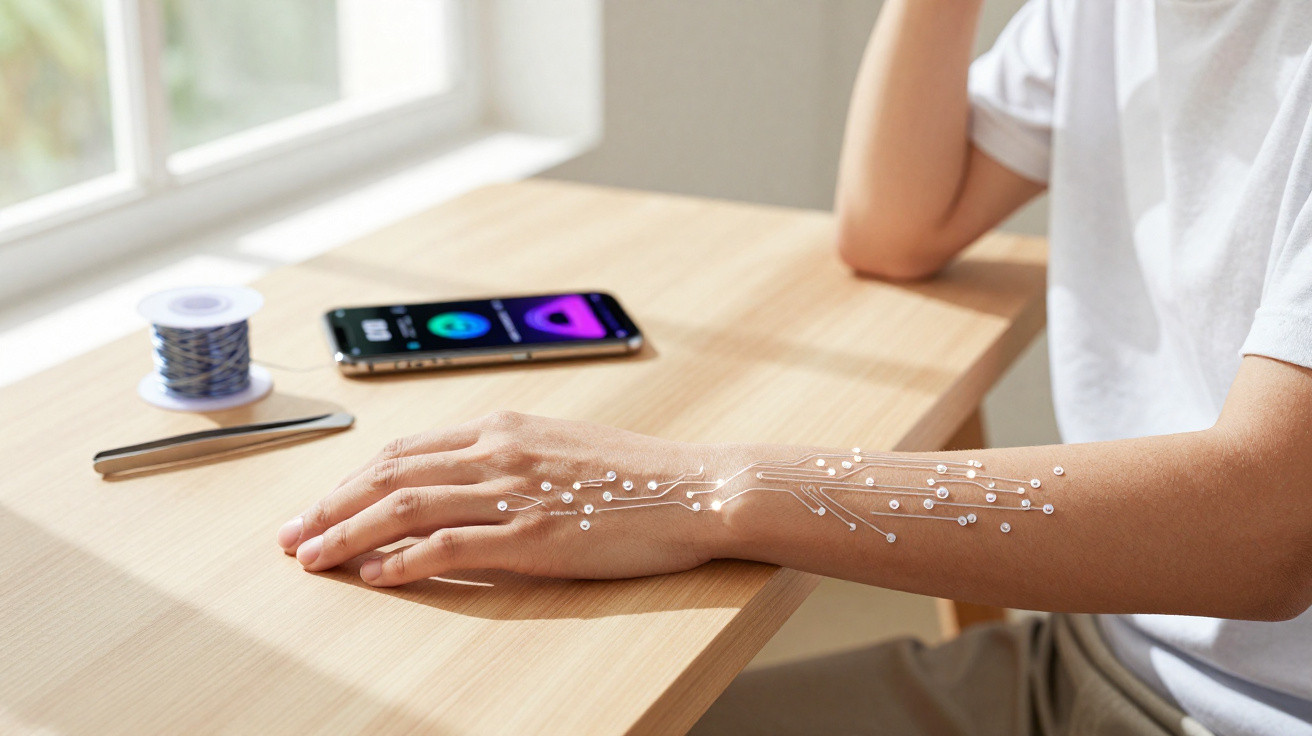
Electronics that can bend, stretch and move like everyday thread may soon allow wearable health monitors to fade almost entirely into what we already wear.
A group of engineers has developed flexible integrated circuits built directly on to thread, enabling sophisticated electronics to coil, flex and sit naturally against the body.
Over time, this approach could produce clothing that tracks health continuously, as well as sensors that watch breathing without any bulky kit. It may even open the way to electronic sutures capable of monitoring healing from inside the body.
The work was led by Sameer Sonkusale, an engineering professor at Tufts University. His team made the circuits using soft materials and a fabrication method that does not rely on an expensive clean room.
What they have produced is a different class of electronics-less like conventional hardware and far more like the textiles we put on every day.
Putting entire circuits onto thread
To make it work, Sonkusale and colleagues created each part of a complex integrated circuit in a thread format.
That meant building transistors, sensors and all the connecting elements as thread-based components, rather than placing them on a traditional flat substrate.
This marks a major shift from standard electronics manufacturing and could enable devices that behave more like fabric than rigid hardware.
“By moving electronics from planar patches to free-form threads, we have opened a path toward wearable bioelectronics that are more like fibers than hardware,” Sonkusale said.
“They will be soft, stretchable, and able to follow the body’s shape rather than forcing the body to accommodate the device. They could even potentially be used like sutures to monitor processes inside the body.”
Health monitors you barely notice
Wearables are already widespread. Over a third of US adults use smartwatches or smart rings, and many of these devices include some type of health tracking.
Integrated circuits made on thread could take that a step further. Instead of a separate gadget, health monitors could be woven into garments, incorporated into soft interfaces, or delivered through threads that sit in contact with the skin.
Because they would flex with movement, such systems could follow the body naturally rather than resting stiffly on top of it. The possible health uses go far beyond simple fitness logging.
Researchers also highlight ideas such as sutures that can measure wound healing directly.
Thread-based sensors might help identify movement patterns associated with cognitive decline or an increased risk of falls in older patients. They could also pick up breathing irregularities in infants.
For situations like these, a soft sensor that is barely noticeable could be far more valuable than a conventional rigid device.
Electronic threads prove their potential
As an initial proof of concept, the team showed circuits that can amplify signals coming from sensitive sensors.
They produced one device intended to be worn at the temple to detect blinking. Another was placed close to the diaphragm to measure changes in breathing pattern and breathing rate.
Together, these demonstrations suggest a future of soft, thread-based wearable systems. Such devices could monitor indicators such as stress or respiratory function while the wearer scarcely notices they are there.
“The technology platform is still in early stages,” said lead author Wenxin Zeng, a PhD candidate in electrical engineering at Tufts.
“But we expect to improve the speed and precision of fabrication, and the ability of the thread-based integrated circuits to carry out more complex functions.”
The technology behind the thread
At the centre of each electronic device is a thin thread coated with gold. Attached to this thread are tiny, fully flexible transistors.
These transistors are the basic building blocks found in any digital device. A conductive, plastic-like material links them to the gold thread on both sides.
Electron flow through the transistor is turned on and off in a way that resembles a tap. A second current serves as a gate, operating essentially like a valve.
The key breakthrough that makes this possible is a material known as a eutectogel.
This gel forms a gap less than a millimetre wide between two ends of the electronic thread. Within that gap, researchers can tightly control electron flow inside a thread-based resistor, capacitor, sensor or other component.
Earlier approaches from other teams used hydrogels to make similar connections, but hydrogels typically dry out as time passes.
The eutectogel removes that issue, staying stable, soft and safe for prolonged contact on or inside the body.
Circuits that can heal themselves
The eutectogel offers an additional advantage: it provides the transistor with a genuine self-repair function.
When the gel breaks, the researchers found that putting the separated pieces back together and applying gentle heat restores both the mechanical integrity and the electrical performance.
The electronic thread cannot be fixed if it is physically cut. Even so, the gel elements at the core of each transistor can be reconnected.
This capability could prolong the useful life of the devices in ways that rigid electronics cannot.
Cutting costs of flexible electronics
Unlike conventional integrated circuits, these thread-based electronic circuits do not require a clean room during fabrication.
Traditional circuits usually depend on photolithography, which deposits precisely patterned layers of material on to a surface, or on other processing techniques that use high temperatures.
That difference makes the approach much better suited to soft polymers and textile-like materials.
Most importantly, it creates a realistic path to genuinely low-cost production-something that could be crucial if the technology is to move beyond the lab and into everyday clothing.
Image Credit: Wenxin Zeng






Comments
No comments yet. Be the first to comment!
Leave a Comment