
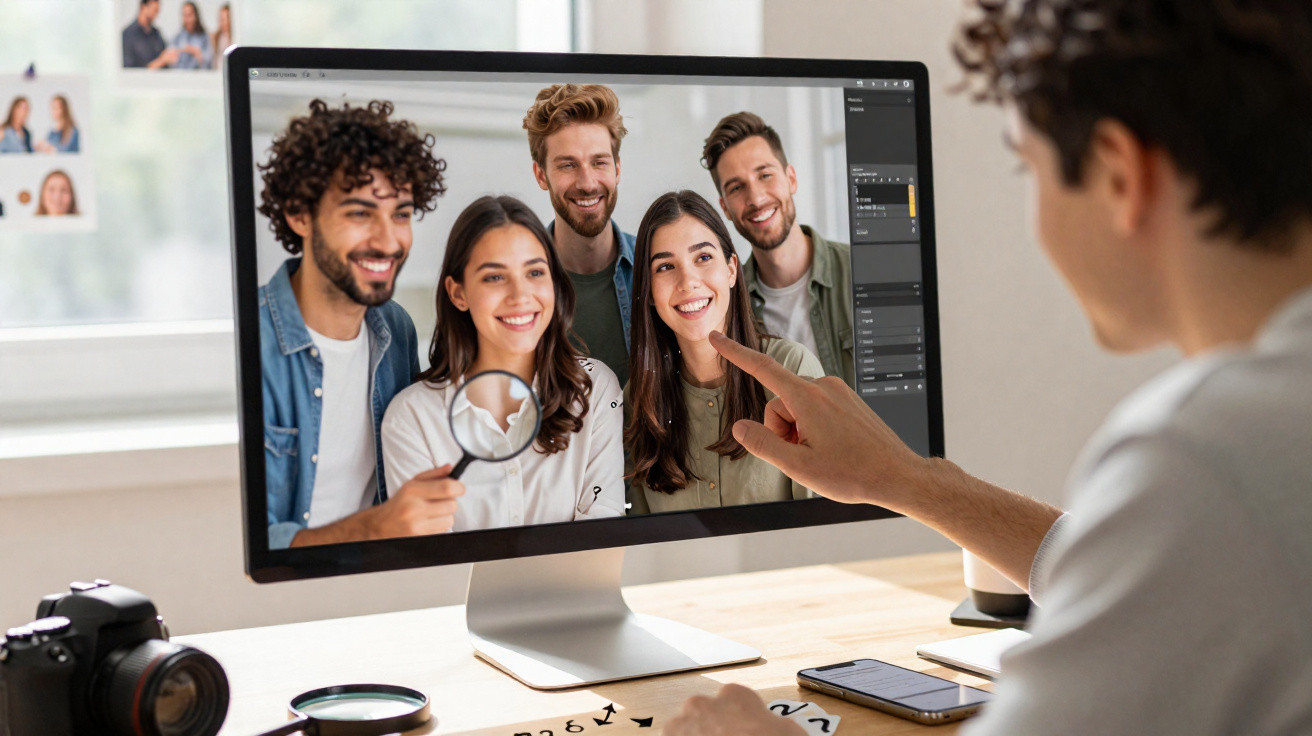
A picture that looks flawless does not always capture something that genuinely happened. As generative artificial intelligence (AI) tools have advanced, synthetic images have become increasingly persuasive, and relying on visual judgement alone may no longer be enough to work out what is real.
For Igor Baliberdin-a strategic designer and founder of LOOOP, with over 20 years’ experience at the intersection of design, business and technology-the biggest shift is recognising that there is no longer a single, tell-tale “AI mistake” that reliably gives an image away. “The technology has moved on a lot. These days, simply hunting for an odd-looking hand or a misspelt word might work in some situations, but it is not a dependable strategy. What matters most is developing an investigative eye and combining different signals,” he explains.
The expert says a few precautions can help you assess an image before you believe it or share it. Below are some practical tips.
1. Look closely at hands, eyes, teeth and fine details
Body parts are still useful areas to scrutinise, particularly when they appear in complicated poses or scenes. Hands with disproportionate fingers, jewellery that seems to melt into the skin, teeth that look overly uniform, or eyes with reflections that do not match the environment can suggest artificial generation.
“This does not mean that any strange detail is proof of AI. A real photograph can also show warping, blur, or lighting issues. The point is to check whether several small inconsistencies are happening at the same time,” says Igor Baliberdin.
2. Zoom in and hunt for inconsistencies
An image may look entirely natural in a quick glance on a phone, yet show problems once you zoom in. Pay attention to skin textures, strands of hair, object edges, patterns, lettering and elements in the background.
“It helps to look at what we usually ignore. AI can get the main subject very right and still produce small inconsistencies in the relationships between objects. The issue is often in the detail, not at the centre of the image,” the designer explains.
3. Check light, shadows and reflections
Lighting can also reveal a synthetic image. Consider whether the light direction makes sense, whether shadows behave consistently with the objects, and whether reflections in mirrors, glass, or metallic surfaces match what is happening in the scene.
“A photograph comes from a series of physical relationships: light, distance, perspective, depth, reflection. When one of those relationships does not add up, that is a sign to investigate more closely,” the specialist advises.
4. Be wary of text and objects that look “almost right”
Signs, packaging, screens, documents and shopfront lettering are other key areas. Even when AI produces text that looks convincing at first glance, small parts may include odd characters, words with no sense, or information that does not fit the context.
“It is the kind of image that seems fine at first, but when you read what is written, you realise something does not make sense. Visual information needs to be checked against the message it is meant to communicate,” says Igor Baliberdin.
5. Investigate where the image came from
This may be one of the most important steps. Before asking only “does it look like AI?”, ask: who posted it? When? In what context? Is there an original image? Have other reputable outlets or trusted accounts published the same scene? Reverse image search can also help uncover the source of a photo and identify when it first started circulating.
For Igor Baliberdin, this shift in behaviour is essential. “The origin of an image often tells you more than the image itself. A photo without context, received in a group chat or reposted by an unknown account, deserves a higher level of verification,” he adds.
6. Do not rely on your own eyes alone
Even an image that looks credible should be reviewed carefully. If it could cause harm or have serious consequences-especially in news, health, safety or allegations-it is worth combining visual checks with source tracing and confirmation from reliable outlets.
“The more convincing the image, the less sense it makes to trust intuition alone. The question should not be ‘can I tell this is AI?’, but ‘what evidence do I have that this image is true?’,” says Igor Baliberdin.
The new literacy is learning to be sceptical without losing sight
The rise of generative AI is changing not only how images are produced, but also how people relate to what they see. Gartner research published in June 2026 found that 49% of US consumers believe generative AI has worsened the quality of available content, rising to 57% among Gen Z and millennials.
For Igor Baliberdin, the answer is not to assume every image is fake, but to adopt a more critical stance towards digital content. “We are entering a reality where seeing will no longer be enough to believe. That does not mean mistrusting everything, but understanding that images need to be put into context. The eye of the future is not only the eye of someone who recognises a good photograph, but of someone who can question the origin, coherence and intention behind it,” the designer concludes.
By Maria Rossi




Comments
No comments yet. Be the first to comment!
Leave a Comment