
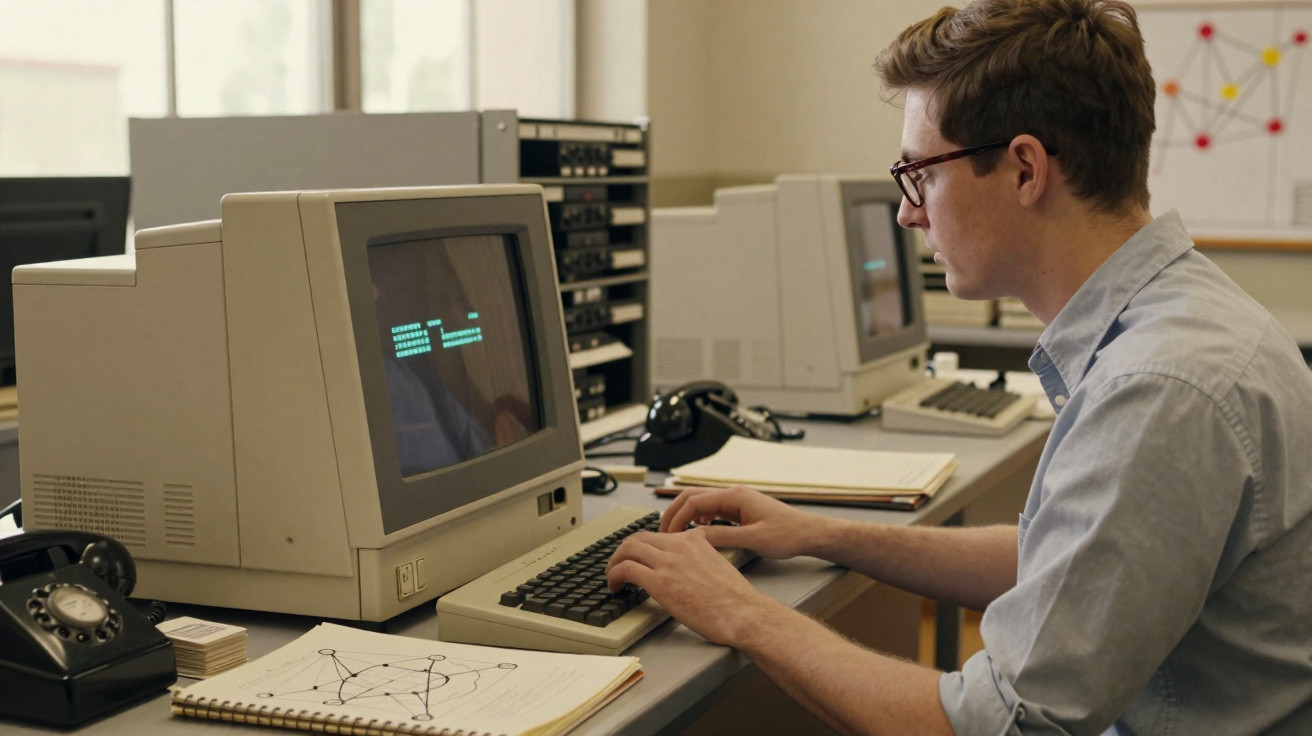
On the night of 29 October 1969, a student sitting at a computer at the University of California, Los Angeles tried to send a simple word to another machine hundreds of kilometres away. The system crashed after just two letters, yet that tiny “LO” would become a landmark in the history of the internet, paving the way for a shift that would transform human communication.
How did the idea of connecting distant computers begin?
In the 1960s, computers were vast, expensive and largely standalone. Even so, researchers were already picturing a future in which different centres could share information and computing resources. A crucial breakthrough was packet switching, where data is split into small chunks before travelling across a network.
In the United States, ARPA-an agency linked to the Department of Defense-funded an experimental project designed to link research institutions. This work produced ARPANET. It was not yet the modern internet, but it brought together essential ideas that would allow machines in different locations to exchange information over a shared network.
Where did the first ARPANET connection take place?
The network’s first two points were set up at UCLA in Los Angeles and at the Stanford Research Institute, known as SRI, in Northern California. Each site had a computer connected to a device called an IMP-effectively a forerunner of today’s routers, responsible for directing information between machines.
- UCLA received one of ARPANET’s first nodes in 1969.
- The Stanford Research Institute became the second site connected to the network.
- The computers exchanged data via devices known as IMPs.
- The trial aimed to demonstrate that distant machines could communicate reliably.
UCLA’s laboratory was headed by Professor Leonard Kleinrock, whose research was closely tied to the development of computer networking. There, student Charley Kline was tasked with operating the machine that would attempt to “talk” to the SRI computer, where programmer Bill Duvall was monitoring the test.
What was the first message sent?
The plan was to transmit the word LOGIN. Kline typed the letter “L” and, over the telephone, asked whether it had appeared on the SRI computer. It had. He then entered “O”, which also arrived correctly. However, when he typed the third letter, the remote computer crashed.
As a result, the first recorded message between those computers was simply “LO”. It was not a scripted phrase, a historic greeting, or a grand statement. Around an hour later, the fault was fixed and the full word was sent successfully, confirming the connection genuinely worked.
A video shared by the YouTube channel Talk Scientist recounts the story of how the internet emerged.
How did ARPANET evolve into the internet?
After that test, the network expanded quickly. More research centres and universities joined, but a fresh problem emerged: different networks needed a way to communicate with one another. To address this, researchers such as Vint Cerf and Bob Kahn developed the foundations of the TCP/IP protocols, which are central to communication between independent networks.
On 1 January 1983, ARPANET officially adopted TCP/IP, a date often treated as a turning point in the birth of the modern internet. Years later, Tim Berners-Lee created the World Wide Web, making it easier to access documents connected by links. The internet and the Web, therefore, are not exactly the same invention.
Why do those two letters still matter?
Today, billions of messages, videos, searches and files move across the internet, yet the story of this vast infrastructure includes an attempt that ended with only two letters on the screen. The episode shows how major technological revolutions can start quietly-experimental, modest, and even shaped by an unexpected failure.
The next time a message crosses the world in seconds, it is worth thinking back to that night in 1969. The simple “LO” was never intended to make history, but it signalled the beginning of a new way to connect people and information. Understanding this origin helps reveal the scale of the transformation sparked by two computers and a single experiment.



Comments
No comments yet. Be the first to comment!
Leave a Comment