
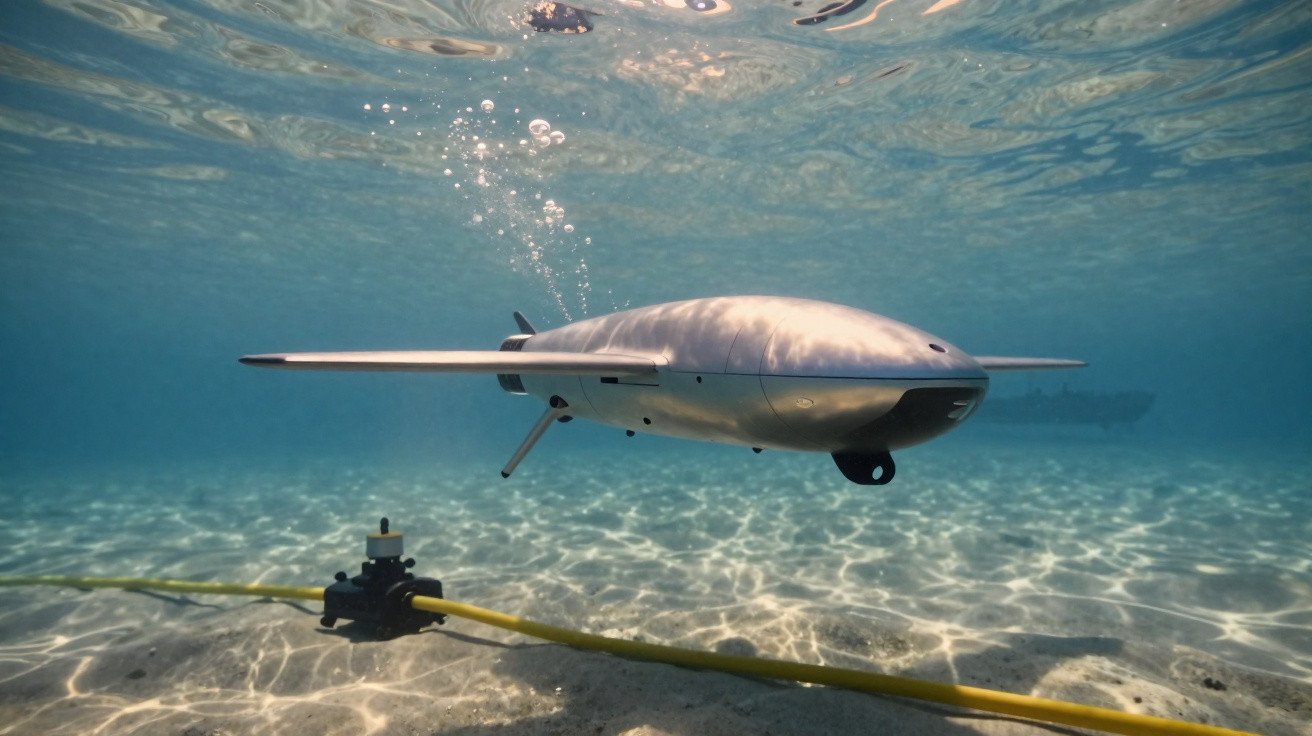
The countries behind the AUKUS agreement have recently announced the launch of their first Pillar II flagship project, focused on developing uncrewed underwater drones, with deliveries planned from 2027. Backed by Australia, the United States and the United Kingdom, the effort is intended to strengthen shared maritime capabilities for surveillance, reconnaissance, strike missions and the protection of critical undersea infrastructure.
AUKUS Pillar II flagship project for Uncrewed Underwater Vehicles (UUVs)
The announcement was made at the Shangri-La Dialogue in Singapore, where the three nations’ defence ministers (the US role being the Secretary of War) reaffirmed the need to speed up the development of advanced capabilities under AUKUS Pillar II. According to their joint statement, the programme will develop advanced payloads and enabling systems for Uncrewed Underwater Vehicles (UUVs), aiming to expand how all three countries can operate in complex maritime environments.
As set out in the official communique, these new systems are expected to enhance the protection of strategically important undersea infrastructure, enable advanced surveillance, reconnaissance and strike capabilities, and support logistics operations. They are also intended to reinforce advantage across anti-submarine warfare, anti-surface warfare, mine countermeasures, electronic warfare and manoeuvre in contested littoral areas.
US Secretary of War Pete Hegseth said: “the flagship project will deliver a set of highly adaptable, multi-mission payloads for UUVs, designed to support undersea operations and maintain our collective advantage in the maritime domain”.
UK Defence Secretary John Healey stated: “this will rapidly provide our forces with the most advanced combat technologies as we jointly produce a range of next-generation sensors and weapon systems for underwater drones”.
Healey added that uncrewed underwater vehicles will improve the three countries’ ability to respond to threats against critical infrastructure such as undersea cables and pipelines. He also acknowledged the need to accelerate delivery across the alliance’s planned projects, remarking that “for too long in AUKUS we have talked a lot and delivered little”.
Programmes that underpin the underwater drone co-operation
The work on underwater drones builds on existing initiatives among the three partners. These include the Autonomous Warrior exercise, conducted under Pillar II’s Maritime Big Play Initiative. In addition, the United States and Australia are already collaborating on capabilities linked to autonomous underwater vehicles through programmes such as Ghost Shark, based on development of Anduril’s Dive XL system, while the United Kingdom is progressing in parallel with Project Cetus and the Excalibur UUV.
Pillar I progress and the broader AUKUS context
The announcement came alongside an update on progress under AUKUS Pillar I, which is aimed at developing a nuclear-powered, conventionally armed submarine capability for Australia. The three governments confirmed that key milestones remain on track, including the creation in 2027 of the Submarine Rotational Force–West (SRF-West), intended to support the deployment and sustainment of submarines in Western Australia. It was also reported that Canberra is planning multi-billion-dollar investments in naval and logistics infrastructure to support the future operation of these assets.
Developments under both pillars sit within AUKUS’s strategic aim-established in 2021 by Australia, the United States and the United Kingdom-to drive the joint development of advanced military capabilities. As a recent precedent, Australia announced in February 2026 that it would purchase critical nuclear propulsion components from the United Kingdom worth 310 million Australian dollars for the future SSN-AUKUS submarines, whose reactors will be based on British technology with US technological and industrial support.





Comments
No comments yet. Be the first to comment!
Leave a Comment