
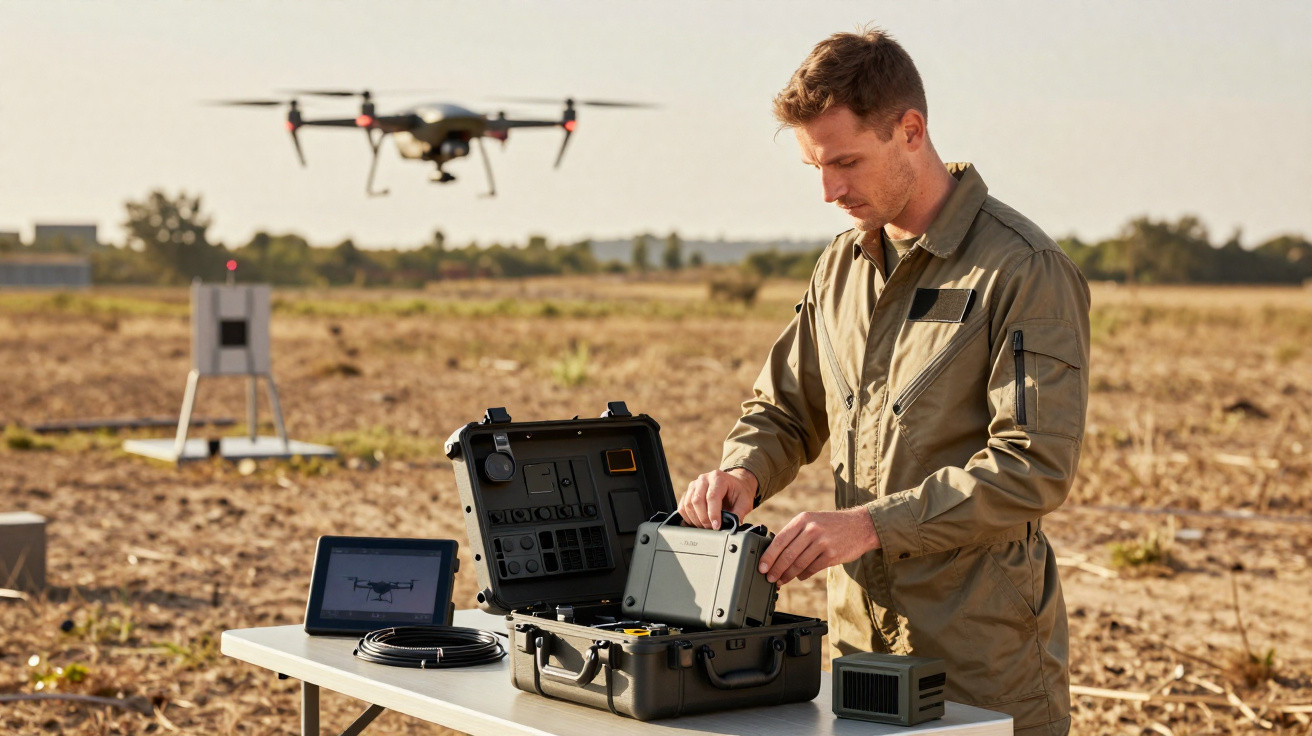
Rather than relying on special forces creeping up to enemy positions with handheld laser designators, a new French-built drone payload aims to project the beam from stand-off range - steering artillery rounds and missiles while keeping every operator out of harm’s way.
A drone that points, missiles that follow
At the heart of this change is MERIO, a French firm that has unveiled a lightweight laser designation system intended to be fitted straight onto drones. The idea reads simply, but its implications are anything but.
A compact unmanned aircraft can orbit high above the area or remain at a safe distance, then fix on a target using electro-optical and infrared sensors. Once tracking is established, the drone directs an invisible laser beam onto the aim point. Any compatible laser-guided bomb, artillery shell or missile can then steer towards that spot.
This drone-borne laser marker lets forces steer precision strikes while staying well outside enemy fire and without line-of-sight from the ground.
This removes one of the most hazardous battlefield roles: the forward observer who must get close enough to “paint” a tank, bunker or command post with a portable laser, often while under fire.
In this model, the observer can stay back at a command post, fly the drone via secure radio or satellite link, and approve a strike using live video and sensor feeds.
Solving the limits of traditional laser designators
Up to now, laser designation has mostly depended on either ground teams or fast jets - and both approaches bring major limitations.
- Ground teams have to infiltrate, stay concealed and keep the target in view.
- Crewed aircraft consume scarce flight hours, often require tanker support, and depend on safe air corridors.
- Weather, smoke and terrain can make laser designation unreliable or outright dangerous.
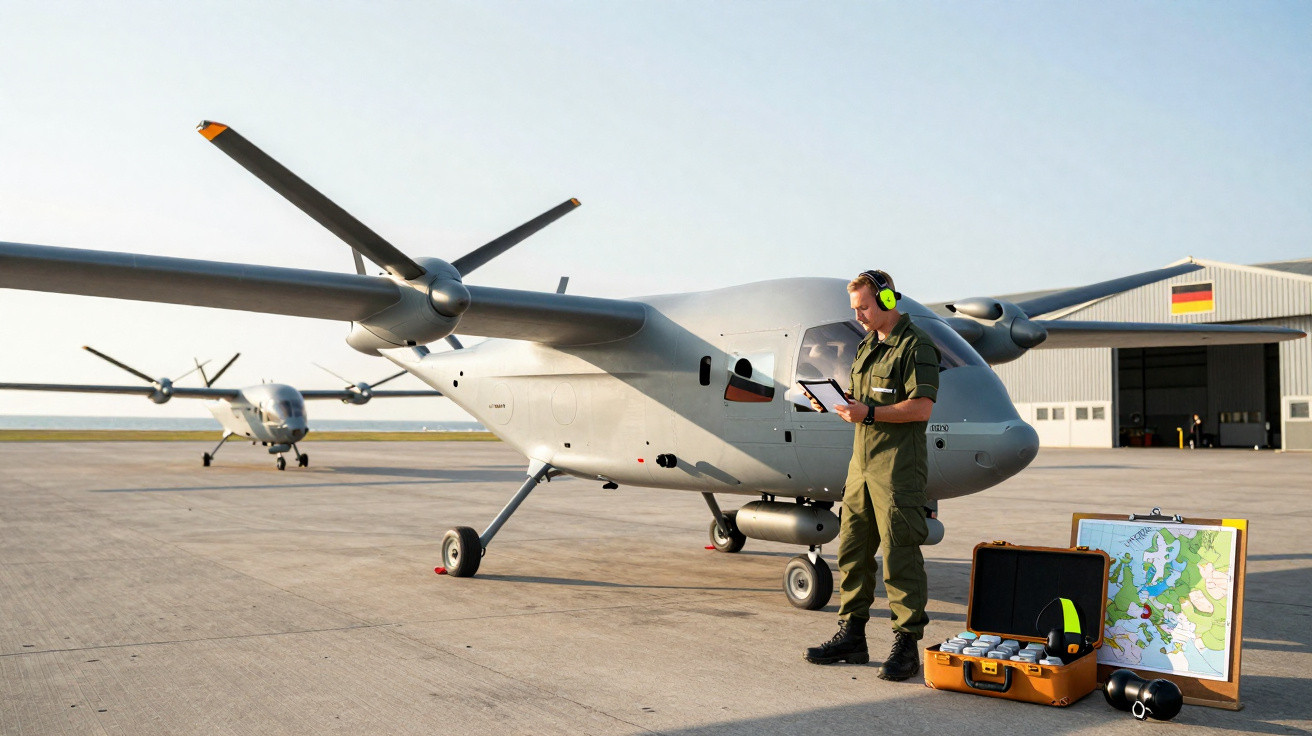
MERIO’s approach shifts that capability onto drones built to persist and, if necessary, be expendable. Because the system is modular, it can be installed on a variety of airframes - from small tactical UAVs operated at battalion level to larger medium-altitude, long-endurance (MALE) drones used across a theatre.
The concept reflects gaps highlighted in recent conflicts. In Ukraine, artillery duels have underlined the value of accurate target marking - and just how vulnerable spotters can be. In the Sahel, French and allied forces have faced huge, hard-to-reach areas where pushing troops forward simply to mark a single pick-up truck or compound is both slow and high-risk.
By lifting the laser onto a drone, European forces aim to keep their people out of kill zones while still hitting with metre-level precision.
Inside the Milvus payload: a compact targeting toolbox
MERIO’s answer centres on its Milvus optronic block: a stabilised sensor ball weighing under 6 kg. Despite its low mass, it combines capabilities more often associated with far larger targeting pods.
Key components of the Milvus system
| Function | Role |
|---|---|
| Electro-optical HD camera | Provides daytime high-definition imagery for identification and tracking. |
| Thermal camera | Detects heat signatures, enabling operations at night or through smoke and haze. |
| Laser rangefinder | Measures exact distance to the target for fire-control systems. |
| Laser designator | “Paints” the target for guided munitions to home in on. |
| 3-axis gyroscopic stabilisation | Keeps the aim rock-steady despite wind, turbulence or sharp manoeuvres. |
Together, these features let a drone hold a precise mark - on something as specific as a vehicle window, trench entrance or antenna mast - and keep it designated while the munition is in flight. That steadiness matters when the aircraft is being buffeted by poor weather or manoeuvring to avoid threats.
From Bordeaux trade show to the battlefield
This is not being pitched as a far-off concept. MERIO presented the system publicly in October 2025, using the UAV Show in Bordeaux as the springboard for a broader European push.
During the event, the company signed a strategic agreement with TEKEVER, a Portuguese-rooted manufacturer of ISR (intelligence, surveillance, reconnaissance) drones already fielded by several European states for maritime patrol and border monitoring.
The intention is to integrate the Milvus payload across multiple TEKEVER platforms, pairing MERIO’s targeting optics with established airframes and data links.
The French–Portuguese tie-up is framed as a step toward a more autonomous European strike chain, from sensor to shooter.
A tight but realistic schedule
Based on the timeline presented at the show, the programme is ambitious yet largely built around technologies that already exist.
- Public unveiling: October 2025
- TEKEVER agreement: October 2025
- Joint trials with French forces: starting January 2026
- Integration on TEKEVER ISR drones: second quarter 2026
- Deployable operational capability: targeted for late 2026
Because the payload draws on components that have been validated elsewhere, industry observers consider the milestones attainable - assuming military testing confirms performance in realistic conditions.
Designed for the next generation of conflicts
Modern wars point to a clear pattern: the side that can detect and strike faster gains the advantage. Precision, pace and protecting personnel increasingly outweigh mass alone.
MERIO’s concept aligns with that direction. The same payload can be mounted beneath a small tactical drone to support a company-level assault, or installed on a larger drone able to loiter for hours over contested ground. Planners can scale its use to match the intensity and duration of operations.
A civilian use case also exists. A stabilised, high-definition payload equipped with a laser can support disaster response, search and rescue, and monitoring of critical infrastructure - where accurate range data and imagery help teams act quickly while reducing risk.
Strategic autonomy: Europe’s quiet objective
Beyond the technology itself, the programme also carries a political signal. The war in Ukraine has highlighted Europe’s reliance on foreign-made sensors and munitions, particularly from the US and Israel.
By producing what it describes as a “100 percent sovereign” payload in France, while working with European partners on the drone side, MERIO is presenting itself as part of a broader drive for industrial independence. The company emphasises that the system avoids restrictive export licences and “black box” components that could be limited or switched off by third countries.
Control over targeting technology is turning into a strategic asset, not just a procurement line item.
If European nations can field domestically sourced sensors, drones and munitions, they gain greater freedom of action in crises where allies may hesitate or attach conditions.
How a laser-guided strike actually unfolds
To non-specialists, laser-guided weapons can sound almost mystical. In practice, the sequence is straightforward.
On the drone, the Milvus system chooses an aim point and continues tracking it. When a compatible bomb or missile is launched, a sensor in its nose searches for laser energy reflected off the target.
As it flies, the munition repeatedly adjusts its control surfaces to keep the strongest part of that reflection centred. This happens automatically, in fractions of a second. If the laser is interrupted, the missile loses its “beacon” and either switches to a fallback path or misses altogether.
The method is extremely accurate, but it still depends on line-of-sight. Thick cloud, heavy smoke or hard cover can break the laser link - which is why drones that can reposition quickly, and that carry multiple sensor modes, are appealing: they can move to re-establish the mark.
Benefits, risks and the bigger picture
The clearest gain for armed forces is reduced exposure. Instead of pushing special forces or forward observers deep into an urban maze, commanders can task a drone to provide the designation. Combined with modern artillery and air-to-ground munitions, that alters how long-range fire support can be employed.
Compromises remain. Drone-based designators rely on resilient communications and can be threatened by jamming or cyber interference. Opponents are already investing in anti-drone systems and electronic warfare designed to blind, confuse or deceive unmanned aircraft.
Ethical and political debate is also likely to sharpen. As greater distance is inserted between people and targets, questions grow around decision-making, accountability and whether easier strike options lower the threshold for using force. If rules and oversight are not robust, a system that simplifies the conduct of strikes can also make restraint harder.
For the moment, European militaries appear intent on closing the gap with - and in some areas challenging - capabilities long dominated by the US and Israel. A compact French sensor under a medium-sized drone may not look like a revolution, but when paired with precision artillery and missiles, and a doctrine built around remote designation, it subtly changes how conflict is planned and fought on Europe’s periphery.




Comments
No comments yet. Be the first to comment!
Leave a Comment