
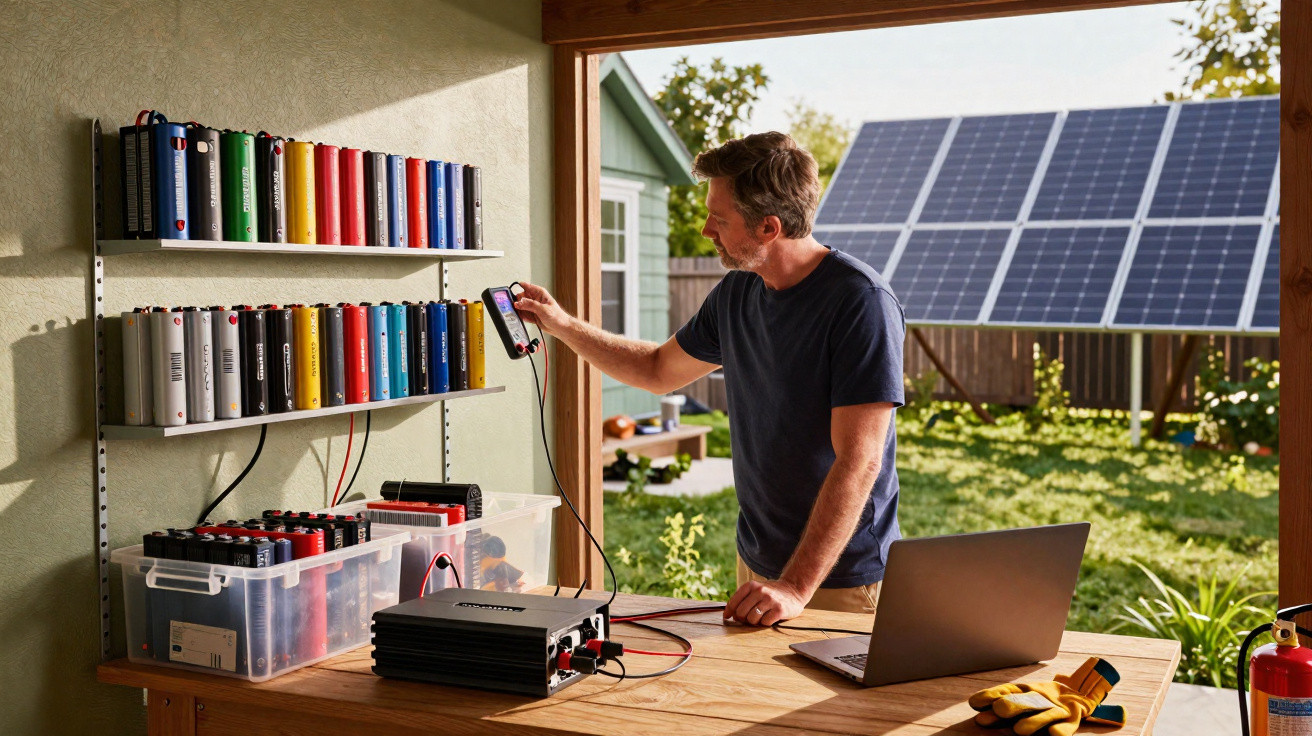
In an ordinary European village, an unassuming home has managed to live almost independently from the mains, thanks to a DIY setup taken to the extreme.
The person behind it is neither a big-company engineer nor a tech millionaire. Since 2016, he has relied on a home-built system made from hundreds of discarded laptop batteries to supply practically the entire house with self-generated electricity.
A backyard energy laboratory
The story begins with a mix of frustration and curiosity: an expensive electricity bill, environmental concerns, and an urge to experiment. Rather than fitting only a standard solar kit, the homeowner chose to go further and tackle a less visible issue: the mass disposal of laptop batteries.
He started gathering used packs-many labelled “dead” by repair shops and companies. Once he opened each unit, he found what most people never see: even when a whole battery is written off, a large share of the cells inside can still hold a decent charge.
Rejected by the market, these lithium cells were given a second life, turning electronic waste into a strategic energy reserve.
With near watchmaker-level patience, he stripped them down one by one, tested each individual cell, separated the usable from the faulty, and began assembling bespoke packs. At first, the system merely helped the solar panels cover night-time use. Over time, it became the home’s electrical core.
From electronic waste to a domestic micro power station
Once it was clear the approach worked, the project expanded. He already understood hybrid systems, having combined solar panels with an old industrial forklift battery. The laptop cells then became an extra layer-adding flexibility and increasing storage capacity.
Between 2016 and the years that followed, he amassed more than a thousand laptop batteries. From these, about 650 reclaimed cells were arranged into stable, monitorable modules and installed in a small shed roughly 50 metres from the house. That outbuilding effectively became his private “engine room”.
Today, the storage works alongside 24 solar panels rated at 440 W each, a setup that in total exceeds 10 kW of installed capacity. Power produced during daylight is fed into the battery modules, which then release electricity gradually overnight and on cloudy days.
Since 2016, the house has been supplied continuously by this homemade arrangement, and, according to its creator, not a single cell has needed replacing so far.
How the DIY engineering actually works
The trick is not simply piling up old batteries. The critical point is dealing with uneven ageing between cells. A used laptop battery typically contains sets with mismatched capacities and voltages-something that can undermine an entire bank if everything is connected indiscriminately.
To prevent that, he breaks down every pack and checks each cell using simple but dependable test equipment. He then groups cells with similar characteristics, avoiding combinations where heavily worn components sit alongside others that are still in excellent condition.
He chose to assemble the modules in tidy racks, using properly sized busbars and copper cabling to cut losses and limit overheating. The whole bank is run through charge controllers and inverters, which convert the batteries’ direct current into alternating current suitable for household appliances.
Basic stages of the home-built system
- Collect used laptop batteries from repair shops and businesses.
- Manually open the casings to reach the internal cells.
- Test every cell individually to assess capacity and safety.
- Sort by wear level and build them into modules.
- Connect the modules to the solar panels and the house wiring via inverters.
This takes time, concentration, and a working grasp of electronics and safety. It is not a beginner’s weekend project.
Environmental and financial impact of reused energy storage
This case poses an awkward question for the industry: how many batteries judged unusable still contain good cells waiting for a second application?
Electronic waste is growing worldwide, with millions of batteries thrown away each year. With laptops, many packs are replaced after a partial loss of runtime, not because every internal cell has failed. That gap is what makes reuse initiatives possible.
| Aspect | Discarded battery | Reused battery |
|---|---|---|
| Cost to the user | Buying a new part | Low or none, via collection |
| Common destination | Landfill or partial recycling | Energy storage system |
| Remaining usable life | Often underused | Several more years of additional use |
Financially, the savings build month after month. By cutting reliance on the grid, the homeowner has effectively neutralised the electricity bill over almost a decade. The main investment has been time, learning, and a handful of tools and components for testing, protection, and control.
What this experiment suggests for other countries
Where power is expensive or supply is unreliable, the concept becomes more relevant. Many parts of Latin America, including Brazil, deal with tariff swings, occasional blackouts, and a steady rise in electricity costs.
Projects like this highlight alternative routes: repurposing batteries from laptops, electric bicycles, scooters, and even out-of-service hybrid cars to create domestic or community-scale energy banks.
The core technology already exists: lithium cells, solar panels, inverters and controllers. The challenge lies in organisation, safety and access to information.
Although this European example is an individual effort, it aligns with larger initiatives such as “second life batteries” programmes used by car manufacturers to repurpose electric-vehicle packs for stationary storage.
Risks, precautions, and what non-experts need to understand
Working with lithium batteries is serious business. Short circuits can lead to fires, and damaged or swollen cells must be disposed of correctly-not reused. For anyone tempted to try something similar, safety has to come first.
Main risks when handling batteries
- Short circuits caused by poorly positioned metal tools.
- Overheating due to incorrect assembly or inadequate ventilation.
- Using cells that are damaged, swollen, or corroded.
- No protection systems to prevent overcharging and deep discharge.
Another key component is the BMS (Battery Management System). It tracks voltage, temperature, and balancing between cells. Without that kind of protection, an array containing hundreds of cells becomes a significant hazard.
From the outside, it may look like a clever “hack”. In reality, it involves plenty of calculation: cable sizing, protection via circuit breakers and fuses, proper ventilation in the shed, and planning around the home’s daily energy demand.
Practical directions for curious Brazilians
Rather than copying the project blindly, a more realistic route is to start small. Some enthusiasts build modest banks from reclaimed cells to run garden lighting, monitoring systems, internet routers, or other low-power equipment.
That sort of setup provides hands-on learning about:
- How to test and sort reclaimed cells.
- Series and parallel configurations, and how they affect voltage and capacity.
- How a battery behaves across daily charge and discharge cycles.
Another option is forming local energy co-operatives, where qualified technicians take on the demanding work of sorting and assembling cells, then supply ready-built modules to small rural producers, neighbourhood shops, or homes in remote areas.
As conventional energy costs rise and electronic waste volumes grow, the pairing of solar power with reclaimed batteries is likely to spread. This European homeowner’s experience shows that, with technical knowledge, planning, and respect for safety limits, what seems like a DIY workaround can become a model for a new phase of household energy independence.






Comments
No comments yet. Be the first to comment!
Leave a Comment