
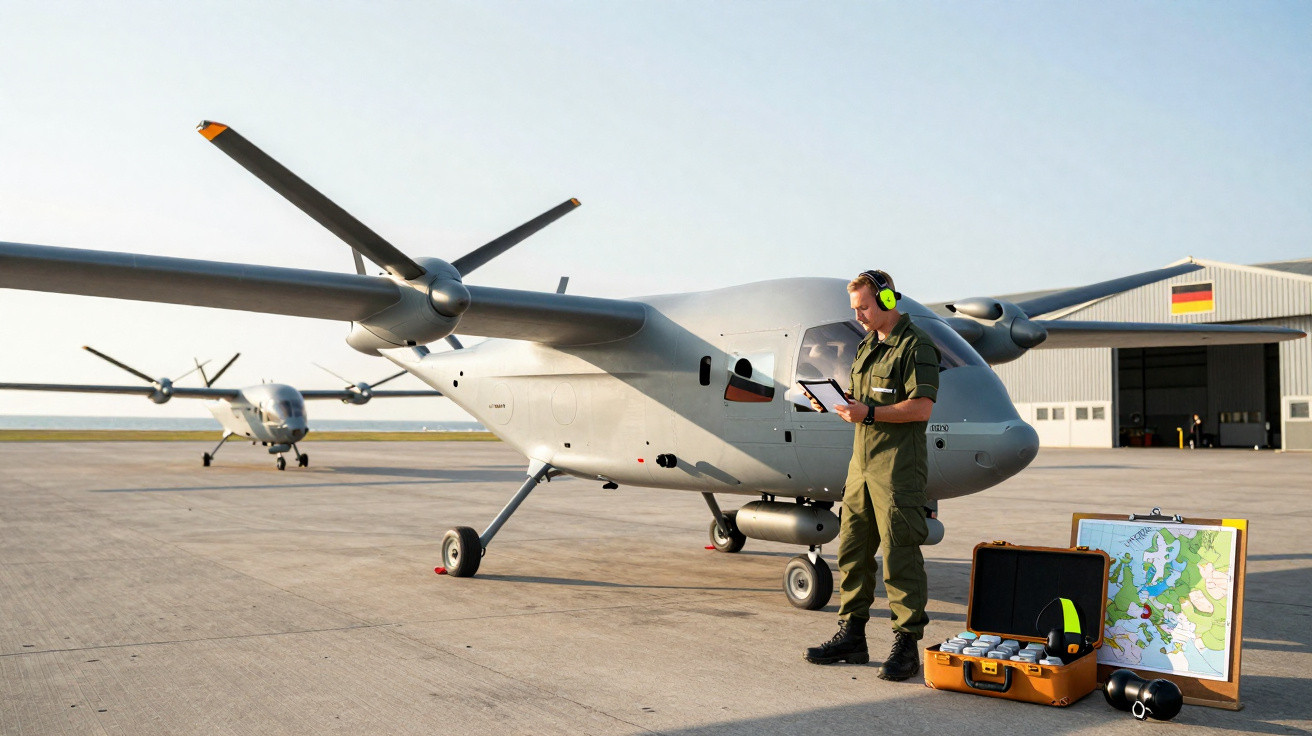
Berlin’s latest move points to a different way of watching the seas: fewer crewed patrols, more always-on sensors, and tighter alignment with NATO allies that already rely heavily on advanced unmanned aircraft.
Germany seals €1.52 billion contract for maritime drones
Germany has placed an order for eight MQ-9B SeaGuardian drones from US supplier General Atomics Aeronautical Systems in a €1.52 billion agreement. The purchase was channelled through the NATO Support and Procurement Agency, approved by the German parliament’s budget committee in mid-December, and then disclosed publicly soon afterwards.
The contract includes four full SeaGuardian systems, with each system made up of two aircraft plus its own ground segment. In addition, Germany is set to receive four ground control stations built to demanding certification requirements, allowing the drones to operate safely in airspace shared with civil aviation.
The first SeaGuardian deliveries are scheduled for 2028, giving the German Navy a new long-range surveillance tool by the end of the decade.
Within the German Navy’s aviation arm, Marineflieger, the plan is to station the drones at Naval Air Wing 3 “Graf Zeppelin” in Nordholz, a major maritime aviation location on the North Sea coastline.
Focus on Baltic and North Atlantic tensions
German officials describe the SeaGuardian buy as a response to a shifting security picture in northern European waters. In recent years, both the Baltic Sea and the North Atlantic have experienced increased Russian activity, from submarine deployments to questionable movements by ostensibly “civilian” vessels.
A particular concern in Berlin is the vulnerability of seabed infrastructure. Pipelines, electricity cables and data connections run across the sea floor, and several European governments fear that an adversary could disrupt these links during a crisis or as part of hybrid activity.
The drones are expected to monitor Russian naval movements and help guard vulnerable energy and data infrastructure beneath the waves.
Alongside the procurement, the German government is pursuing a campaign aimed at what it calls the Russian “shadow fleet” of oil tankers, which it alleges helps Moscow circumvent EU sanctions and finance the war in Ukraine. Stronger maritime situational awareness sits at the heart of that political push.
How SeaGuardian fits into Germany’s naval toolkit
SeaGuardian is intended to add to, not displace, Germany’s crewed maritime patrol capability. The Navy is assembling a fleet of eight Boeing P-8A Poseidon maritime patrol aircraft, and the first aircraft arrived in 2025. In concept, the two types are designed to cover different parts of the overall surveillance task.
- P-8A Poseidon: crewed platform, heavily equipped for anti-submarine warfare and strike missions
- MQ-9B SeaGuardian: uncrewed platform for persistent surveillance and reconnaissance across wide areas
- Surface ships and submarines: close-range tracking, interdiction and deterrence
By operating drones alongside crewed aircraft, Germany aims to maintain coverage over vast sea spaces for extended periods without overworking aircrews or using expensive jets on lower-intensity patrol duties.
What the SeaGuardian can actually do
SeaGuardian is the maritime version of the MQ-9B family and is built for lengthy sorties at long range. General Atomics markets it with an endurance of more than 30 hours and a mission radius of roughly 2,200 kilometres (around 1,200 nautical miles). From a single base on the coast, that reach would allow the German Navy to watch large stretches of the Baltic and the North Atlantic.
The aircraft can be configured with a sensor suite optimised for maritime tasks. Germany is expected to use:
- maritime surveillance radar to find ships and small craft
- electro-optical and infrared cameras to confirm identities visually
- anti-submarine warfare mission kits, including sonobuoys
- secure datalinks to share information in real time with ships and aircraft
For cold-weather operations, the airframe includes a de-icing system. It also features satellite communications described as enabling “pole-to-pole” control, meaning the aircraft can be flown and managed over long distances via satellite links.
Germany plans to use the drones primarily for reconnaissance at first, while retaining the option to expand into full anti-submarine missions later.
Anti-submarine potential
With the appropriate mission kits, SeaGuardian can be adapted for unmanned anti-submarine work. The kits can carry up to 40 “A”-size or 80 “G”-size sonobuoys-floating sensors that detect submarine activity and send acoustic information back to operators.
At present, Berlin’s priority is intelligence, surveillance and reconnaissance. That includes following ship movements, observing choke points and building a near-continuous picture of activity at sea. The anti-submarine mission could expand later as methods develop and cooperation with P-8 Poseidons becomes more established.
Interoperability with NATO partners
Germany’s selection of SeaGuardian closely tracks what allied forces are already operating. The MQ-9B family is becoming more common across Europe, creating shared experience as well as compatible data formats and operating procedures. UK and Belgian forces already fly the type, and Poland has signed its own deal for MQ-9B SkyGuardian systems.
| Country | MQ-9B variant | Main role |
|---|---|---|
| Germany | SeaGuardian | Maritime surveillance and anti-submarine warfare |
| United Kingdom | Protector RG Mk1 (MQ-9B) | Intelligence, surveillance and reconnaissance |
| Belgium | MQ-9B | ISR and support to NATO missions |
| Poland | SkyGuardian | Border and regional security operations |
A larger shared fleet supports joint training, aligned maintenance approaches and coordinated patrols over common operating areas such as the Baltic. It also eases mission planning with the US Navy and other P-8A users, because SeaGuardian and Poseidon are designed to integrate within NATO-standard networks.
Berlin sees common drones as a way to plug directly into allied surveillance grids rather than building its own isolated system.
Operating in civilian airspace
One of the most significant aspects of the German package is on the ground. The four ground control stations are described as “certifiable”, meaning they are engineered to comply with European safety requirements that enable unmanned aircraft to operate alongside commercial traffic rather than depending solely on restricted corridors.
SeaGuardian is equipped with a Detect and Avoid system intended to identify other aircraft and reduce the risk of mid-air collisions. Together with certified ground infrastructure, this could enable routine transits through congested European airspace to reach patrol boxes, rather than needing segregated airspace for every sortie.
Why long-range drones matter at sea
Maritime surveillance now extends well beyond the hunt for hostile warships. It also covers sanctions-busting, illegal fishing, smuggling and environmental hazards such as oil spills-areas where long-endurance drones can contribute significantly.
A single SeaGuardian can remain over a shipping corridor for more than a day, recording vessel movements and helping establish patterns of life. If something abnormal occurs-such as a ship disabling its transponder-the aircraft can stay overhead and deliver live feeds to analysts and decision-makers on shore.
Replicating that persistence with crewed aircraft is difficult because of crew fatigue and higher operating costs. Drones can also be surged during periods of tension, adding coverage without immediately drawing pilots away from other tasks.
Potential scenarios in European waters
German officials are already considering specific missions for the drones once they enter service. Probable scenarios include:
- tracking the Russian “shadow fleet” across the Baltic and North Sea, monitoring tankers suspected of attempting to evade sanctions enforcement
- surveying seabed infrastructure routes, watching for unusual surface or sub-surface activity around pipelines and cables
- supporting search and rescue by expanding search patterns and directing rescue vessels towards people in distress
- assisting customs and border agencies in identifying vessels linked to smuggling or trafficking
In an anti-submarine setting, a SeaGuardian could deploy sonobuoys to cover an area, transmit contact information to a P-8 Poseidon or a frigate, and then remain overhead as a communications relay while crewed forces close in.
Key terms and risks behind the technology
Some programme terminology is worth clarifying. “Interoperability” refers to German drones being able to exchange data, use compatible radio standards and apply shared tactics with NATO forces without elaborate workarounds. “Certifiable” ground control stations are those designed to meet aviation safety rules comparable to those applied to airliners, allowing regulators to approve routine operations.
The capability also brings risks and compromises. Persistent surveillance can generate vast volumes of data, increasing the need for trained analysts and more capable software to identify what matters. Long-range drones can also be exposed to electronic warfare, including jamming and attempts to compromise datalinks, particularly in contested areas close to Russian territory.
Domestically, drones that are armed-or could be armed-remain politically sensitive in Germany. Even if SeaGuardian begins as an unarmed sensor platform, debate about future tasking and possible weapon integration is likely once the system is established and crews gain experience.
For now, the SeaGuardian purchase highlights a wider shift: Germany is increasingly treating the Baltic and the North Atlantic as front-line security theatres rather than simply heavily used shipping lanes. Long-endurance uncrewed aircraft, built around shared NATO standards, are becoming central to that approach.





Comments
No comments yet. Be the first to comment!
Leave a Comment