
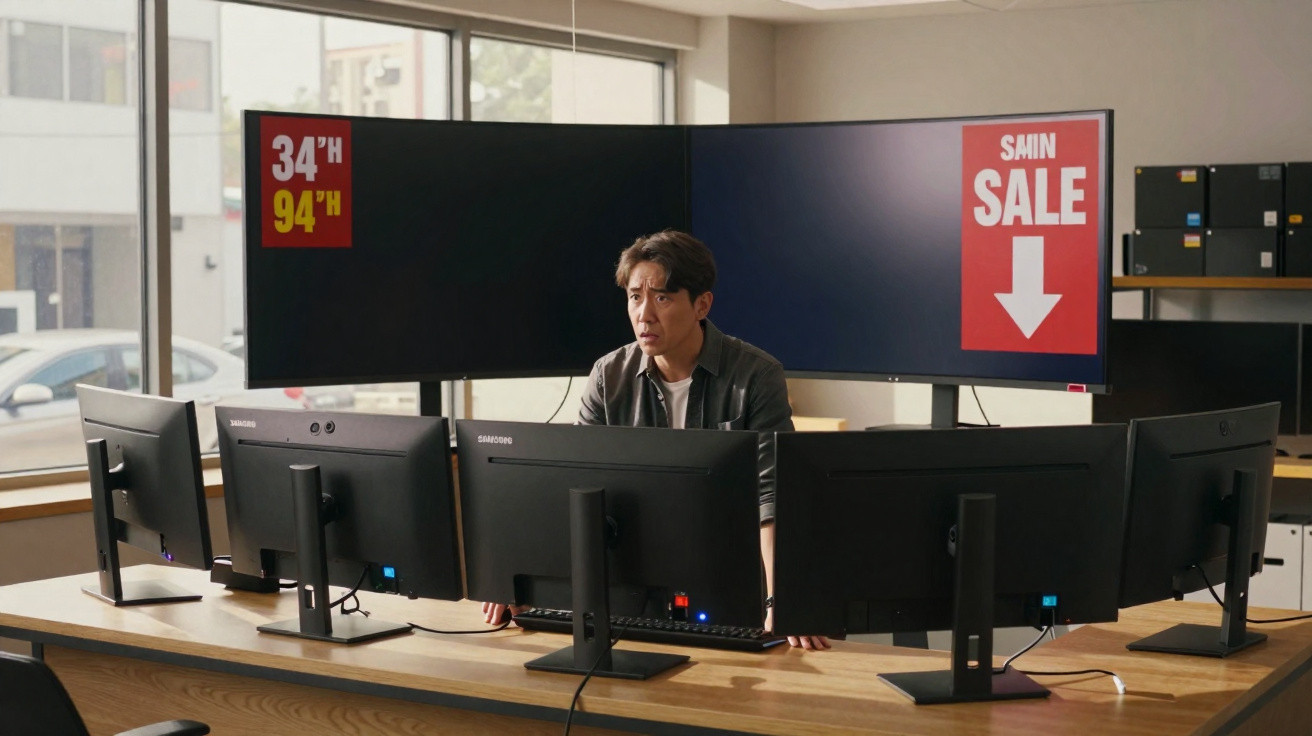
The email landed with the urgency of a flash-sale alarm: “Samsung Odyssey G5 34” at a price that looked like someone had typed it wrong. On Reddit, people were hammering refresh on the checkout page with unsteady hands, half-expecting the deal to disappear mid-click. Over on Discord, one person quipped that buying from a smaller brand now felt more like charity than a genuine tech decision.
At the same moment, a French indie monitor maker published a blunt, frustrated post: “We can’t compete with this. Not even close.” Others quickly followed with claims of dumping, accusations of predatory pricing, and a growing feeling that the ultra-wide market was being squeezed from the top.
The reductions kept coming. So did the arguments.
This flash sale seemed to signal something beyond a normal promotion.
When a bargain stops feeling like a bargain
Spend five minutes in any tech forum this week and you’ll see the same image shared again and again: the Samsung Odyssey G5 34-inch ultra wide reduced to a figure that undercuts a huge slice of the category. Not by a few pounds, but by a vast gap. Some posters boast about piling on vouchers and cashback to push it even lower, treating it like a challenge they’ve beaten.
Others read the replies and feel their stomach tighten. Because that kind of promotion doesn’t merely seem bold - it seems deliberate.
On a German price-tracking website, the G5 34’s graph looks like a rollercoaster that abruptly drops off a cliff in late January. One day it sits among the mid-range ultra wides; the next it’s priced where the budget brands used to sit, alongside the names you mostly encounter in Amazon flash deals.
A small UK reseller told me they shifted fewer than ten units of their top-selling 34-inch model in the week Samsung’s discount took off. “We can’t even get close to the panel cost at that promo price,” they said. “Either Samsung’s losing money on this, or someone in accounting has gone mad.”
That’s the context for the dumping claims. In trade law, dumping is a serious allegation: selling below cost to suffocate competitors and capture market share. Proving it legally can take years, access to detailed accounts, and real political appetite. On social media, it often takes just one viral post and a punchy headline.
More than anything, people are reacting to the imbalance. Samsung can run a “crazy sale” for a quarter and absorb the margin hit across multiple regions. A five-person monitor brand in Spain can’t. A local shop renting a small warehouse can’t. This is the point where the discount stops looking like a straightforward promo and starts resembling a pressure tactic.
Behind the cart: what to do when giant discounts distort your choices
If you’re sitting with your cursor hovering over “Buy now” on the Odyssey G5 34, one practical approach can help you cut through the noise. Start by writing down how you will actually use the monitor: gaming, spreadsheets, video editing, watching content. Not the fantasy scenario - the realistic one. Then choose three priorities for that use in everyday language: for example, “no eyestrain”, “smooth motion”, “fits on my desk”.
With that list in front of you, compare the G5 not to its promotional price, but to two or three alternatives with broadly similar specifications. You’re not scoring the size of the discount; you’re testing whether the monitor still makes sense when the hype is stripped away.
Many people miss this step and end up with a huge screen that doesn’t quite suit their routine - or their office - or their graphics card. Most of us have experienced that feeling when the massive box turns up and you realise you bought the spec sheet rather than the day-to-day experience.
Check the warranty conditions, the panel type, commonly reported problems such as ghosting or flicker, and how reliable the brand is with firmware updates. After that, spend ten minutes seeing whether a smaller brand offers the same comfort - perhaps with fewer extras, but with stronger local support. And let’s be honest: despite the marketing, hardly anyone calibrates their monitor every single day.
Even amid the promotion frenzy, some shoppers are trying to be more intentional. An indie game developer I spoke to in Poland described it like this:
“I know Samsung can buy prime placement, billboards, everything. Those smaller brands can’t. If I always go with the cheapest big name during these crazy sales, I’m voting for a future where there are only three logos left on the shelf.”
They follow a simple guideline they call the “split ticket”:
- One major-brand screen when the value is truly exceptional
- One purchase from a smaller or regional brand when specs are comparable
- Never buying only on discount size, always checking real use cases
- Avoiding impulse buys during 24-hour “panic” flash deals
- Spending five minutes reading small-brand owner reviews, not just big-name hype
It won’t remove the pressure from the market overnight, but it’s a reminder that your basket isn’t neutral. Each purchase slightly nudges where the monitor market goes next.
A sale that exposes more than just the price
The Samsung Odyssey G5 34 ultra wide discount has become more than a gaming bargain. It has turned into a stress test for how we feel about tech giants, local resellers, and the unwritten expectations around “fair competition”. Some buyers shrug and say the market is ruthless and the strongest should survive. Others counter that when one brand can cut prices so far, so quickly, the playing field may already be slanted.
Reality is probably somewhere in the awkward middle. Large firms do have more freedom to sacrifice margin, clear stock, or temporarily flood a segment. Smaller brands are often more vulnerable, more personal, and more exposed to one quarter of poor figures. At the same time, those smaller players can benefit from the competitive pressure a giant like Samsung creates, which pushes panel quality and refresh rates forwards.
What this debate really highlights is a contradiction in us as buyers. We want the lowest price today, yet we also claim to want plenty of choice tomorrow. We like supporting the underdog - then we close the tab and order the safest big-name option because it’s on a fire sale. Some people will buy the G5 34 and love it, getting a genuinely solid monitor for a startling price. Others will look at local shops and niche brands and wonder how many more “mega promos” they can withstand.
No one can say yet whether regulators will ever take interest in this particular case, or whether it will simply end up as another spike on a price chart. What is clear is that each wave of ultra-aggressive discounting leaves a trace - on margins, on competition, and on that quiet sense of what feels fair when you’re browsing for tech late at night with a credit card within reach.
| Key point | Detail | Value for the reader |
|---|---|---|
| Odyssey G5 34 deep discount | Massive price cut positioning a major brand at near budget-level pricing | Helps you judge if the bargain fits your real needs, not just your fear of missing out |
| Pressure on smaller brands | Local and indie monitor makers say they can’t match promo pricing without losses | Gives context so you can weigh price against long-term market diversity |
| Buyer strategies | Compare on use cases, not just discount size, and consider splitting support between big and small brands | Lets you feel more in control of your tech purchases in an uneven market |
FAQ:
- Is Samsung really dumping the Odyssey G5 34 below cost? Only Samsung’s internal accounting can answer that for sure, and trade authorities would need detailed data to prove dumping legally. What’s clear is that the promo price looks unusually low compared with typical margins in the ultra-wide segment, which is why accusations are surfacing.
- Is the Odyssey G5 34 still worth buying at full price? At its regular price, the G5 34 competes with a wider range of strong rivals, including smaller brands with good panels and support. The value then depends on what you prioritize: brand ecosystem, warranty, and resale value versus potentially better calibration or support from niche players.
- Should I feel guilty buying it on sale? You’re not responsible for Samsung’s global pricing strategy. Your job as a buyer is to align your purchase with your budget, needs, and values. If this monitor genuinely serves you for years, that stability also has its own quiet value, regardless of the controversy.
- Are smaller monitor brands really at risk from this kind of promo? Some already operate on thin margins and rely on steady, mid-range pricing to survive. An ultra-aggressive promo from a giant can temporarily siphon off demand, especially among price-sensitive buyers, which can hurt their cash flow for that quarter.
- How can I support fair competition without overpaying? Compare products on real-world use, not only on who sliced the most off the RRP. Sometimes the best move is to mix: grab a major-brand deal when it truly fits you, and on your next purchase, give a serious look to a well-reviewed smaller or regional brand that’s playing by the same rules, just with less firepower.

Comments
No comments yet. Be the first to comment!
Leave a Comment