
Same sun sinking, same cliff edge, same briny gusts hitting our cheeks. When the sky burst into orange and magenta, we both hammered the shutter as if it were urgent. Moments later he squinted at his display, pinched to zoom, and let out a disappointed sigh. I zoomed in on my shot and couldn’t help smiling.
He looked across. “What camera is that?”
I told him. He gave a small nod-half envy, half genuine interest-the familiar look you see when you realise your kit is starting to hold you back. The distance between a “nice photo” and a “that looks like a film still” has seldom felt bigger.
In 2025, mirrorless cameras sit right in that space. They’re more than mere gadgets. They’re what lets you aim higher with what you shoot.
The best mirrorless cameras in 2025: where the magic actually happens
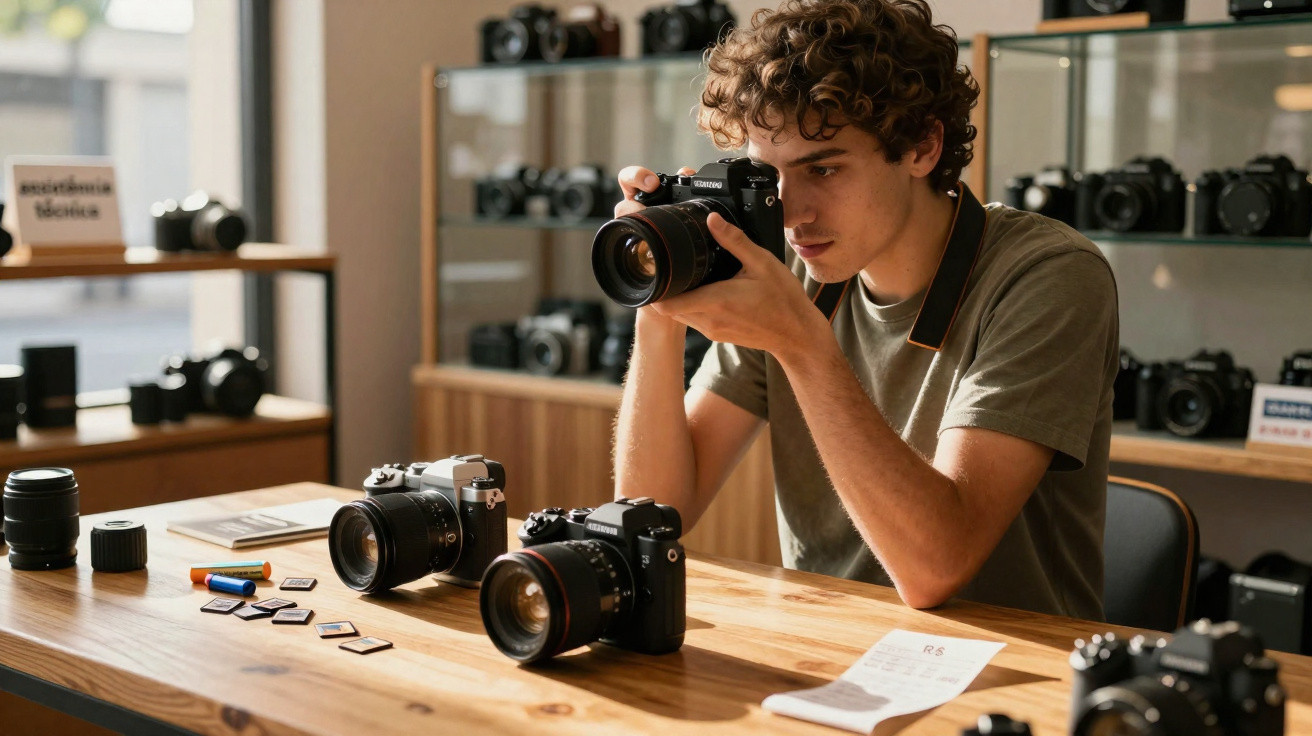
Step into a camera shop in 2025 and the mirrorless section looks like a sweet aisle designed for adults. Sony bodies with chunky grips and autofocus that feels straight out of science fiction. Canon hybrids capturing 8K video as though it’s routine. Nikon and Fujifilm delivering those colours that look right the moment you review the shot. Pick one up and, somehow, your hands can already guess where the controls should sit.
Beneath the noise of specs and launch headlines, one question keeps buzzing: “Which one will make my photos look like the ones I save on Instagram?” That’s the real reason the best mirrorless cameras matter. They’re not only about more megapixels; they increase the odds of coming home with sharp, emotional, genuinely usable frames in awkward, everyday light.
A few standouts are already shaping the year without much fuss. Sony’s A7R V suits anyone chasing outrageous detail plus AI autofocus that clings to eyes like a magnet. Canon’s EOS R5 Mark II brings smoother 8K workflows and a rolling shutter that’s kinder to hybrid shooters. Nikon’s Z8 and Z9 deliver near-flagship performance in bodies you can actually carry around. And Fujifilm’s X-T5 and X100VI keep winning people over with film-like colour and those physical dials that make you want to shoot. Each of these cameras answers the same question in its own way: when you press the shutter, what matters most to you?
How to actually choose: specs are loud, your needs are quiet
The part few people say out loud is this: the best mirrorless camera in 2025 usually isn’t the absolute “top of the line”. It’s the model that fits how you actually work. If most of your photos are of children racing around a dim lounge, lightning-fast autofocus and strong high-ISO performance will beat 60 megapixels every time. If you’re often on the move, carrying comfort can matter far more than 8K modes you’ll almost never touch.
Begin with three straightforward prompts: What do you photograph 80% of the time? How often do you print, and at what size? How much weight can you realistically carry before the camera starts staying at home? Answer those honestly and most “best of” lists collapse into a short set of bodies that fit your life.
A real example makes it clearer. A reader emailed me last spring: two small children, a dog, and a compact flat with awful light. They were convinced they “needed” a top-end full-frame Sony because a YouTuber insisted on it. We walked through the reality instead. Nearly everything went to WhatsApp, with a handful of prints destined for frames in the hallway. No paid work, no massive billboard output. I steered them towards a mid-range APS-C body paired with a fast prime around a 35 mm equivalent.
Two months later, they sent a photo of their child mid-jump on the sofa-frozen, crisp, eyes bright. That setup cost less than half of the “dream body” they’d been eyeing, and it lived on the coffee table rather than in a drawer. That’s what spec sheets never show you: whether a camera is easy to keep close to your everyday life.
The wider market is moving in the same direction. Mid-tier mirrorless bodies are selling faster than ultra-high-end flagships. People are realising that a smartly chosen $1,500 kit can outperform a poorly chosen $4,000 setup in normal, day-to-day shooting. In user surveys, the features people truly praise aren’t always the headline-grabbers. They talk about dependable human/animal eye AF, batteries that last a full wedding or a long hike, and menus that don’t make you want to launch the camera into the nearest river.
There’s a simple reason for it. Once you cross a certain baseline of image quality, comfort and trust take over. If the camera focuses correctly more often, wakes quickly, and feels natural in your hands, you start attempting bolder angles, darker scenes, and faster action. That willingness to experiment is where your best photographs come from. A body that’s “perfect on paper” but intimidating will lose that fight every weekend.
Practical choices: what to look for, what to ignore, what to forgive
Put the marketing noise to one side. When you’re at the shop counter-or scrolling an online listing in 2025-use a simple, practical approach. First, choose an ecosystem: Sony, Canon, Nikon, Fujifilm, and possibly Panasonic if video is your priority. Don’t assess bodies alone; check the lens line-up and typical prices too. Over time, lenses are where the real spending happens.
Next, focus on four fundamentals: autofocus, low-light performance, ergonomics, and lenses. The rest is mostly nice-to-have. If you shoot children, sport, wildlife, or street work, autofocus rules. For travel, weight and stabilisation rise up the list. For portraits, skin tones and lens availability do the heavy lifting. A couple of hours handling cameras properly in a shop teaches you more than weeks of scrolling through spec tables.
On a personal level, the trap I see most is the “guilt purchase”. Someone spends a lot on a flagship body thinking, “This will make me shoot more.” It rarely plays out that way. If the camera is heavy, fiddly, and costly enough to make you nervous, it quietly stays on the shelf. Let’s be honest: nobody really keeps that up every single day.
Another common misstep is treating resolution as if it’s a personality trait. Massive files slow your computer, fill your drives, and won’t fix shaky composition. For most people in 2025, 24–33 megapixels is a genuinely ideal range: enough room to crop, plenty for large prints, and far less painful on storage. The goal is simple: you want a camera that behaves like an extension of your eye, not a technical test you keep failing.
One professional photographer summed it up in a way I’ve never forgotten:
“The best camera of 2025 is the one that still feels fun after a long, bad day. If I pick it up and my shoulders drop a little, that’s the one I keep.”
To make this more actionable, here’s a quick “cheat sheet” you can take into a shop-or your next late-night Google spiral:
- If you love detail: Consider high-resolution full-frame bodies, but match them with fast primes rather than relying only on a kit zoom.
- If you love video: Put your money into clean 4K at 60p or 120p, with controlled rolling shutter and sensible heat management.
- If you love travel: Choose lighter gear; a compact body with a flexible zoom will beat a huge rig you leave behind.
- If you’re on a budget: Spend more on one excellent lens and a bit less on the body; sensors age, glass doesn’t.
So, which mirrorless should you actually get in 2025?
There isn’t a single champion-and that’s what makes the choice interesting. For some people, the best mirrorless in 2025 is the Sony A7 IV (or the model that replaces it): well balanced, dependable, backed by a deep lens ecosystem, and excellent at autofocus. For others, the Canon R6 Mark II is the answer: forgiving, lovely colour, and a true workhorse for families and events. If your world is fast reportage or sport, Nikon’s Z8 can feel like the first body that finally keeps pace with your instincts.
Then come the decisions driven more by feeling than raw power. The Fujifilm X100VI, for example, isn’t the most “powerful” option on a spec sheet. Even so, for many street and travel photographers it becomes a second brain. They take it everywhere-over a shoulder alongside keys and headphones-and they capture moments they’d have missed with bulkier kit. That tiny change in habit can mean thousands more frames each year. Hidden among those frames are the photographs that end up meaning everything to you, or to someone you care about.
Most of us have had the experience of scrolling back through our phone and noticing whole stretches of life are missing-or reduced to dark, blurred snapshots. The purpose of searching for “the best mirrorless camera in 2025” isn’t to win a spec argument. It’s to lose fewer moments. A camera you trust gives you a bit more nerve to raise it, a bit more calm when light is poor, and a few more keepers when the sun is fading, the kids are tired, and the dog has stopped co-operating.
Perhaps the best mirrorless, in the end, is the one that helps you become slightly more like the person you want to be when you look through the viewfinder: more present, more observant, a touch braver with strangers, and a little more patient at home. You’ll never find that in a spec chart, but you recognise it in your chest during the first week with the right camera. Quiet as it is, that feeling tends to outlast the newest firmware update.
| Key point | Detail | Why it matters to the reader |
|---|---|---|
| Choose the ecosystem before the body | Compare Sony, Canon, Nikon, Fujifilm, Panasonic and, crucially, their lens ranges | Stops you getting stuck with limited lens choice or inflated prices |
| Prioritise autofocus, ergonomics, low-light | Push secondary specs (8K, niche modes) into the background | Raises your hit rate in real life, not just on paper |
| Invest in quality lenses | In most cases, a great lens on a mid-range body beats the reverse | Longer-lasting spend, more flattering look, more “pro” feel |
FAQ:
- What’s the single best mirrorless camera in 2025? There’s no universal winner for everyone. For most people, a mid-range full-frame body such as the Sony A7 IV or Canon R6 Mark II delivers the best balance of capability, cost, and lens choice.
- Should I go full-frame or APS-C? If you often shoot in low light, want shallow depth of field, or plan to work professionally, full-frame can help. If you prefer smaller, lighter, less expensive kit, APS-C options from Fujifilm, Canon, or Sony are often the more sensible route.
- How many megapixels do I really need? For online sharing and prints up to A2, 24–33 MP is more than enough. Only go higher if you crop heavily, shoot commercial work, or print very large.
- Is 8K video worth paying for? For most creators, not really. Day to day, clean 4K at 24/30/60p with strong autofocus and manageable file sizes matters more than an 8K headline.
- Should I upgrade my camera or buy a new lens? If your current body is under 5–6 years old, adding a sharp prime lens often improves real-world image quality more than replacing the body.




Comments
No comments yet. Be the first to comment!
Leave a Comment