
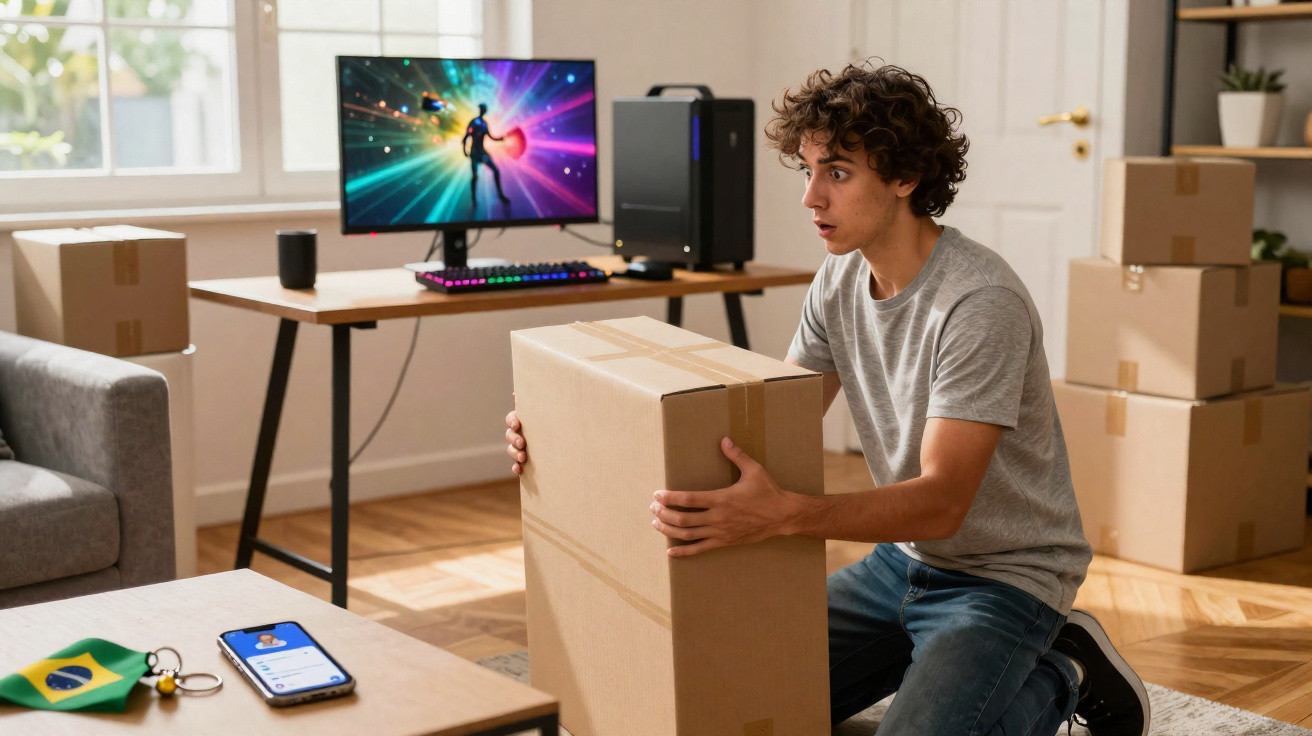
The tracking status had only just switched to green when the doorbell went. Sam - a 27-year-old gamer who’d refreshed the Amazon app roughly 40 times that morning - practically stumbled on the way to the front door. On the doormat sat a large brown box with that familiar smile, exactly the size he expected for the OLED monitor he’d been saving for. He felt a quick surge of triumph… until he spotted something off.
Tucked behind the first parcel was a second one - same size, same branding - with his name and address printed perfectly. Same order ID. Same product. Two OLED monitors, a single receipt.
He froze in the doorway, one box in each hand. The driver had already disappeared, and his thoughts were quietly buffering.
Was this a lucky break - or the beginning of a long, messy problem?
When one OLED turns into two: the gamer’s strange delivery day
Sam didn’t feel like he’d outsmarted anything. If anything, he felt uneasy. He’d pushed his finances to grab this 68.6 cm (27-inch) OLED during a promotion, swapping nights out for months just to make it work. In his mind, receiving a second unit wasn’t a cute packing error - it looked like an impending customer-service saga. He opened the first box with slightly trembling hands, lifting away the protective foam as if it were Christmas morning and a tax deadline rolled into one.
The display was spotless and exactly as advertised: inky blacks, a razor-thin profile, and that unmistakable new-electronics scent only proper tech obsessives recognise. Meanwhile, the second box sat in the corner like evidence he wasn’t sure he wanted to admit existed.
Most people know that moment: a small, unexpected win drops into your lap, and you start bargaining with your own conscience. Between two game queue pops, Sam kept glancing at that spare box, trying to work out who’d actually made the mistake. Amazon’s logistics? A warehouse picker? A system hiccup? Reddit is full of “double delivery” threads where people compare both their luck and their morals like they’re swapping trading cards.
Some posters boast about keeping everything. Others insist they returned the extra out of principle - sometimes even paying costs themselves. The reality is untidy and human, and rarely as straightforward as a terms-of-service page makes it sound.
Legally, for the average customer, the situation can be unexpectedly murky. In plenty of countries, unsolicited goods can’t be forced back on the recipient - especially if you never asked for them. But large platforms operate in a grey area, with automated processes that often decide on a case-by-case basis what’s worth doing. Sometimes, writing off an extra parcel costs less than pulling it back into the returns machine. Sam didn’t know any of that when he opened the Amazon chat window.
He only knew one thing: if he stayed quiet and it was flagged later, he worried Amazon might lock his account or mark him as a scammer. For someone who buys almost everything online, that felt more painful than losing a second monitor.
What actually happens when you try to return a free extra
Sam began in the obvious place: “Return or replace items” on the order page. Only one monitor appeared. There was no second line item, no duplicate entry, nothing hidden. He even tried scanning the label on the second box with the app, hoping it would magically link itself. Still nothing. So he hit “Chat with us”, bracing for a long, robotic exchange - the sort that makes you reconsider your life choices by the third copy-and-paste reply.
He kept his message plain: he’d ordered one monitor, two had arrived, and he wanted to send one back. No theatrics. No spin.
The initial responses sounded script-driven. “Did you receive your order?” Yes. “Is anything missing?” No. “Is anything damaged?” No again. He restated the issue twice, emphasising that there were two identical monitors. Eventually the agent replied in a more human tone, saying they needed to check with the “fulfilment team”. A few minutes dragged by. Sam alt-tabbed into a match, only half focused, eyes flicking back to the chat bubble.
Then came the message that made him reread the same line three times: they couldn’t create a returns label for the second monitor - so he could keep it. No extra charge.
From Amazon’s perspective, that sort of call is rarely emotional; it’s a calculation. The expense of arranging collection, transport, inspection, restocking, and the risk of damage can easily exceed the value of simply letting an extra item remain with the customer. With large electronics, that maths gets harsh very quickly. A free OLED monitor sounds outrageous to one person, but across global logistics it can be little more than background noise.
There’s a quieter angle too. By telling an honest customer “keep it”, the platform buys something unusually valuable in 2026: trust, word of mouth, and screenshots that spread everywhere. One seemingly generous decision can travel extremely far online.
How to react if Amazon (or any store) sends you something twice
Sam’s experience sounds like a daydream, but the steps he took are simple to replicate. First: record everything. Take photos of both parcels with labels clearly visible. If you want to be extra careful, film a quick unboxing of the second unit without peeling off the protective film. If anything becomes complicated later, that documentation is your safety net. Second: stick to official routes. Start with the order page, then move to customer support chat or phone - rather than leading with a social media rant.
When you contact support, be completely direct: one item ordered, two received, one unopened, and you’d like to return the extra. No jokes, no winks, no “looks like I’ve won”.
Many people avoid support because they expect a battle. But when the mistake benefits you - and you’re coming in with a straightforward, honest explanation - the whole dynamic shifts. You’re not demanding a favour; you’re offering to give something back. That tends to disarm a lot of agents. Even so, plenty of readers will be tempted to say nothing and hope it simply disappears. Realistically, most people don’t face this often, but when the item is expensive, silence can backfire if the company tracks serial numbers or shipping scans and notices a mismatch.
The downside isn’t only a potential charge later. It can also mean losing access to an account tied to past purchases and warranties - a steep price to pay.
In Sam’s case, Amazon’s final note was brief and courteous: no return required, enjoy the product. He saved a screenshot and backed it up like a rare skin drop. That single line is his protection if a future audit ever queries the duplicate delivery.
“Thank you for your honesty. Since we are unable to process a return for the extra unit, you may keep it at no additional cost.”
If you want to avoid spiralling when a digital “gift” lands at your door, a few habits make a big difference:
- Note the date and time, plus the name (or ID) of the support agent you spoke to.
- Ask directly: “Can you confirm in writing that I can keep this second item at no charge?”
- Save the chat or email as a PDF - not only a screenshot on your phone.
- Leave the extra item boxed for a few days in case they reverse course quickly.
- If you still feel uncomfortable, donate it or sell it - and keep proof you had Amazon’s permission.
Between luck, ethics, and algorithms: what this story really says about online shopping
Sam didn’t strike it rich because Amazon miscounted a monitor. He simply ended up with a better setup than he’d imagined: one OLED for his main PC, the second for his console - or possibly to sell later to cover a few bills. The ironic part is that what stayed with him wasn’t the free screen, but the tiny ethical checkpoint he had to clear in his own living room. That brief five-minute window when he muttered, almost to himself, “Do I really have to tell them?”
Stories like this highlight how tightly big platforms are woven into everyday life. We don’t merely “place orders” now; we operate inside rules shaped by algorithms and policies most of us never read from start to finish.
There’s also a low-level exhaustion behind these anecdotes. People are so used to chasing refunds, tracking missing parcels, and unpicking subscription traps that when a mistake finally goes their way, the urge to keep quiet is very real. But these platforms aren’t our mates - and they aren’t exactly villains either. They’re enormous systems that sometimes glitch for us and sometimes against us. The one lever most of us still control is how we behave when nobody’s watching.
Sam’s small decision - open the chat, be honest, accept the outcome - wasn’t about being a saint. It was about being able to sleep at night.
If a second parcel ever shows up at your door, you’ll probably remember this. You might grab your phone a little faster, take that label photo, open the app, and start the chat you’d have avoided a few years ago. You might also bring it up with friends - on Discord or over a drink - and ask the usual question: “Would you have said something?” That’s how a simple logistics hiccup becomes more than lost stock. It turns into a small mirror held up to your own choices.
| Key point | Detail | Value for the reader |
|---|---|---|
| Act through official channels | Use the order page and support chat or phone, not just social media | Reduces legal risk and creates a clear written trail |
| Get written confirmation | Ask the agent to state you may keep the extra item at no charge | Protects you if the company’s system flags the duplicate later |
| Document everything | Photos, dates, names, and saved conversations | Gives you proof and peace of mind in case of future disputes |
FAQ:
- Question 1 Do I legally have to return a second item I never ordered?
- Answer 1 It depends on your country. In many places, unsolicited goods don’t have to be returned, but if they’re clearly tied to a paid order, companies can try to claim them back. Contacting support and getting a written answer is your safest move.
- Question 2 Can Amazon charge me later for the extra monitor?
- Answer 2 They could technically attempt it if their system thinks it was delivered as part of a normal order. If you report the error, and they confirm in writing that you can keep it at no cost, that significantly reduces the risk of a surprise bill.
- Question 3 What if support insists I return it but doesn’t send a label?
- Answer 3 Politely state that you’re willing to return it but need a prepaid label and clear instructions. You’re not expected to pay shipping for their mistake, especially on a large or heavy item.
- Question 4 Is it wrong to keep quiet if I get a duplicate package?
- Answer 4 That’s a personal line. Ethically, most consumer advocates recommend reporting it, particularly for expensive products. From a practical standpoint, silence carries more risk when serial numbers and scans can trace every box.
- Question 5 What should I do with a second item if they let me keep it?
- Answer 5 You can use it, resell it, or donate it. Keep the confirmation message somewhere safe, and if you resell, hold onto your chat logs just in case questions come up later.



Comments
No comments yet. Be the first to comment!
Leave a Comment