
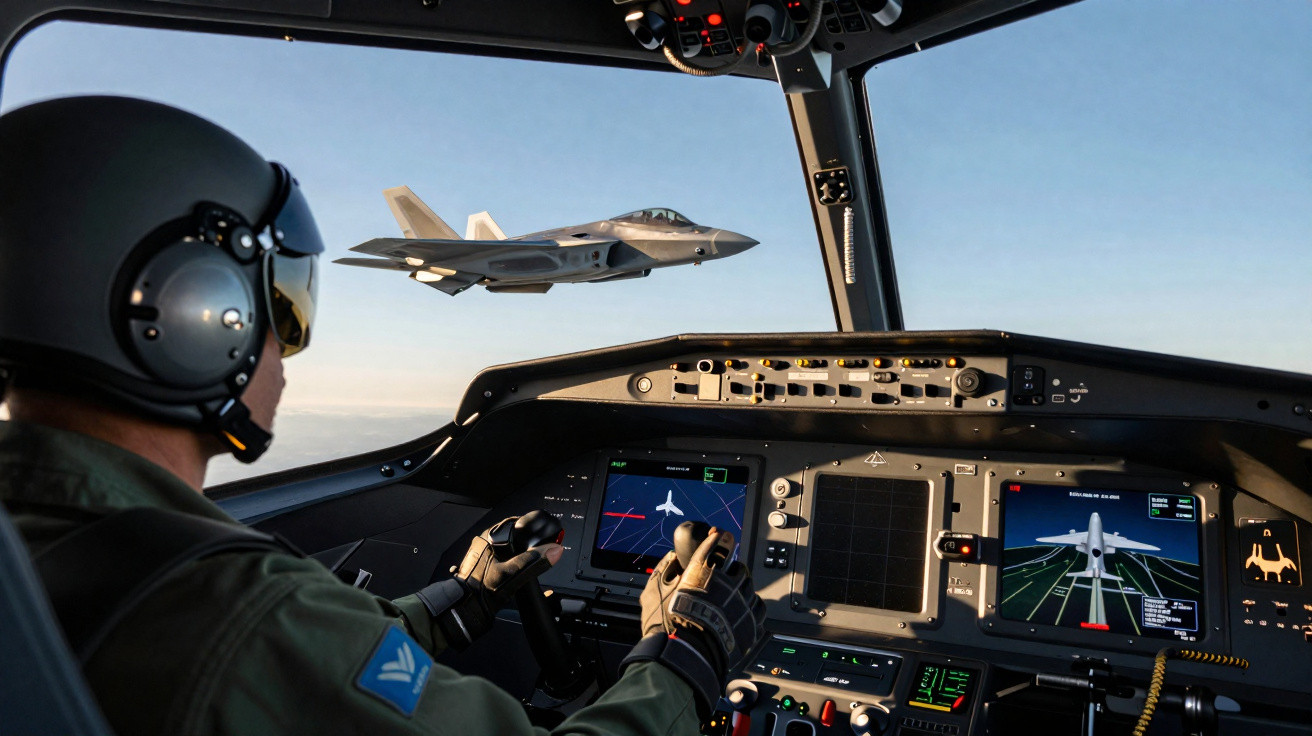
A low-profile sortie at a remote test range has seen an F-22 Raptor pilot take hands-on command of a jet-powered drone from inside the fighter, in what industry figures describe as an early move towards routine “loyal wingman” missions.
F-22 pilot flies a drone wingman from the cockpit
General Atomics Aeronautical Systems has confirmed the flight test took place on 21 October at the Nevada Test and Training Range. Operating from the F-22’s single-seat cockpit, the pilot directed an MQ-20 Avenger unmanned jet using a tablet and a newly developed software framework.
According to the company, this is the first known instance of an F-22 controlling a drone wingman in flight through a US government-owned, non-proprietary communications arrangement. The activity was paid for by industry rather than the Pentagon, and sits within a broader internal research-and-development push.
The F-22 did not just share data with the drone; the fighter’s pilot actively directed the MQ-20 using an onboard tablet.
General Atomics partnered with Lockheed Martin (the F-22’s manufacturer) and L3Harris. Lockheed’s Skunk Works advanced development team fitted both aircraft with L3Harris datalinks and software-defined radios, and then connected the system into the Raptor’s cockpit through a straightforward control interface.
How the human–drone teaming test actually worked
At its core, the demonstration relied on several technologies operating in tandem:
- An open radio architecture developed by Lockheed Martin.
- L3Harris software-defined radios installed on both F-22 and MQ-20.
- A tablet-based interface in the cockpit to task and monitor the drone.
- Autonomy software on the MQ-20 to carry out complex actions once tasked.
Using the tablet and its datalink connection, the F-22 pilot sent instructions to the Avenger. With mature autonomy algorithms onboard, the MQ-20 carried out assigned actions without the human having to “fly” it continuously via conventional controls.
Instead of “flying” the drone moment by moment, the pilot issued high-level orders and let the MQ-20’s autonomy handle the details.
This style of control matches the direction of travel for the US Air Force’s Collaborative Combat Aircraft (CCA) concept: aircrew provide broad mission intent, while unmanned wingmen route themselves, manage threats and complete discrete parts of the mission with limited supervision.
Collaborative combat aircraft: from concept to flightline
The Nevada event aligns closely with the US Air Force’s CCA programme, which is intended to deliver drone wingmen able to fight alongside front-line aircraft such as the F-35 and the future Next Generation Air Dominance (NGAD) fighter. General Atomics is using the MQ-20 as a surrogate platform while it develops a purpose-built CCA design, the YFQ-42A, for the first round of the competition.
Anduril is also contracted for the opening CCA phase, with both firms flying prototype airframes. RTX and Shield AI are contributing autonomy software intended to let the new drones cooperate with crewed fighters and with each other.
| Programme element | Role in CCA effort |
|---|---|
| F-22 Raptor | Initial “threshold platform” for integrating and controlling CCAs |
| MQ-20 Avenger | Surrogate testbed for CCA autonomy and control interfaces |
| YFQ-42A | General Atomics’ dedicated CCA airframe candidate |
| Anduril prototype | Competing CCA design for the first production round |
Senior leaders have said publicly that they want more than one manufacturer to reach production, including newer entrants. Concept awards for a second tranche of CCAs are expected shortly, widening participation and potentially dividing work across mission sets such as electronic attack, missile-truck roles or stand-in surveillance.
Why start with the F-22?
The US Air Force has designated the F-22 as the “threshold platform” for introducing unmanned teammates into front-line operations. Officials point to the aircraft’s availability, its importance in potential high-end fights, and its value as a place to develop tactics that can later be transferred across other fleets.
Although the F-22 is no longer being built, it remains at the core of US air superiority. Using the Raptor as a testbed lets the service trial crewed–uncrewed teaming against demanding threat scenarios, then feed what it learns into the F-35 and future combat aircraft.
The F-22 is a starting point, not the final destination; the Air Force intends to extend drone teaming to the F-35 and beyond.
The same pathway also reduces risk for next-generation platforms. If the most difficult integration challenges can be addressed on an in-service, combat-coded aircraft, future jets can be designed with drone command functions built in from the beginning rather than added afterwards.
Inside Skunk Works’ role and industry strategy
Skunk Works led the October integration work for Lockheed Martin. Known for rapid, discreet development of advanced aircraft, the team’s job here was to blend new radios, software and cockpit interaction tools into an already intricate stealth fighter.
For General Atomics, the demonstration also serves a competitive purpose. Putting an operational F-22 in the air alongside an MQ-20 shows the company can deliver not only advanced autonomy, but also the essential (and less visible) work of networking, software integration and secure datalinks. That matters as the CCA contest gathers pace and as air forces internationally look for credible loyal wingman solutions.
What this could mean on a future battlefield
If the Nevada trial is mapped onto combat scenarios, the potential applications expand rapidly. An F-22 pilot could push a drone wingman ahead to test enemy radar coverage, jam hostile sensors, or act as a decoy. A separate unmanned aircraft could carry additional missiles, increasing the fighter’s effective reach without adding more human pilots to the sortie.
In heavily defended airspace, drones could be tasked with the most hazardous flight profiles-drawing fire or absorbing losses-while crewed jets stand off further away. The October tablet interface also implies a future in which one pilot supervises a small “pack” of robotic aircraft rather than directly controlling a single platform.
Think of the pilot less as a traditional aviator and more as a mission commander, orchestrating several assets at once.
That change would bring practical implications. Training pipelines, cockpit design and even models of mental workload would need to evolve. Aircrew would have to learn when to rely on autonomy, how to recognise its limits, and when to hand tasks back to the human.
Key terms and concepts worth unpacking
Collaborative combat aircraft and loyal wingmen
“Collaborative combat aircraft” is the US Air Force term for an emerging family of drones intended to operate alongside fighters and bombers. In wider discussion, these platforms are often described as “loyal wingmen”, although the official label places emphasis on collaboration rather than straightforward subordination.
In contrast to traditional remotely piloted aircraft, CCAs are intended to operate with substantial onboard autonomy. They can follow pre-planned routes, respond to threats and exchange sensor information with other aircraft, while requiring only occasional, high-level human direction.
Open radio architectures and government-owned standards
One of the more understated-but consequential-details from the October flight is the use of a government-owned, non-proprietary communications architecture. That approach avoids locking the Air Force into any single supplier’s datalink or software ecosystem, and should make it simpler over time to connect different drones, aircraft and ground nodes.
Open radio architectures enable radios and waveforms from multiple vendors to operate within a shared framework. For commanders, this offers greater flexibility; for industry, it shifts competition towards capability and performance rather than closed systems and vendor lock-in.
Risks, benefits and what comes next
Letting fighter pilots command unmanned wingmen offers obvious advantages: additional weapons, sensors and decoys without putting more lives at risk. However, it also introduces challenges. Cybersecurity becomes pivotal, as radio- and software-controlled aircraft present attractive targets for jamming and hacking. Rules of engagement will also need to address when an autonomous system may act without a direct instruction.
Human factors remain central too. Fighter pilots already balance navigation, threat detection, communications and weapons employment. Adding drone supervision risks pushing workload too far unless cockpit design and training are adapted with care. The October focus on a simple, intuitive interface points to how companies are attempting to keep the burden manageable.
Further demonstrations are planned under General Atomics’ internal development work. In parallel, the Air Force’s CCA programme continues to progress, with General Atomics and Anduril already flying prototype airframes. The F-22 is expected to remain a key test platform before experience is transferred to the F-35 and, later, sixth-generation fighters.
For the moment, one brief sortie over Nevada stands as a small but meaningful marker: a stealth fighter pilot, a touch-screen tablet and a jet-powered drone operating together-less science fiction than an early outline of what air combat could resemble in the 2030s.






Comments
No comments yet. Be the first to comment!
Leave a Comment