
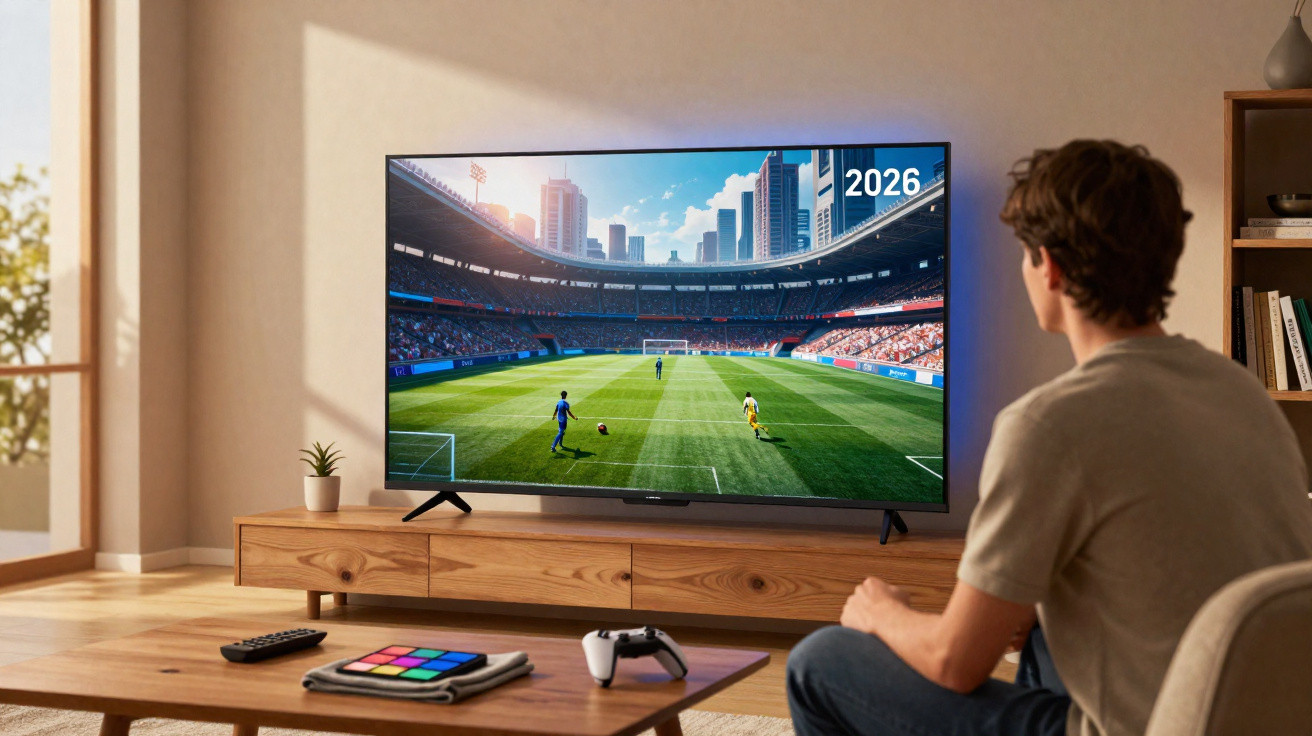
After years of hype around 8K and ever-larger pixel counts, the TV world is changing tack. The 2026 generation is less about adding more pixels and more about extracting better light, colour and motion from the pixels you already have. For most people at home, that will make a bigger difference to day-to-day picture quality than moving from 4K to 8K.
Why the industry is moving on from 8K
For a long time, brands marketed 8K as the inevitable next step. In real living rooms, though, it rarely felt like a must-have upgrade.
In showroom demos, 8K looked spectacular. At home, from normal viewing distances of a couple of metres, the improvement over a strong 4K television was often marginal-even on very large screens. Put simply, most eyes cannot resolve all that extra detail from a typical sofa.
Then there was the content gap. True native 8K films and series are still vanishingly rare, while most of what people actually watch remains 4K or even HD, with the set doing the upscaling. That is a hard sell when buyers are weighing up a steep price tag against a familiar Netflix catalogue.
The industry has realised that what viewers really notice is not more pixels, but better pixels.
Improvements in contrast, peak brightness, colour accuracy and motion are far easier to spot than an 8K resolution bump. Crushed blacks in dark scenes, blur in sport, or blown-out highlights in bright daylight pull you out of what you are watching immediately. This is exactly where 2026 models are trying to deliver the biggest gains.
HDR steps into the spotlight
High Dynamic Range (HDR) is not new, but 2026 televisions are treating it very differently. Instead of relying on largely static picture presets, the next wave aims to make HDR adaptive-tweaking performance scene by scene, factoring in both the content and the viewing environment.
Two competing standards sit at the centre of this fight: Dolby Vision 2 and HDR10+ Advanced. Both are designed to squeeze far more from 4K panels without changing the resolution specification.
The race is no longer about how many pixels a TV has, but how intelligently those pixels are driven.
Dolby Vision 2: smarter tone mapping and motion control
Dolby’s updated approach puts the creator’s intent first. Rather than forcing a universal grade and expecting every television to cope, Dolby Vision 2 is built around what the display can actually achieve.
Its headline change is two-way tone mapping. Instead of the source device sending a single “maximum brightness” plan and hoping for the best, the television reports back what it can do-how bright it can go, how deep its blacks are, and the precision with which it can render colour.
That means the same scene can be adjusted appropriately on a compact OLED in a normal sitting room and on a high-output Mini LED in a bright, sunlit lounge. The result should feel tailored on both types of screen, rather than tuned for the weakest hardware.
Dolby Vision 2 also extends into motion. A tool called “Authentic Motion” allows filmmakers and studios to define how much motion smoothing-if any-should be permitted on a frame-by-frame basis. The aim is to avoid that shiny “soap opera effect”, while still keeping clarity when it genuinely helps, such as during fast pans.
For the first time, motion settings can be baked into the HDR metadata instead of left entirely to aggressive TV algorithms.
Early hands-on reports from CES 2026 suggested richer colour impact, highlights that stay better controlled, and movement that more closely reflects directors’ intentions.
HDR10+ Advanced: Samsung’s AI-driven answer
HDR10+ Advanced, backed by Samsung and its partners, takes a different route-more open and more automated. It continues to be licence-free, which is attractive to manufacturers that do not want to pay Dolby’s fees.
Here, the emphasis is on AI. The set identifies what is playing-whether that is drama, football, a live concert or a video game-and then alters HDR behaviour on the fly. Brightness, local dimming and colour mapping are adjusted in real time to preserve detail without bleaching the image.
A new “HDR10+ Bright” profile is intended for particularly luminous televisions, especially premium Mini LED models capable of 4000 to 5000 nits of peak brightness. The idea is to keep intense highlights-sunlight glints, sparks, reflections-within control rather than turning them into harsh white patches.
For movement, HDR10+ Advanced uses a system called “Intelligent FRC” (frame rate control). Instead of applying heavy motion interpolation everywhere, it uses metadata within the content to decide when extra frames should be created. Done well, that limits artefacts while keeping fast action crisp only when it is warranted.
Samsung is betting on a TV that figures everything out for you, with minimal manual tweaking and no licence costs.
What this means for 2026 TV ranges
These next-generation HDR systems also come with clear hardware demands. An inexpensive entry-level 4K panel will not suddenly gain full support through a simple firmware update.
In its complete form, Dolby Vision 2 is aimed at high-spec sets. It requires strong processing power and panels that can reach up to 12-bit colour depth-more than 68 billion possible shades. No mass-market television sold before 2026 can fully meet that specification, so anyone who wants the whole package will likely need to buy a new model.
HDR10+ Advanced, meanwhile, expects advanced backlighting. It is tuned for Mini LED and high-end QLED screens with thousands of local dimming zones, giving the television finer control over bright and dark areas within the same picture.
Manufacturers are already choosing sides:
- Philips intends to include Dolby Vision 2 across multiple 2026 OLED televisions.
- Hisense is backing Dolby Vision 2 on its top-tier models.
- Samsung is prioritising HDR10+ Advanced and still shows no sign of adding Dolby Vision support.
Content platforms are likely to split in a similar way. Amazon’s Prime Video has already indicated support for HDR10+ Advanced. Canal+ is collaborating with Dolby Vision 2. Netflix and Disney+ are expected to follow once more titles are mastered for these standards, but that transition is likely to take months or even years, not weeks.
Should you upgrade your TV in 2026?
If you own a recent 4K television, there is no need to rush. Sets released in 2024 and 2025 that already support today’s Dolby Vision and HDR10+ are still very capable. For many homes, the 2026 versions will feel like a refinement rather than a dramatic transformation-especially until there is a sizeable catalogue of compatible content.
For most people, a solid 4K HDR set bought recently will stay relevant for years, even as Dolby Vision 2 and HDR10+ Advanced roll out.
The decision becomes more consequential at the premium end. Anyone shopping for a flagship model will face a new, more complex choice, where HDR format support sits alongside panel type and screen size as a key part of the buying decision.
In practical terms, the market appears to be heading towards two parallel ecosystems. Some brands and services will favour Dolby Vision 2’s creator-led philosophy, while others will back HDR10+ Advanced for its open approach and automation. Depending on which streaming services you value most, you may find yourself nudged towards one camp.
Key differences at a glance
| Feature | Dolby Vision 2 | HDR10+ Advanced |
|---|---|---|
| Business model | Proprietary, licensed format | Open, licence-free standard |
| Target hardware | High-end OLED / Mini LED, 12-bit capable | High-brightness Mini LED / QLED with strong local dimming |
| Tone mapping | Two-way TV–source communication for tailored scenes | AI-driven adjustments based on content type |
| Motion handling | “Authentic Motion” with creator-defined smoothing | “Intelligent FRC” adding frames only when metadata suggests |
| Positioning | Focus on artistic fidelity and control | Focus on automation and wide manufacturer adoption |
What HDR, nits and bits actually mean
If the terminology feels opaque, a few basics help. HDR-High Dynamic Range-means a television can show brighter highlights and deeper shadows at the same time. Imagine a sunset shot where you can see both the bright sky and the facial detail of someone in front of it, rather than one part turning into a flat grey smear.
Nits are a measure of brightness. A typical budget set might manage roughly 300–400 nits. Premium Mini LED models rated at around 2000–3000 nits can keep HDR highlights visible even in a bright, sunlit room. HDR10+ Advanced’s “Bright” profile assumes televisions capable of much higher peaks, up to 4000–5000 nits.
Bit depth describes how many shades a screen can represent for each colour. Many current televisions use 10-bit panels, which already cover more than a billion colours. Dolby Vision 2’s move towards 12-bit is intended to reduce banding in smooth gradients-think blue skies or subtle lighting transitions.
Real-world scenarios for 2026 TVs
Imagine a Sunday afternoon Premier League match on a 2026 Mini LED television. With HDR10+ Advanced, the set recognises live sport, pushes brightness, tightens local dimming so kits stand out cleanly against the pitch, and adjusts motion processing to keep the ball sharp without making the whole broadcast look like overly smoothed video.
Now switch to a film mastered in Dolby Vision 2 at night. With the room dark, the television and source coordinate to rein in peak brightness, deepen black levels, and follow the motion preferences chosen by the production. Dim scenes keep texture and detail rather than collapsing into murky grey, while pans retain a cinematic feel instead of turning unnaturally fluid.
For gaming, both formats may prove even more significant. Lower input lag, fast response, and HDR that adapts in real time-from shadowy dungeons to blinding explosions-can materially change how a game feels. As consoles and PCs adopt these enhanced standards, gaming monitors may start borrowing the same 2026-TV techniques.
Risks and trade-offs for buyers
The biggest downside is fragmentation. A household with a set that supports only Dolby Vision 2 may not see the full benefit of HDR10+ Advanced content built mainly around Samsung’s ecosystem-and the reverse is equally true. Standard HDR10 remains the fallback, but the best-looking version of a programme may depend on where this format tug-of-war lands.
There is also the usual early-adopter dilemma. First-generation models tend to command higher prices and may not include every promised feature from day one. Updates can close some gaps, but value-focused buyers may prefer to wait a year for the standards to settle and for more compatible content to arrive.
On the positive side, stepping away from the resolution arms race should benefit mid-range sets as well. Even if they never offer full Dolby Vision 2 or HDR10+ Advanced support, the broader advances in tone mapping and motion processing are likely to filter down-delivering cleaner HDR and more consistent images on more affordable 4K televisions.




Comments
No comments yet. Be the first to comment!
Leave a Comment