
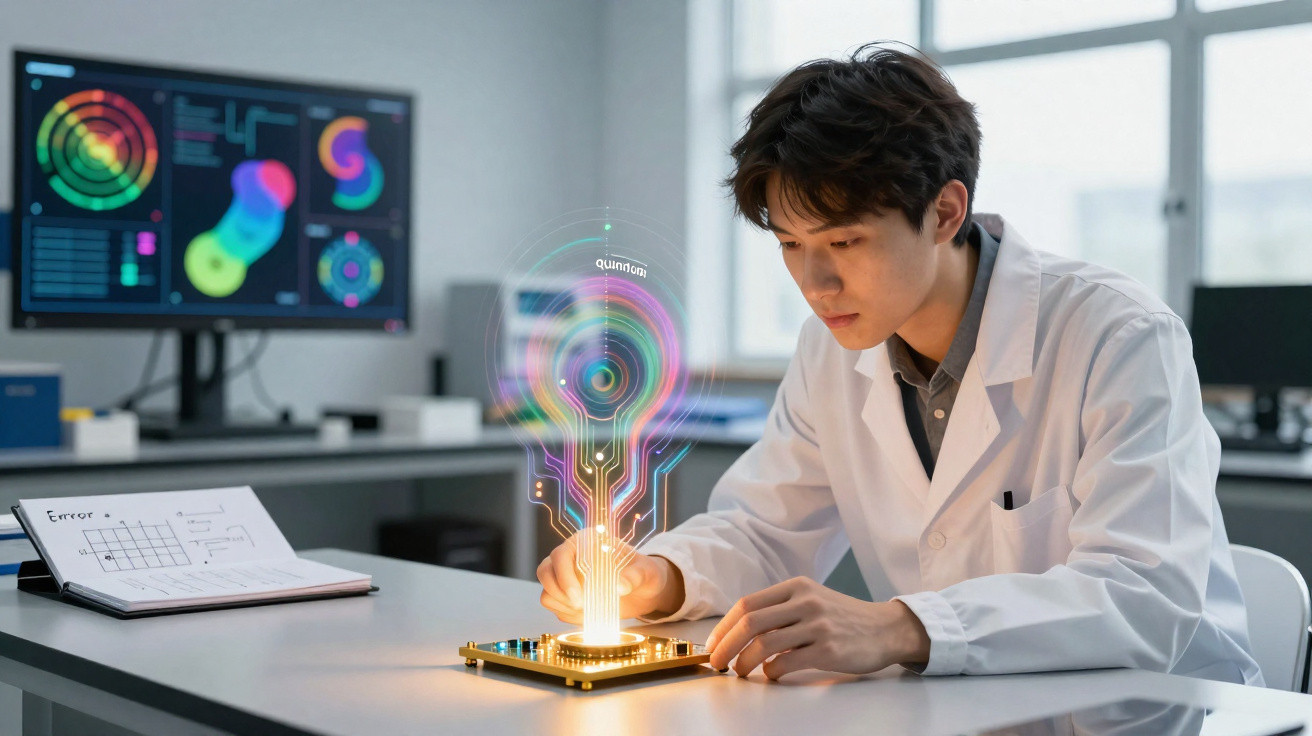
Even with errors that refuse to go away, today’s quantum machines have managed to reproduce the hallmark signatures of chaotic behaviour at sizes that were, until recently, considered out of reach.
This shifts what we can reasonably expect from imperfect hardware when probing complex physical systems, even as sturdier, fault-tolerant machines remain some way off.
Trusting in quantum results
Working on a 91-qubit superconducting processor at IBM Research, the team reported these features across large, interacting quantum systems.
The project was led by Laurin E. Fischer at IBM Research Europe in Zurich, who showed that the agreement holds under genuine day-to-day operating conditions.
This focus is crucial because the point at which quantum computers become tools scientists can rely on is governed by trustworthiness rather than raw speed.
Quantum chaos as a benchmark
Using the superconducting processor, the researchers modelled quantum chaos-fast scrambling that washes out local information-over circuits spanning 51 to 91 qubits.
In big, interacting systems, chaos also helps errors propagate, and that makes classical verification increasingly costly as circuits scale up.
To push the device hard, the experiments employed 4,095 two-qubit gates, a depth where noise can easily become indistinguishable from the underlying physics.
If the expected patterns still align with theory in that regime, it provides scientists with a practical way to decide which quantum results merit serious weight.
Controlled chaos in circuits
To generate chaos while retaining some built-in constraints, the team chose dual-unitary circuits, which keep a form of reversibility in both time and space and therefore preserve a small number of internal checks.
Previous studies had shown that, for these circuits, physicists can calculate certain local correlations exactly even though the overall dynamics remain complicated.
That limited set of exact predictions acts as a reference point, allowing noisy experimental data to be compared with a well-defined target curve rather than relying on intuition.
Without such embedded checks, an apparent success could simply be a fortunate cancellation between hardware errors and theoretical expectations.
A signal that should fade
The central diagnostic was an autocorrelation function, which quantifies how strongly an initial disturbance resembles itself at a later time.
In the chosen model, this quantity falls as information spreads, indicating the system progressively forgets its starting point.
For several parameter choices, exact theory called for a straightforward exponential decay, giving the team a clear benchmark to aim at.
Because the observable is local, it can reveal problems early-before accumulating errors turn the overall picture into something misleading.
Quantum error correction
With no correction applied, the measured signal decayed too fast, so the group turned to error mitigation: software-based procedures that infer noise-free values after the quantum runs complete.
They first characterised how layers of two-qubit gates skew the results, and then applied classical post-processing designed to remove a large fraction of that systematic bias.
After mitigation, the decay curve agreed with theory for gate regimes beyond the simplest classically tractable cases, making the benchmark more representative of genuine research workloads.
A key review also set out why full quantum error correction-active checks that detect and repair errors during execution-demands many more qubits than current hardware can supply.
Tensor methods explained
To make error mitigation scale, the researchers relied on tensor networks, mathematical constructions that represent enormous computations as connected collections of smaller components.
Rather than intervening mid-circuit, the technique assembled an approximate inverse noise map and applied it only once the circuit had finished.
Their Tensor-network Error Mitigation (TEM) method learned the device’s noise behaviour from calibration experiments and then corrected the final observable.
Because TEM assumes the noise model remains stable, drift in the hardware can blunt its accuracy and leave behind residual bias.
Testing competing models
Once the exact dual-unitary checks were satisfied, the team moved the circuit away from the dual-unitary regime, where no closed-form solutions are available.
They then set the quantum results alongside two classical tensor-network simulations: one that follows the evolution of quantum states and another that follows the evolution of operators.
Those two classical approaches produced conflicting predictions, but across the tested settings the TEM-mitigated hardware data remained closer to the operator-tracking simulation.
In effect, the quantum processor served as a referee, supplying evidence in cases where classical approximations point in different directions.
Speed makes mitigation practical
Beyond accuracy, the work also depended on throughput: for the largest jobs, the end-to-end workflow completed in a little over three hours.
Sampling rates above 1,000 measurements per second allowed the team to collect large data sets without tying up the machine for days.
That speed mattered because mitigation requires repeated noise characterisation, and shorter cycles make it easier to spot drift before it contaminates later measurements.
The cost is additional classical computation, which could constrain smaller groups unless they can draw on shared cloud resources.
Building useful quantum tools
When chaotic simulations are validated in this way, they can double as benchmarks-giving hardware teams a concrete target and theorists an extra route for testing ideas.
One report presented progress as the combined outcome of advances in hardware, software and error handling, rather than a single silver-bullet breakthrough.
“There are many pillars to bringing truly useful quantum computing to the world,” said Jay Gambetta, Director of IBM Research.
Until fault-tolerant machines are available, validated simulations could still contribute to materials research, drug discovery, traffic flow analysis and logistics planning.
What reliability unlocks
Overall, the findings indicate that careful benchmarking, paired with post-processing, can make noisy quantum hardware useful for studying chaos.
At the same time, researchers will need wider sets of measurements and longer circuits, because mitigation performance can degrade as noise changes over time.




Comments
No comments yet. Be the first to comment!
Leave a Comment