
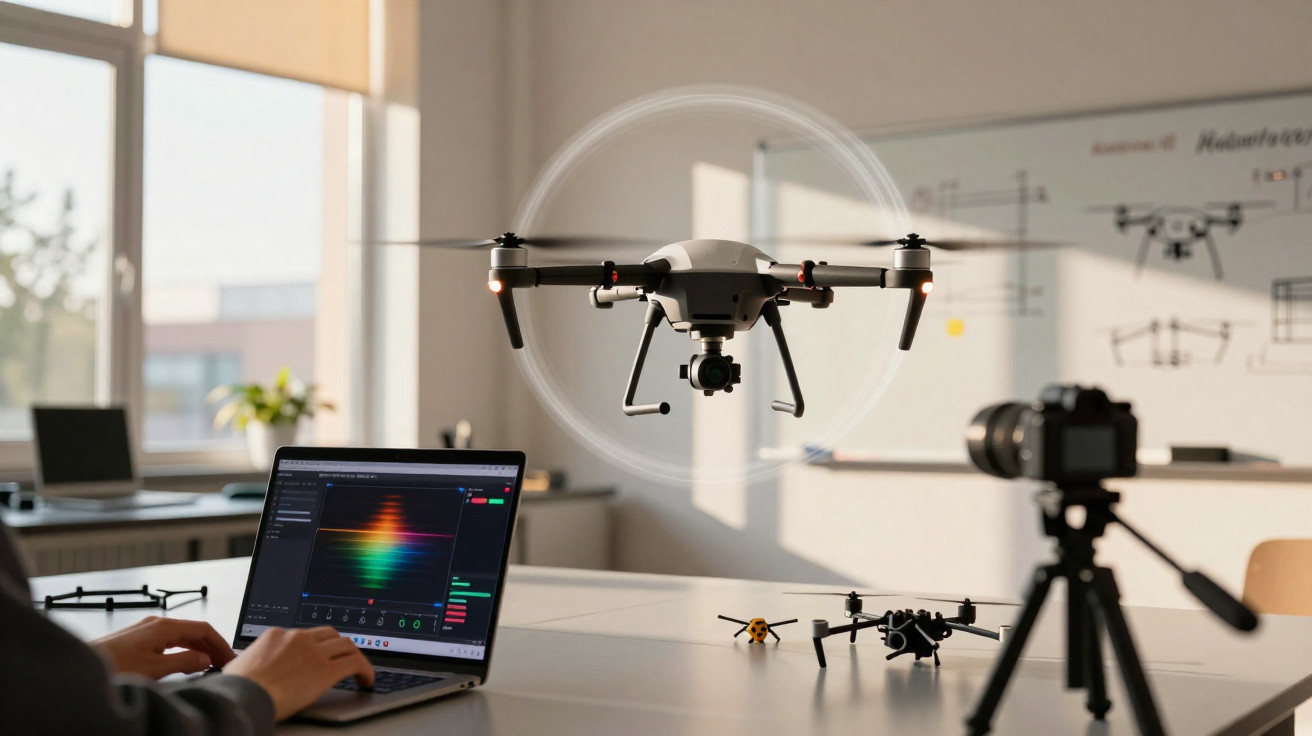
Drones can reach just about anywhere, yet remaining unnoticed once they arrive is far more difficult.
Engineers at Northwestern University have identified an unexpected way to tackle that challenge.
Rather than disguising a drone with paint, patterns, or see-through materials, they created a craft that rotates so rapidly that the human eye cannot resolve it clearly.
In flight, the drone becomes a faint, near-transparent blur, making it about ten times more difficult to detect than a typical quadcopter.
In time, the same idea could allow drones to watch wildlife, map delicate ecosystems, and check infrastructure while avoiding becoming a distraction in the very places they are meant to monitor.
Trying to hide in plain sight
For years, the usual route to making a robot less conspicuous has been to alter its appearance. Engineers have experimented with colours and patterns designed to blend into the background.
They have also produced surfaces that change colour like a chameleon, as well as clear plastic components that help the body all but vanish.
A smaller body of work has focused on motion itself. One method, known as motion camouflage, has a robot move along a trajectory that masks its apparent motion to an observer, reducing the chance of being noticed.
Building a drone that disappears
This team took a different approach, reshaping the drone around the limitations of human vision.
Their single-propeller vehicle, named Phantom Twist, spins quickly enough that the eye turns it into a smear rather than a distinct object.
The project was led by Michael Rubenstein, an associate professor of computer science and mechanical engineering at Northwestern.
“This idea of low visibility through persistent motion is something few people have explored,” he said.
Phantom Twist bears little resemblance to the familiar four-rotor quadcopter. It uses one motor and one propeller, positioned off to one side.
When the propeller rotates in one direction, the rest of the drone rotates the other way. This counter-rotation stabilises the craft in the air, and it ensures that no part of the structure remains stationary.
Single-propeller flyers that spin are not a new concept. A 2017 design used the same single-motor, counter-rotating principle to become the smallest self-powered flying robot of its time.
What earlier versions did not do was make that blur the central objective.
How motion blur hides it
The mechanism behind the drone’s disappearing act is motion blur-the same smearing effect seen when something moves faster than the eye can follow. Human vision has limits.
To form a clear image, the eye needs a brief integration window-roughly 50 to 150 milliseconds-to collect enough light. Movement faster than this gets effectively averaged into a blur.
Phantom Twist takes advantage of that delay by rotating between 15 and 25 times per second.
At those speeds, individual components pass too quickly to be perceived on their own, producing the same effect that turns spinning fan blades into what looks like a continuous disc.
The whole drone disappears
A conventional quadcopter does not gain the same advantage because only its propellers move; the body remains fixed and therefore visible.
“For our drone, the whole thing is rotating, so there are no stationary parts,” said Rubenstein.
Emma Alexander, a Northwestern computer scientist who researches how people and machines see, helped convert that biology into a concrete design goal.
“When an object spins quickly, we perceive it as blurring out and losing distinct features,” she said.
Because much of the rotating drone is perceived as empty space, its few solid elements-the motor, batteries, and circuit board-visually merge with whatever sits behind them. Instead of reading as a machine, it appears as a light haze.
The team also confirmed the effect in photographs. They flew the drone about 1.8 metres from a camera and recorded it using a quarter-second exposure.
The resulting streaked photographs closely mirrored their simulations, matching them almost feature for feature.
Testing thousands of possible designs
Reaching the final configuration relied less on intuition and more on a brute-force, computational search.
First, the researchers had a computer produce around 20,000 flyable drone layouts, each placing the motor, batteries, circuit board, and counterweights in a different arrangement.
To estimate which configurations would be least noticeable, they simulated each design spinning in flight and overlaid the blurred result onto 100 real-world backgrounds.
A perceptual model intended to approximate human vision then scored how much each drone image stood out from its scene.
They selected the 500 lowest-scoring designs for a second stage, where an optimiser adjusted each component’s position and angle to drive the visibility score down even further.
“The design process was fully automated,” said Rubenstein.
The secret is empty space
In the best-performing layout, components were intentionally distributed at varying heights and angles, leaving gaps between them so their blurred paths would not accumulate into a dark, solid ring.
With the parts spread out, the drone averages into a thin cloud rather than a recognisable shape.
On the model’s own scale, the finished drone is about ten times less noticeable than a standard quadcopter.
The optimisation stage by itself reduced its visibility score by more than a tenth. All three prototypes were able to hover for around 10 minutes, maintaining position to within roughly 5 cm.
Making the drone harder to see
Phantom Twist is not completely invisible. At close range, slender rods and wiring can still be spotted, and in bright light the rotating elements can momentarily flicker into view.
That flicker arises from the same visual system the drone is designed to exploit. In bright conditions, people can perceive flashes at rates far higher than the drone’s rotation speed. One study reported that observers could detect flicker above 500 flashes per second.
This means a drone that seems to disappear indoors may shimmer back into view outdoors.
Noise is another clue. The propeller still produces a buzz, which could undermine the idea near quiet wildlife. The team is aiming for future versions built from clearer materials and using quieter propulsion.
Overall, the research demonstrates an alternative route to concealing a machine-one that outruns the eye rather than attempting to blend into the background.
With more transparent components and quieter propulsion, the same approach could enable near-invisible drones to pass over nesting colonies, wetlands, and ageing bridges, collecting data without altering the behaviour they were sent to observe.
Image/Video Credit: Northwestern University
Comments
Уличные светильники должны располагаться на опорах или тросах https://xn----8sbbqwjb8ce.xn--p1ai/
Возможно располагать светильник на стенах зданий в микрорайонах, если при таком монтаже будут выполнены условия:
Напольные https://xn----8sbbqwjb8ce.xn--p1ai/
Состоят из опоры и светильника в плафоне https://xn----8sbbqwjb8ce.xn--p1ai/
Одни модели рассчитаны для установки на твердом, ровном основании, другие — для монтажа в грунт https://xn----8sbbqwjb8ce.xn--p1ai/
Первый вариант обычно выполняет роль основного освещения дорожек, площадок, парковки https://xn----8sbbqwjb8ce.xn--p1ai/
Второй вариант применяется для декоративной подсветки клумб, фонтанов и других объектов на участке https://xn----8sbbqwjb8ce.xn--p1ai/
О желтых проводах заземления: области применения заземляющих кабелей, правила монтажа (укладки), материалы изготовления https://xn----8sbbqwjb8ce.xn--p1ai/
Какой заземляющий кабель лучше использовать https://xn----8sbbqwjb8ce.xn--p1ai/
Отличие кабелей по материалу изготовления сердечника (медь или алюминий) https://xn----8sbbqwjb8ce.xn--p1ai/
https://xn----8sbbqwjb8ce.xn--p1ai/
https://xn----8sbbqwjb8ce.xn--p1ai/
https://xn----8sbbqwjb8ce.xn--p1ai/
Прежде чем вы начнете составлять схему уличного освещения вашего участка, решите, для чего оно вам необходимо https://xn----8sbbqwjb8ce.xn--p1ai/
В основном оформляют такую систему с целью:
Если участок не электрифицирован, или садовые фонарики устанавливаются в удаленном месте, куда трудно подвести провода, используйте автономные аккумуляторные фонари, или работающие от солнечной энергии https://xn----8sbbqwjb8ce.xn--p1ai/
Рисунок не должен быть слишком простым, но и сложные картины тут неуместны, лучше чтобы рисунок замыкался и повторялся по кругу https://xn----8sbbqwjb8ce.xn--p1ai/
Затем можете покрасить изделие, установить в него необходимую лампочку и вешать в нужное место https://xn----8sbbqwjb8ce.xn--p1ai/
Leave a Comment