
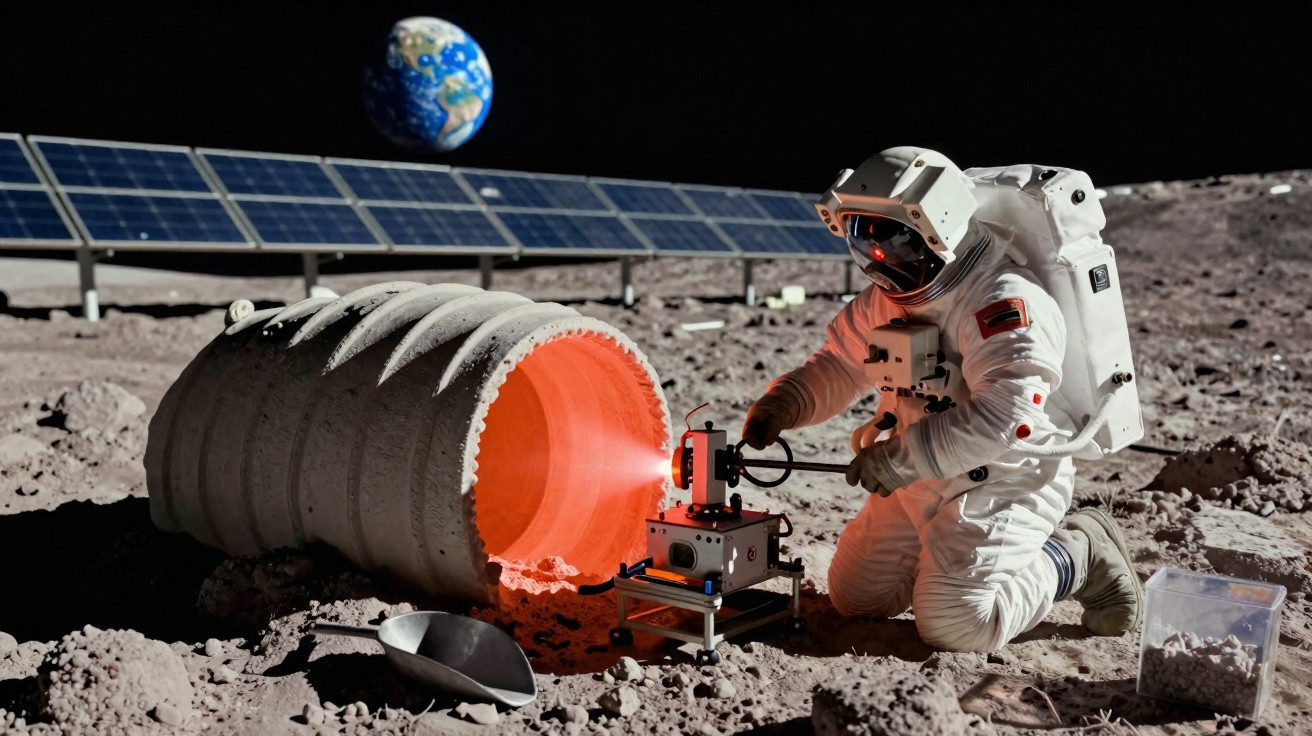
From Earth, the Moon appears still and serene. At closer range it is anything but: surface temperatures flip between intense heat and severe cold, there is no air to breathe, and abrasive dust sticks to virtually everything.
If people are to live there for months or even years, they cannot realistically send every brick, girder and spanner from Earth. Launch vehicles have strict payload limits, and mission budgets are finite.
That is why researchers are exploring ways to build using materials already on the lunar surface. The grey, powdery layer that blankets the Moon - known as regolith - could be turned into feedstock for habitats, landing pads and even practical equipment.
A new study reports that simulated lunar soil can be melted and formed into robust, heat-resistant parts using a laser-based 3D-printing technique.
Turning moon dust into hardware
In a laboratory setting, the team used a manufactured stand-in for lunar dust called regolith simulant. Using a high-power laser, they melted the fine powder in thin layers, stacking each fused layer onto the surface beneath. This produced small components capable of withstanding extreme heat.
The specific simulant was LHS-1, designed to resemble soil from the Moon’s highlands - an area marked by heavy cratering and rich in dark basaltic rock.
Selecting the right simulant is important because lunar regolith is not chemically uniform across the Moon. Should astronauts touch down in the highlands, they will need materials that respond like LHS-1.
This line of work sits within the broader concept of in-situ resource utilisation - using local resources at a destination rather than transporting everything from Earth.
For NASA’s Artemis programme missions, which are intended to support a sustained human presence on the Moon by the end of this decade, in-situ resource utilisation could lower costs and reduce operational risk. Needing fewer resupply launches means fewer critical launch windows and less reliance on Earth-based logistics.
Surface affects lunar printing
Working with lunar dust is not as straightforward as simply melting sand. The researchers examined how reliably the material formed under varying conditions, including the effect of the surface supporting the printed layers.
When LHS-1 was printed onto stainless steel or glass, the results were poor because the material did not bond effectively. By contrast, printing onto an alumina-silicate ceramic substrate led to much better adhesion.
The most likely explanation is that the ceramic and the simulant can crystallise together, improving both thermal stability and mechanical strength.
Sizhe Xu, the study’s lead author and a graduate research associate in industrial systems engineering at The Ohio State University, described how delicate the process can be.
“By combining different feedstocks, like metal and ceramics, in the printing process, we found that the final material is really sensitive to the environment,” he said.
“Different environments lead to different properties, which directly affect the mechanical strength and the thermal shock resistance of certain components.”
Put simply, minor changes in the surrounding conditions can determine whether a part succeeds or fails - a serious concern when manufacturing on the Moon, where the environment is unforgiving.
Space changes everything
Beyond changing the base surface, the team also varied oxygen levels, laser power and printing speed. Each of these parameters affected how stable and strong the finished structure became.
Sarah Wolff, the study’s senior author and an assistant professor in mechanical and aerospace engineering at The Ohio State University, highlighted how difficult it is to reproduce space-like conditions on Earth.
“There are conditions that happen in space that are really hard to emulate in a simulant,” she said. “It may work in the lab, but in a resource-scarce environment, you have to try everything to maximise the flexibility of a machine for different scenarios.”
Space adds challenges such as hard vacuum, abrupt temperature swings and pervasive fine dust that can infiltrate seals and joints. Any manufacturing system deployed there must function through all of those stresses.
Engineers therefore cannot presume that a process proven in a controlled laboratory will behave identically at a distance of 384,400 km (238,900 miles).
Powering the printers of the future
At present, the group’s printer operates on mains electricity in the lab. On the Moon, however, energy will be limited.
Solar power is a natural candidate, particularly near the lunar south pole where certain areas experience extended stretches of sunlight. The study indicates that future printers could be enlarged and supported by solar-driven systems or hybrid power configurations.
Additive manufacturing - more commonly known as 3D printing - is already widely used on Earth, enabling engineers to produce intricate geometries without machining them from solid stock.
In space, that adaptability could be even more useful. Instead of waiting for the next cargo flight, astronauts could fabricate spare parts, tools and structural elements on demand.
Xu emphasised the breadth of what might be possible. “There are so many applications that we’re working toward that with new information, the possibilities are endless,” he said.
Innovation returns to Earth
The researchers also see the work as relevant beyond lunar exploration. Wolff argues that the same capabilities could help address challenges on Earth.
“If we can successfully manufacture things in space using very few resources, that means we can also achieve better sustainability on Earth,” she said. “To that end, improving the machine’s flexibility for different scenarios is a goal we’re working really hard toward.”
Building with scarce inputs forces engineers to rethink how manufacturing is done: reducing waste, reusing what is available and creating machines that can cope with shifting conditions. Those approaches are equally valuable on Earth, where supply chains can fail and raw materials can become constrained.
The Moon may serve as the proving ground, yet the benefits could extend well beyond it. If regolith can be transformed into durable structures under extreme conditions, the result will not only be stronger space habitats, but also smarter and more resource-efficient systems back home.
The complete study appeared in the journal Acta Astronautica.





Comments
No comments yet. Be the first to comment!
Leave a Comment