
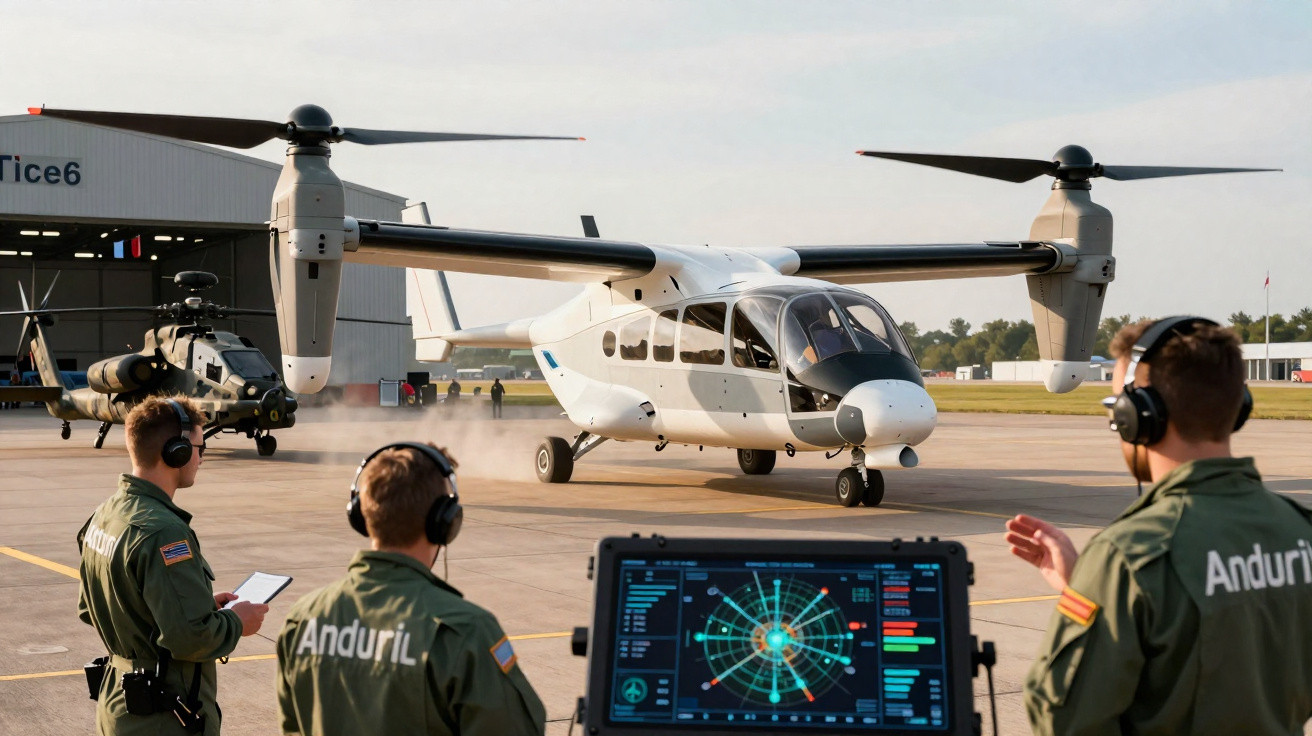
Thunder autonomous tiltrotor attack drone at Farnborough Airshow 2026
At the Farnborough Airshow 2026 in Farnborough, United Kingdom, Anduril Industries and Archer Aviation introduced Thunder, a new Group 5 autonomous tiltrotor attack drone designed to fly either alongside crewed attack helicopters or entirely on its own.
As reported by Aviacionline, the programme underlines one of the most substantial doctrinal shifts now unfolding in rotary-wing aviation. Lessons from the war in Ukraine-where widespread drones, precision munitions and persistent intelligence, surveillance and reconnaissance (ISR) have sharply increased the vulnerability of attack helicopters-are driving the push for uncrewed aircraft that can take on the most dangerous battlefield tasks.
Anduril says Thunder has been shaped for this emerging environment: a fiercely contested low-altitude airspace where survival hinges on combining speed, endurance, range and the ability to concentrate combat power without placing aircrew in harm’s way.
Dual-use platform: Thunder (defence) and Halo (civil)
Thunder is the military derivative of a shared, dual-use autonomous VTOL platform co-developed by Anduril and Archer Aviation. The commercial version will be called Halo, using the same underlying architecture for civilian transport, logistics and emergency-response roles.
According to the companies, this dual-use approach is intended to merge the scale benefits of the civil market with the specific demands of military operations.
For defence, Thunder targets mission sets where uncrewed systems can reduce risk to pilots while keeping combat mass high. For civil operators, Halo is planned for cargo transport, aeromedical evacuation, search and rescue, support to offshore operations and logistics in remote regions.
Design, payload options, teaming with Apache/FVL, and the doctrine behind it
Thunder uses a tiltrotor configuration with vertical take-off and landing (VTOL), aiming to blend a helicopter’s operational flexibility with the aerodynamic efficiency of a fixed-wing aircraft in cruise.
The design also adopts a series hybrid-electric propulsion system and variable-speed tiltrotors (Optimum-Speed Tiltrotors). The stated purpose of this solution is to reduce fuel burn, extend range and lower noise during low-altitude flight.
Anduril and Archer add that the platform is intended to be built using supply chains already established in the eVTOL industry, a move they say will cut costs and make large-scale production easier.
Rather than replacing attack helicopters, Thunder is positioned as a force multiplier within mixed formations, intended to operate alongside the Apache and future Future Vertical Lift (FVL) aircraft.
Its modular architecture is meant to accept a range of weapons and payloads, including air-to-surface missiles such as Hellfire, JAGM and Barracuda-100M, precision-guided munitions, 70 mm rockets, electronic warfare systems, ISR sensors, counter-drone capabilities and even logistics loads.
Anduril states that Thunder’s offensive potential could be comparable to heavy attack helicopters such as the AH-64 Apache. The company also argues that three Thunder drones operating with a single AH-64 Apache would allow a Combat Aviation Brigade to triple the amount of available munitions without increasing the number of pilots exposed to combat-at a cost significantly lower than adding more crewed helicopters.
A further differentiator highlighted is collaborative operation via Anduril’s Lattice software, which is intended to coordinate formations, share tactical data in real time, carry out autonomous manoeuvres and sustain operations even in degraded conditions caused by GPS jamming or electronic warfare-relying instead on sensors, computer vision and on-board processing.
Thunder’s development is also presented as part of the doctrinal change adopted by the United States Army after the Future Attack Reconnaissance Aircraft (FARA) programme was cancelled in 2024. At the time, the service acknowledged that experience from the Ukraine conflict showed many missions expected of a new crewed reconnaissance helicopter could be carried out more cheaply, more persistently and with less risk by uncrewed systems and space-based assets.
Since then, US industry has accelerated work on autonomous platforms intended to operate with crewed aircraft-an approach also evident in efforts such as the United States Air Force’s Collaborative Combat Aircraft (CCA) programme.
Within that broader shift, Thunder applies the man–machine teaming concept to rotary-wing aviation, focusing on large drones that can enter heavily defended airspace, execute high-risk missions and substantially increase the firepower available to land forces.
Anduril reports that multiple test flights have already been completed using full-scale surrogate aircraft to validate the system architecture. The first flight of the Thunder prototype is planned for 2027. Archer, meanwhile, says it will announce the first commercial customers for the Halo platform later this week.


Comments
No comments yet. Be the first to comment!
Leave a Comment