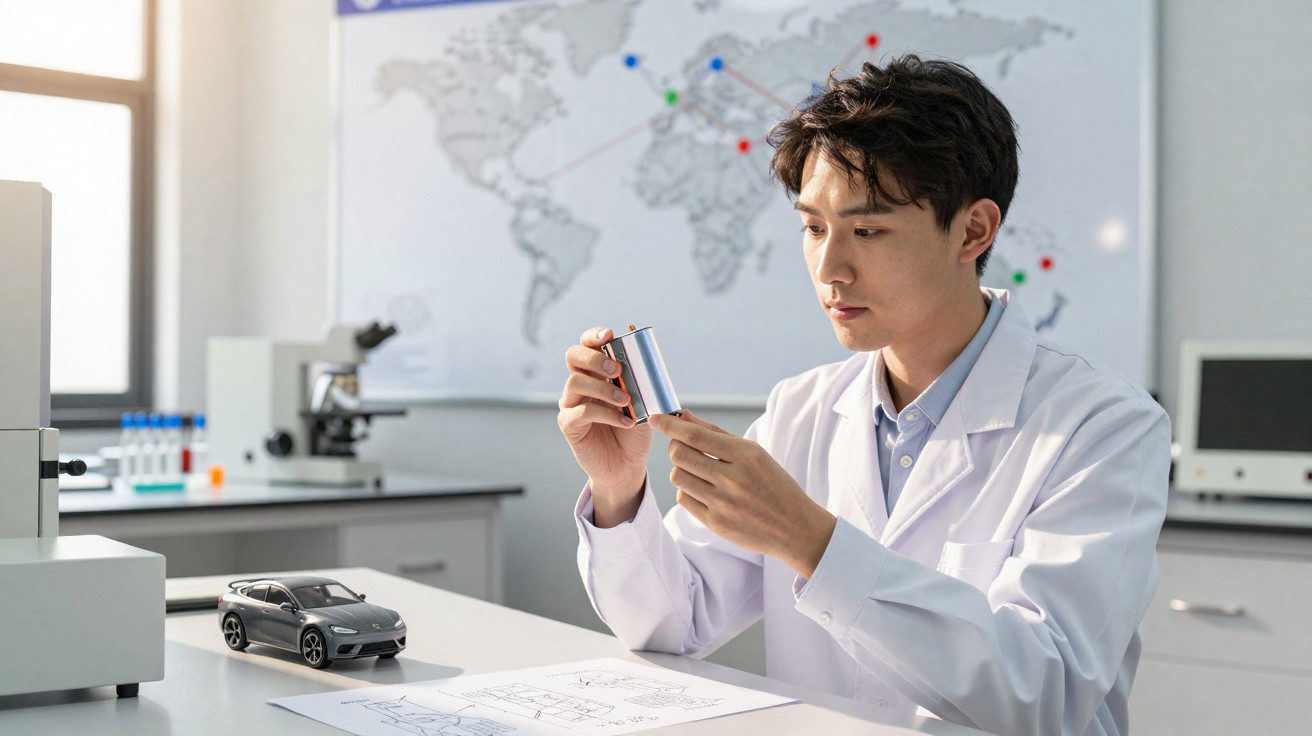
China is not falling behind in the battery race. On the contrary, the country still controls a substantial share of the industrial chain supplying electric cars sold worldwide.
According to the International Energy Agency, China accounted for more than 80% of global battery cell production in 2025 and also led the manufacture of the active materials used in electric-vehicle batteries.
That position is underpinned by giants including CATL, BYD and CALB, as well as an industrial network and domestic market of exceptional scale. However, the warning now emerging from China itself is more specific: the country may remain the leader in mass battery production while risking the loss of part of its technological lead in solid-state battery development.
A report cited by the Chinese press warns that, despite leading in scientific output and patent volume, China may be unable to dominate solid-state battery manufacturing in the same way. The reason lies in the nature of the technology itself: solid-state is not simply another step forward from current batteries. It is a different race, involving alternative materials, new industrial processes and far fiercer competition over intellectual property.
Solid-state batteries operate under different rules
Solid-state batteries replace the liquid electrolyte found in today’s batteries with a solid material. In theory, this change could deliver higher energy density, improved thermal safety, faster charging and more compact batteries - everything the automotive industry wants to make electric vehicles more appealing.
In reality, though, they are a major challenge. The technology remains difficult to industrialise, with hurdles including material stability, durability, dendrite formation, the moisture sensitivity of certain electrolytes, material costs and the ability to manufacture millions of cells to consistent quality standards - yes, it sounds as though we are speaking Chinese. Jokes aside, an Auto Talks feature explains what dendrites are and outlines some of these drawbacks.
In short, manufacturing millions of LFP (Lithium Iron Phosphate) or NMC (Nickel, Manganese and Cobalt) lithium-ion cells with high industrial efficiency is one thing. Mastering a technology that is only now moving beyond the prototype stage, and relies on entirely different chemical interfaces and manufacturing processes, is another. China’s scale remains a huge advantage, but it may not be enough in this race.
The most significant patents are outside China
China holds around 35% of patents linked to solid-state batteries and roughly 39% of patents relating to electrolytes. Its scientific output has increased sharply, rising from 21 papers in 2015 to 562 in 2023. These figures demonstrate strength, but they do not tell the whole story.
The picture changes when the concentration of the most important patents is considered. Of the world’s 30 leading organisations for solid-state battery and electrolyte patents, 17 are Japanese, seven are Chinese, five are South Korean and just one is European. No Chinese organisation appears in the Top 10.
This does not mean Chinese companies will be shut out. They could create their own solutions, work around patents through alternative processes, license technology or challenge existing registrations. Even so, intellectual property becomes increasingly important as a technology moves out of the laboratory and into global contracts with car manufacturers.
Is this Toyota’s moment?
Toyota is the company to watch most closely in this context. The Japanese marque has worked on solid-state batteries for years and has strengthened partnerships in materials, one of the key areas for turning this promise into a production reality. It currently accounts for 40% of global solid-state battery patents.
Idemitsu Kosan is developing lithium sulphide to support Toyota’s plans, with a new facility in Japan scheduled for June 2027. Reuters reports that the investment is expected to be around 21.3 billion yen (approximately €114.9 million at the current exchange rate), with annual capacity sufficient for 50,000 to 60,000 electric vehicles.
In South Korea, companies such as Samsung SDI, LG Energy Solution and SK On are also involved in this race. The Korean advantage lies in accumulated industrial expertise in high-energy-density cells and relationships with global car manufacturers.
Europe will remain dependent
For Europe, this potential reshaping is uncomfortable. Europe’s automotive industry already depends heavily on Asia for batteries and has yet to turn its industrial ambition into a supply chain comparable with those in China, Japan or South Korea.
According to the International Energy Agency, almost all battery cells used globally are supplied by companies based in China, South Korea or Japan. In addition, the number of Chinese producers in the European Union has almost doubled since 2023. If China retains its advantage in high-volume batteries while Japan and South Korea gain ground in solid-state technology, Europe’s strategic room for manoeuvre will remain limited, regardless of the industrial plans Brussels is able to mobilise.









Comments
No comments yet. Be the first to comment!
Leave a Comment