On a Tuesday night in a peaceful suburb, a nine-year-old girl is sitting on the sofa, lit by the blue glow of a screen. The television is playing, though no one is paying attention to it. Her mum is replying to work emails, listening with half an ear while scrolling with the other half of her attention. On the child’s phone, TikTok delivers a never-ending run of clips: slime how-tos, beauty filters and a dance trend featuring lyrics her mum would probably dislike. Her thumb hardly stops moving. One, two, three seconds on each video, then another swipe. Again. Again. Again.
Her homework remains untouched in the rucksack by the front door.
Somewhere between the third dance trend and the fifth “story time”, a question hangs in the room, nagging like a flickering bulb.
Who is really bringing up this child at the moment?
What a new study says TikTok is really doing to children’s brains
Researchers from several universities have released a study that reads rather like the premise of a Black Mirror episode. They examined the brains of children and teenagers who spend substantial amounts of time on TikTok, then compared them with those who do not. The pattern they found is troubling.
Regions associated with impulse control and sustained attention appear to be less active, while reward pathways flare up like a Christmas tree whenever the next video starts.
Clinicians use a detached phrase for this type of change: “neuroplastic changes.” Parents may call it something very different when no one else can hear.
Losing your child to a screen.
A 12-year-old boy in the study, referred to anonymously as “Jake”, told the researchers that he “can’t feel his brain” while scrolling. He intended it as praise. There was no pressure from school, no family conflict and no boredom. Only an uninterrupted stream of small pleasures.
The data reflected that sensation. Rapid, bite-sized videos had conditioned his brain to seek quick bursts of novelty. The more time he spent using the app, the more his brain anticipated that speed elsewhere in life. Lessons seemed “slow”. Books seemed “pointless”. Family meals? “Annoying.”
He was not ill. He was adapting.
Just not to the world his parents believed they were getting him ready for.
The research does not portray TikTok as a cartoon villain liquefying children’s brains. Brains continually form and reform connections according to what they are given: books, sport, chaos, security and, yes, endless vertical video. That is the nature of learning.
What concerns the researchers is the pace and force of the process. TikTok’s algorithm, like those behind all social-media feeds, is designed to seize attention, learn what holds it, and deliver more of it - faster, more precisely and more intensely.
Children’s brains are particularly responsive to that cycle. Their reward systems become highly active before their self-control systems are fully developed.
That means the app speaks their brain’s natural language - while the adults around them are still debating “screen time” as though it were 2012.
The dinner-table argument: where does responsibility really lie?
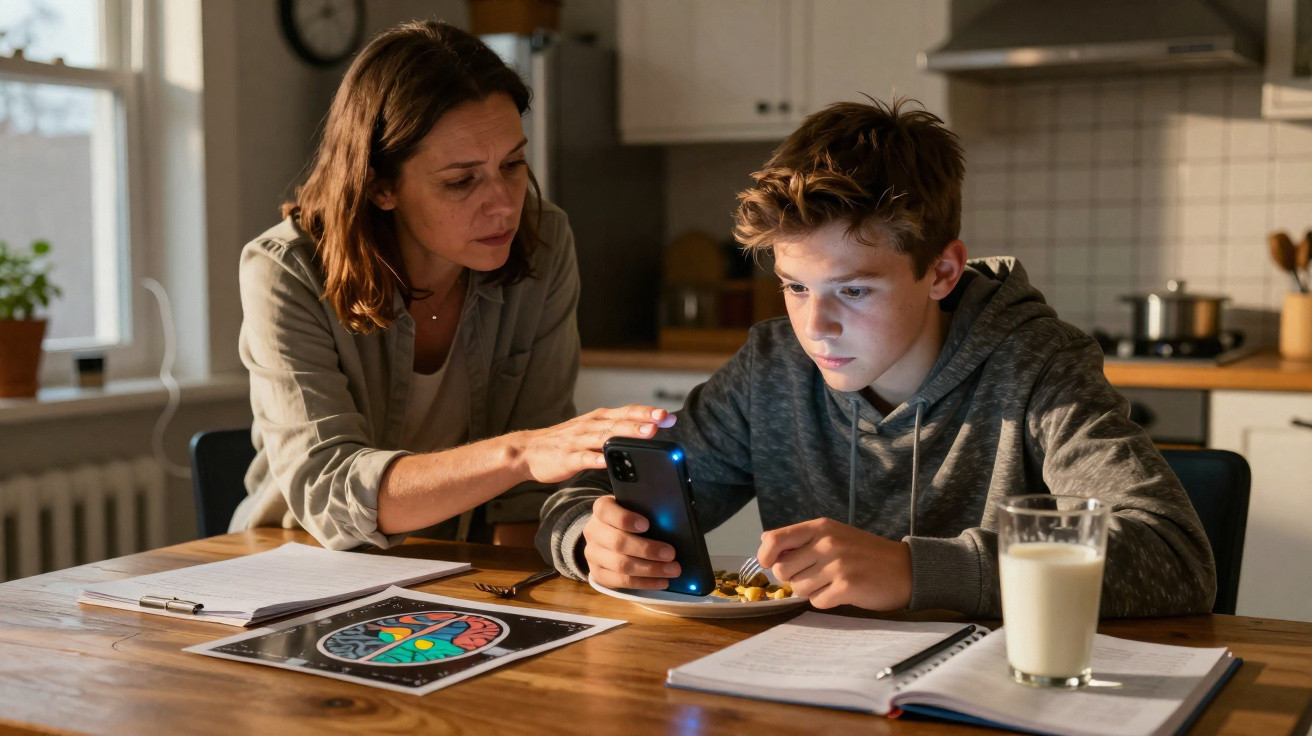
Speak to parents about TikTok and the same combination of guilt and resignation comes up repeatedly. Some impose firm boundaries; others surrender after the third tantrum. Plenty settle on a compromise that feels more like giving in: “At least I know where they are.”
One practical change recommended by experts has little to do with in-app settings or parental-control screens. The real conflict takes place in the small routines that shape each day.
Phones charging overnight outside bedrooms.
Declaring “offline hours” in the way a library might announce quiet time.
Even a basic rule such as: “No TikTok before school or during meals.” These may be modest measures, but they create pockets of calm in an environment built for speed.
Parents also acknowledge something else, usually in private. TikTok can be convenient childcare. After a long shift, while juggling two jobs, or in a small flat without a garden, passing over a phone creates quiet. It creates calm. It buys a precarious moment to breathe.
We have all known that point when “Just twenty minutes” somehow becomes an hour. Then two hours. Then the normal evening routine.
Let’s be truthful: hardly anyone monitors those minutes every day without fail.
So when a study says the app is physically reshaping children’s brains, it does not merely land as a technology story. It feels like a charge against parents.
Across living rooms and comment sections, a culture war is under way over who should bear responsibility. Technology firms point to parental tools and time caps. Parents point to addictive design and algorithms their children cannot reasonably understand. Politicians gesture at everybody while putting together underdeveloped regulatory proposals.
One digital ethicist I spoke with expressed it plainly:
“TikTok isn’t sneaking into kids’ rooms at night. It walks in through the front door, invited, because our whole system is built on convenience. We outsource boredom, and then we’re shocked when attention disappears.”
The straightforward reality is painful, but it also makes clear where parents still retain influence:
- Create non-negotiable offline spaces, including bedrooms, the dinner table and car journeys before 9 a.m.
- Describe the algorithm as a character rather than an unknown force: “It wants to keep you watching.”
- Provide one specific alternative at the precise point you say “Enough TikTok for now.”
- Recognise that certain days will be untidy, noisy and filled with eye-rolling - and persist anyway.
What changes when we accept TikTok is not going away
There is an awkward fact on which most experts now agree: the aim is not a childhood without TikTok. That possibility disappeared when phones became less expensive than laptops and quicker than school Wi-Fi. The real task is to help children develop brains able to cope with both the disorder of the feed and the slower rhythm of everyday life.
That means discussing “training” more often than “addiction”.
Brief videos train brief concentration. Extended work trains extended concentration.
When a child spends three hours a day in one setting and virtually no time in the other, the result is not difficult to predict. The brain follows where the hours go.
Parents who have begun to regain some control often describe an approach that sounds almost traditional. They purposefully plan “boring time”. No screens, no organised activities and no productivity tricks. Simply empty space.
Children protest. They insist they are dying of boredom. They wander about, request the Wi-Fi password once more and stare angrily at the clock. Then, gradually, something changes. A board game comes out. They draw. They make something from cardboard. Sometimes, they even talk.
It does not invariably appear magical. At times, it resembles disorder and complaining. Sometimes it just looks like real life reloading itself in slow motion.
The study of brain rewiring has no setting that can measure this, yet every parent who has attempted it notices the difference.
TikTok’s supporters also highlight the creativity available there: children learning languages, showing their art and finding communities they cannot access offline. Some teenagers say TikTok was the first place where they saw somebody who looked like them, loved like them or thought like them. That cannot simply be dismissed as “bad”.
The risk comes from acting as if the platform is neutral. It is not. It promotes whatever captures attention, provokes outrage, glitters or shocks. This influences not only attention but identity. Children encounter forceful opinions about politics, gender, body image and mental health before they have had the opportunity to form their own inner compass.
So the central question is not “Is TikTok evil?”
It is “Who’s helping kids make sense of everything it throws at them?”
| Key point | Detail | Value for the reader |
|---|---|---|
| Neuroplastic impact | New research links heavy TikTok use with shifts in children’s reward and attention systems | Gives parents language to understand what “rewiring” really means |
| Parental leverage | Small, consistent routines (offline zones, charging stations, “boring time”) counterbalance the feed | Offers practical, realistic measures that do not require complete bans |
| Shared responsibility | Apps, parents, schools and policymakers all shape the environment in which children grow up | Helps readers move beyond blame towards action they can control today |











Comments
No comments yet. Be the first to comment!
Leave a Comment