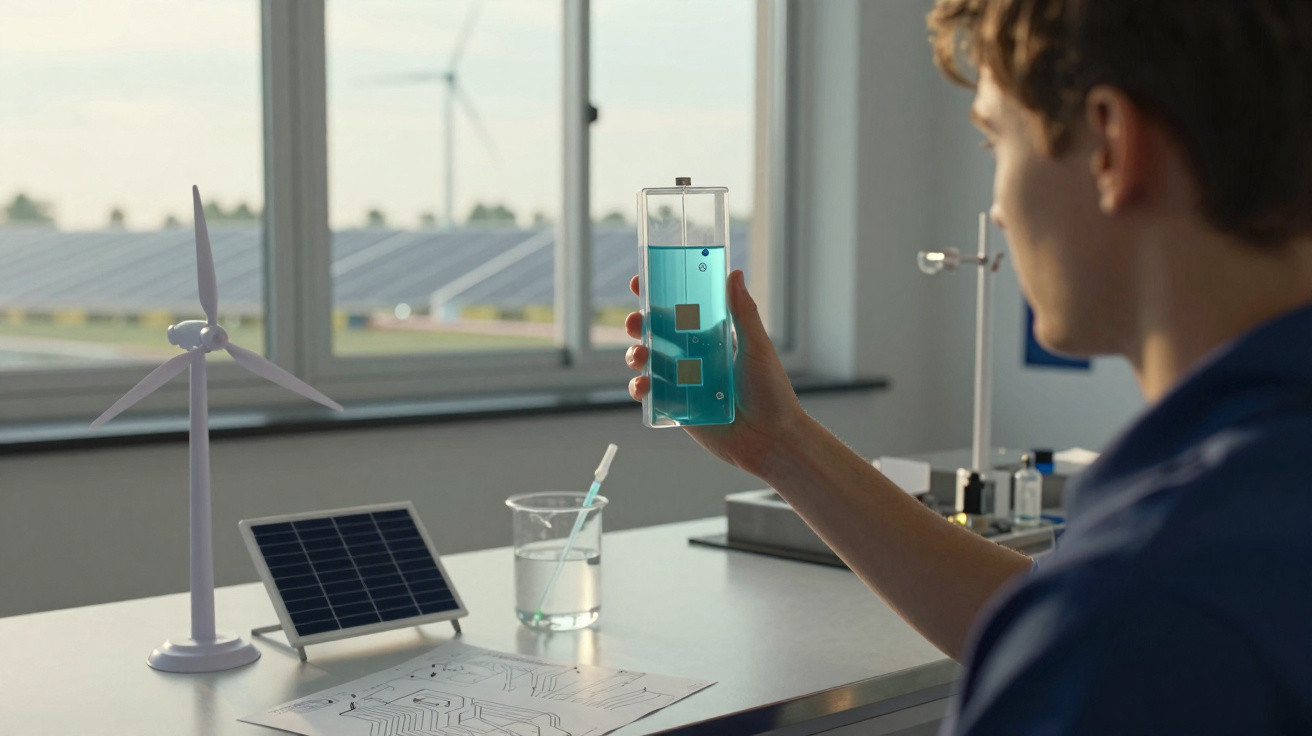
Water and electronics are not normally compatible, yet batteries may actually gain from a little H₂O.
Scientists have created a recyclable ‘water battery’ by swapping the hazardous chemical electrolytes in commercial batteries for water. In doing so, they have addressed major problems facing this developing technology, which may offer a safer, more environmentally friendly alternative.
What are water batteries?
Formally called aqueous metal-ion batteries, ‘water batteries’ use metals including magnesium and zinc. These are less toxic and cheaper to assemble than materials used in many current battery types.
A battery stores energy by generating an electron flow from its positive terminal, the cathode, to its negative terminal, the anode. It releases energy when the electrons move in the reverse direction. The liquid inside the battery transfers electrons between these two ends.
Rather than using an electrolyte such as sulphuric acid or lithium salt, a water battery contains water with a small amount of added salts.
Preventing short circuits in aqueous metal-ion batteries
Most importantly, the researchers behind this advance found a way to stop water batteries from short-circuiting. Short circuits can occur when minute, needle-like metallic structures known as dendrites develop on the battery’s metal anode and break through its internal compartments.
The technology is not expected to displace lithium-ion batteries in the near future. However, with continued research and development, water batteries could become a safe alternative to lithium-ion models within roughly a decade, according to lead author Tianyi Ma, a chemical scientist at RMIT University in Melbourne, Australia.
Lithium-ion batteries power devices ranging from laptops and phones to electric bicycles and cars. In extreme circumstances, they can overheat and catch fire because lithium is a highly reactive metal immersed in an organic electrolyte.
Safety concerns have therefore prompted researchers to seek batteries made from alternative materials that can deliver equivalent performance and a comparable lifespan.
Dendrite formation has been a significant obstacle for aqueous metal-ion batteries. To prevent it, the researchers applied a bismuth-metal coating to the battery’s zinc anode. The bismuth oxidises into rust, forming a protective barrier that prevents dendrites from growing.
Tests by the researchers showed that this feature also extends the life of prototype water batteries: they retained more than 85 percent of their capacity after 500 cycles.
Royce Kurmelovs at The Guardian reports that the team has already produced water-based prototypes in the form of coin-sized batteries for clocks and cylindrical cells resembling AA or AAA batteries.
Magnesium water batteries and renewable energy storage
The researchers are seeking to raise the energy density of their water batteries so that they can compete with the compact lithium-ion batteries used in pocket-sized devices.
Their preferred material is magnesium, which is lighter than zinc and offers the potential for higher energy density. Ma says that, if magnesium-ion batteries can be commercialised, they could replace bulky lead-acid batteries within a few years.
With their low energy density, lead-acid batteries are used to start petrol and diesel vehicle engines and for large-scale grid energy storage. Yet, because they include lead and hazardous acids, they cannot simply be discarded and must instead be recycled by specialist facilities.
Recycling and reusing lithium-ion batteries is also a major priority. Demand for both the batteries and the metals required to manufacture them is expected to rise as global energy systems are electrified to phase out fossil fuels and tackle climate change.
"Addressing end-of-life disposal challenges that consumers, industry, and governments globally face with current energy storage technology, our batteries can be safely disassembled and the materials can be reused or recycled," Ma says.
For a practical test, the researchers connected their battery design to a solar panel and a 45-watt solar light. Following a day of charging, the battery kept the light on for 12 hours. Although small in scale, the demonstration highlights the potential for ‘water batteries’ in renewable energy storage and should spur further research.
The study has been published in Advanced Materials.















Comments
No comments yet. Be the first to comment!
Leave a Comment