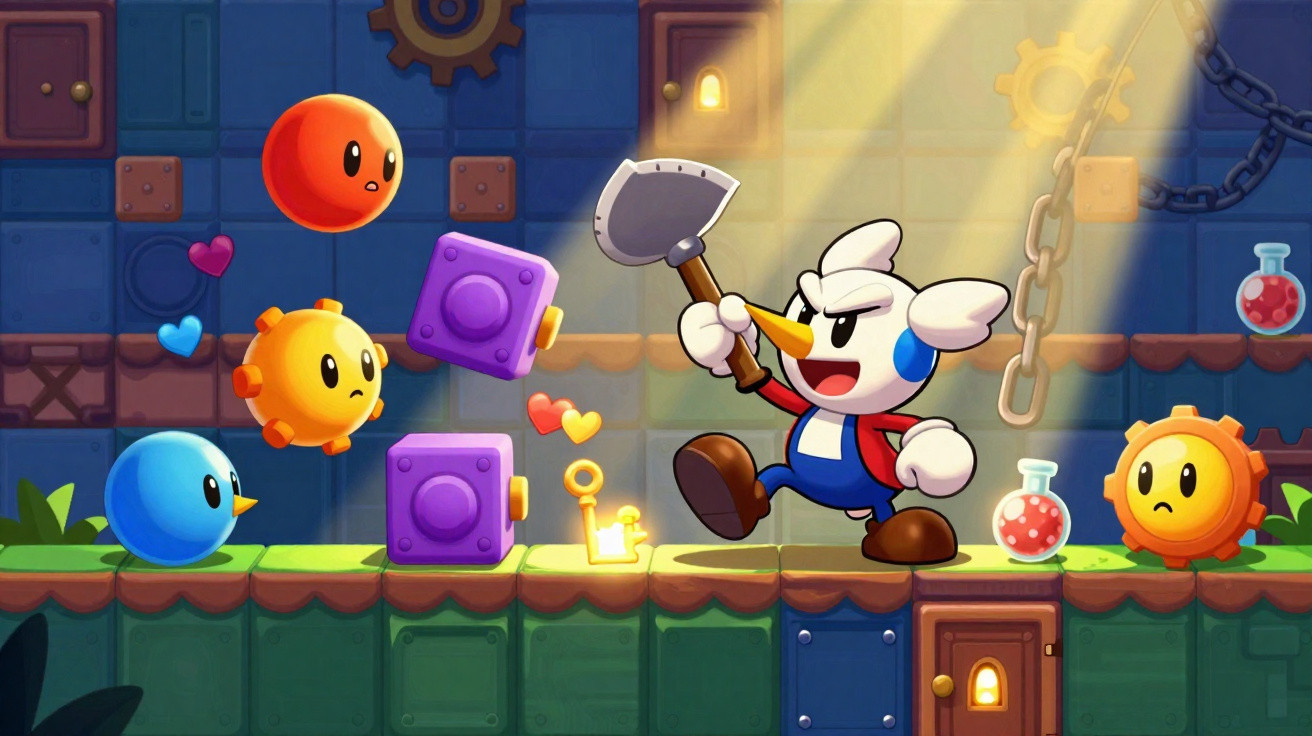
Shovel Knight Pocket Dungeon arrives tomorrow, giving everyone’s favourite shovel-wielding hero - and obligatory indie-game cameo star - an intriguing new direction. After playing countless rounds, I can confirm that its action-focused take on tile-matching puzzle games is effective. Provided you can tolerate its unexpectedly sharp difficulty curve, Pocket Dungeon is well worth a look for anyone after a fresh puzzler to gradually work through.
Shovel Knight Pocket Dungeon’s tile-matching action
Pocket Dungeon’s playfields are filled with descending tiles representing monsters, obstacles, health potions and other items. You need to stop them piling up to the top by removing matching tiles positioned beside one another. By moving Shovel Knight - or another unlockable character - around the board, you can smash matching tiles. The tiles initially fall automatically at a slow pace, but every movement you make speeds up their descent. In addition, both you and the monsters have health bars, with most enemies retaliating once struck. Running out of health means failure, turning Pocket Dungeon into a demanding exercise in clearing tiles reasonably swiftly while choosing attacks carefully enough to avoid being defeated. Removing tiles also earns gems for buying new items and charges a meter that multiplies your gem earnings.
As somebody who enjoys tile-matching games, I needed time to adjust to Pocket Dungeon’s more action-driven formula. Truthfully, I have not completely mastered it yet. At first, I reflexively charged into every matching group of monsters I spotted, overlooking the fact that I would frequently suffer identical damage in response. Death works differently depending on whether you select traditional or roguelike play. Traditional mode gives you unlimited lives, meaning you only lose once the board fills completely. Under roguelike rules, every death sends you back to the beginning, no matter what condition the board is in. I am using the traditional option, though I would call it “less hard” rather than easy, per se. Shovel Knight may die as many times as necessary, but respawning costs valuable seconds and the game does not pause while you are away. When you return, the board could already be full, causing a failure. It has taught me to keep a close eye on my health and assess when it is best to attack.
Surviving each stage
You are not required to clear every tile from a board to succeed. Discovering keys that unlock exit doors takes you onwards to the following stage, so the true objective is simply staying alive until that door appears. Keys can also unlock chests containing valuable power-ups, including a spear that pierces several targets, a shield that blocks attacks and a smokescreen that prevents enemy counterattacks inside a set area. My personal favourite is the straightforward bomb, which removes large sections of tiles, although it can hurt you too if you fail to leave its blast radius.
Shovel Knight Pocket Dungeon is difficult. Because tiles fall more quickly while you are moving - and descend more slowly when you remain still - it is hard to suppress the instinct to charge through as fast as possible, and doing so can lead to a rushed death. That is particularly true when facing enemies that demand more consideration, such as ghosts that disappear temporarily after every hit or frogs that become electrified every other move. Handling several enemy types, all with their own required method of defeat, is no simple task. I endured plenty of punishment before eventually finding my rhythm. I can now make my way around a board cautiously while continuing to act at speed. Eliminating 10+ blocks of a troublesome enemy is tremendously satisfying.
An early difficulty spike
Even so, I feel the game’s difficulty rises sooner than it ought to. Stage 1 provides a solid introduction through its basic enemies, making the mechanics easy to understand. Stage 2, however, introduces shield-carrying foes that need to be attacked from several directions because they block whichever angle you used to strike them last. It is a difficult concept to process so early in the game, and it seems better suited to the 3rd or 4th stage at the earliest. It stopped my progress early on. I am concerned that other players may encounter the same obstacle and give up sooner rather than later.
Losing a stage sends you back to Stage 1, although you can thankfully eventually buy a fast-travel feature that lets you return straight to a stage of your choosing. Between attempts, you spend time at a base camp, where a rotating shop stock lets you buy useful items. Helpful benefits include extending the gem meter’s duration or increasing your hit points. I also like taking part in NPC diversions, such as a reflex-based tile-hitting challenge.
Shovel Knight Pocket Dungeon keeps developing, and on the whole I am enjoying discovering what mischievous surprises it has prepared. The pixel art is, unsurprisingly, excellent, while the soundtrack is every bit as bop-worthy as you would expect from a Shovel Knight game. My metallic backside is also being handed to me less often, yet the game is still an uphill battle in terms of difficulty. Shovel Knight’s block-based puzzle experiment is becoming a fun success, even if it frequently inspires swearing.
Shovel Knight Pocket Dungeon will be available on PlayStation 4, Switch and PC.
















Comments
No comments yet. Be the first to comment!
Leave a Comment