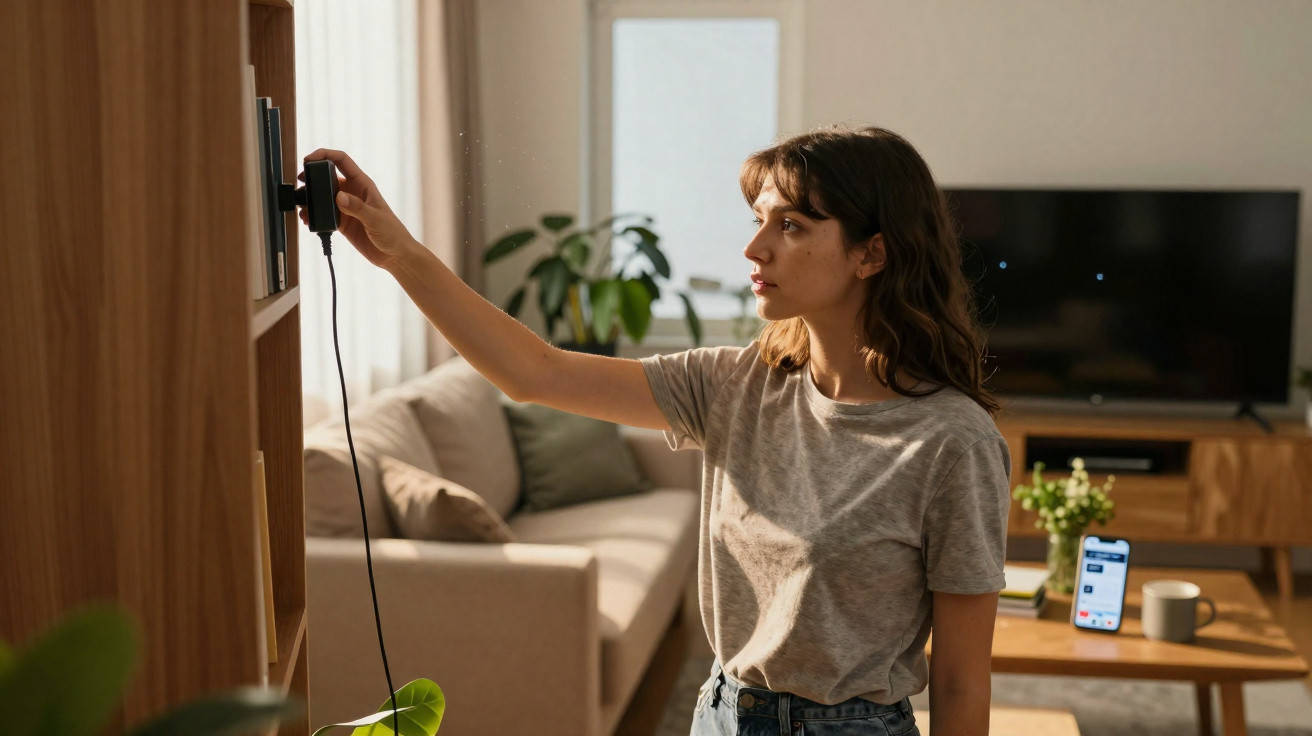
Her living room remembered more than she did. Every giggle, every doze on the sofa, every midnight shuffle to the kitchen had been gathered by tiny silicon eyes and stored away. She paid for security. What arrived instead was a sensation that doesn’t disappear just because you’ve shut the front door.
There was a gentle click halfway through dinner, exactly as the kettle began to breathe, like a mate leaning in to catch what you were saying. Then her phone lit up: “Motion detected: Kitchen.” The clip showed nothing but my back, moving from hob to sink-something I’d already lived once, now handed back to me for replay like a highlight reel I never asked for.
I angled the camera towards the wall. Two hours later, it chimed again. That night I lay in bed and the house felt awake without me, like a stage that stays warm long after the crowd has gone. The hallway was dark. The blue LED wasn’t. Then the camera blinked.
The moment trust cracked
In the beginning it was the small things. A friend walking in and going still because the living-room lens swivelled to find her face. A neighbour waving at the doorbell as if it were waving back. The house seemed to have preferences now. It watched the way a mirror watches when you’re not ready to look.
After that came the stories she couldn’t scrub from her mind. Headlines about camera feeds left exposed by careless passwords. A baby monitor speaking in a stranger’s voice in the middle of the night. A city police department requesting footage after a car alarm somewhere across town. None of it happened to her-and yet, in a way, it did. That’s what proximity feels like in an age of connected devices.
What finally pushed her over the edge wasn’t a hack or a headline. It was the dull thump in her chest each time the app labelled her own life as “motion”. The camera wasn’t merely documenting a room; it was changing how the room was used. You dress differently when a lens might be live. You keep arguments quieter. You laugh a touch less loudly. Privacy isn’t a switch; it’s a feeling.
How she took back the room
She began with paper and tape. She sketched the flat, placing a red dot for every lens and a blue dot for every microphone. Power came first: unplug, count to ten, breathe. Then she went space by space-taking down what was simple, packing away what cost a lot, and swapping “always on” for “only when needed”. Less surveillance, more intention.
Next were the settings. Cloud uploads: off. Push alerts: off. Local-only storage for the single camera she kept in a cupboard, aimed at the bike, and protected by a physical shutter she could slide with her thumb. Let’s be honest: hardly anyone keeps up this routine daily. She moved smart devices onto a guest Wi‑Fi network that never touched her laptop. She fitted a basic contact sensor to the door. The home felt smaller-and, oddly, bigger.
She wrote rules she could actually stick to and taped them inside a kitchen drawer. Then she said out loud what many of us only admit under our breath.
“I felt watched in my own house. I wanted to get home and feel like I had arrived, not like I had logged in.”
Her quick notes for anyone who recognises that feeling:
- Count lenses, not rooms. Remove one more than you think you can.
- Choose shutters you can see and slide, not just toggles you hope you can trust.
- Prioritise local video that never leaves your router.
- Put every camera on a separate network-or don’t keep it.
- Ask what the camera gives you that a better lock or a brighter bulb can’t.
What stays when the cameras leave
What surprised her was what “quiet” looked like. Not silence as sound, but as posture. She made tea and rested against the counter without the sting of being framed. A friend cried on the sofa and didn’t glance up at the ceiling. The dog rolled slowly in a patch of sun as if he were the only golden thing on earth.
Safety didn’t disappear; it just took a different form. There was still a peephole and a chain. There was still a neighbour’s text if a parcel sat too long. There was still a motion light that came on at the right moment-and only at the right moment. We’ve all had that time when home feels like a stranger after a scare, and you want something solid to hold. Cameras sell the feeling of control. Trust builds the habit of it.
Taking down the lenses didn’t wipe out memory. It reminded her that not every moment deserves to be kept as a record. The mind folds some days into itself for a reason. Not everything needs an archive.
From always-on to on-demand: a practical path
Before you unplug anything, audit what you’ve got. Write down every device with a lens or microphone, where it points, and when it records. Use a physical cover on any lens you keep, set it to “wake” only when you’re out, and send footage to local storage behind your own firewall.
Replace “watch everything” with “protect the edges”. Good lighting at entry points. Strong door hardware. A loud, straightforward siren. Share access with one trusted person, not ten. The common pitfalls are familiar: default logins, reused passwords, and third‑party integrations you never touch. You’re not lazy-you’re busy. Be kind to yourself while you simplify.
Treat your attention like rented space. What do you want your home to notice, and what do you want it to forget?
“I didn’t buy a home to keep performing,” she told me. “I bought it to stop.”
Here’s a compact guide you can genuinely try this week:
- Choose one room to be camera‑free for seven days.
- Turn any remaining camera to face a wall until it’s needed.
- Add a motion light or a door chime for real‑time cues.
- Set a weekly reminder to delete local footage older than 48 hours.
- Tell guests where lenses are-or take them down while friends are over.
The cost of feeling safe, and the price of feeling seen
There’s a quiet economy running under our roofs now: you swap calm for clips, ease for alerts, dinner for a thumbnail. A camera can be a tool, the same way a lock is a tool. Trouble begins when it becomes a mood. A home is built from thresholds and choices, not feeds and pings. What you remove can define you as much as what you add.
She didn’t try to convert anyone or lecture in group chats. She simply noticed her breathing change when the last lens came down. The kettle warmed, the dog snored, and the streetlight laid a soft rectangle on the floor. Inside that rectangle, she could put her phone down and not be notified about her own life. That, all along, was the point.
| Key point | Detail | Why it matters to the reader |
|---|---|---|
| Map first, then act | List every lens and microphone, then decide which ones earn their place | A clear starting point beats vague anxiety |
| Prefer on‑demand, not always‑on | Use shutters, schedules, and local storage instead of cloud feeds | Cuts exposure while keeping real utility |
| Guard the edges | Better locks, lighting, and neighbours instead of constant video | Keeps you safer without living on camera |





Comments
No comments yet. Be the first to comment!
Leave a Comment