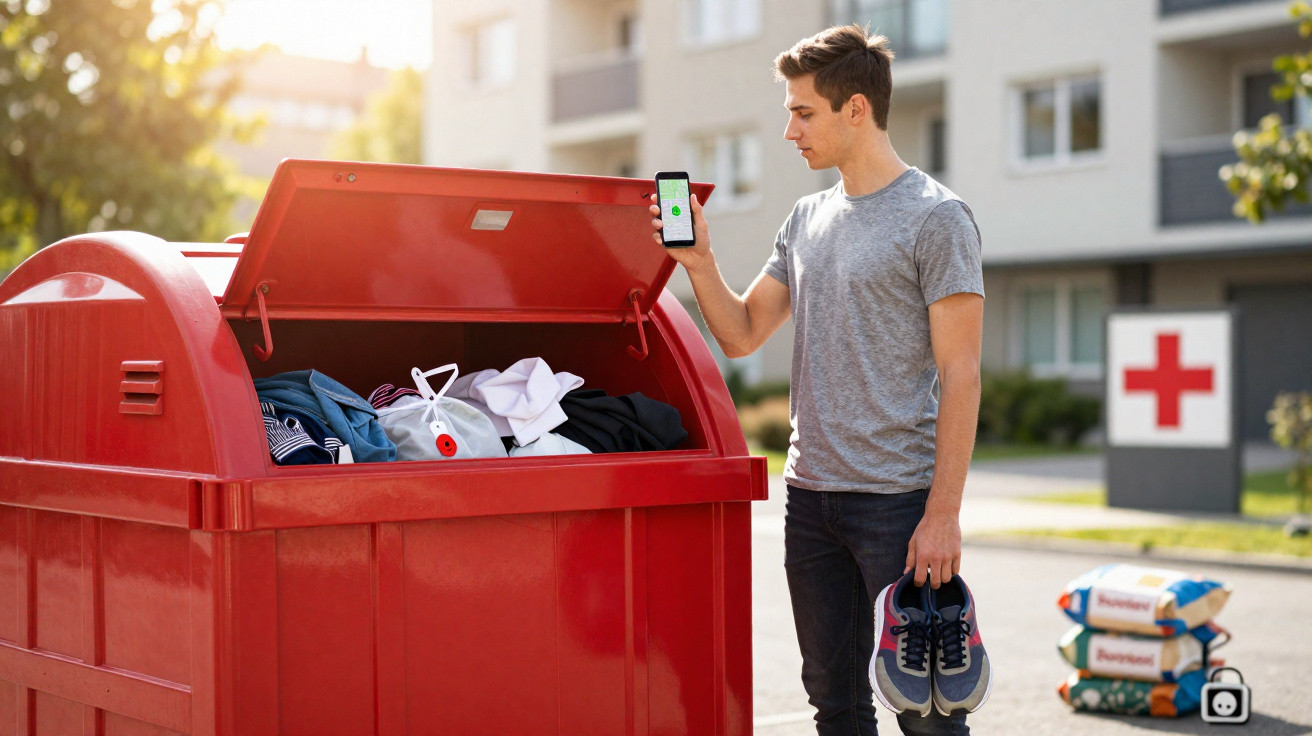
A German influencer put this to the test by dropping his old trainers into a German Red Cross collection bin – after hiding an Apple AirTag in the sole. What appeared to be a simple act set off a lengthy digital pursuit and revealed a little of the multi-million-pound clothing-donation trade.
How old trainers became a GPS experiment
Metal bins for unwanted clothing stand on street corners throughout Germany. The German Red Cross alone operates around 25,000 of these containers across cities, suburbs and villages. Officially, the textiles left in them are intended to help people in need or, at the very least, be reused for a charitable purpose.
That was precisely what the influencer known as Moe.Haa wanted to investigate. He modified a worn pair of trainers by placing an Apple AirTag inside a hollowed-out sole, sealing it again and taking the shoes to a collection bin in Starnberg, south of Munich.
He recorded the drop-off for his followers, although the real focus of the experiment was the tracking. Using the “Find My” app on his iPhone, he was able to follow the route taken by the donated shoes in real time.
AirTags: how a tiny tracker can reveal such long journeys
AirTags are commonly described as “GPS trackers”, although that is not technically accurate. They emit a Bluetooth signal that can be detected by nearby iPhones and other Apple devices. Those devices have GPS and anonymously report the location to Apple’s servers. This makes it possible to trace an AirTag’s position with considerable accuracy almost anywhere in the world.
The denser the network of iPhones, the more complete an AirTag’s travel route becomes – including in used-clothing collection.
This system works remarkably well in Europe, where Apple devices are widespread. For Moe.Haa’s experiment, the AirTag was therefore the ideal tool.
The Red Cross trainers’ route: from Bavaria to Bosnia
The journey began without incident. At first, the trainers’ location remained in Starnberg for some time. They then started moving, with the tracker reporting a stop in Munich. The city is home to, among other facilities, sorting centres and logistics sites for used clothing.
Up to that point, the route matched the familiar pattern of collection and sorting. The surprise came when the dot in the app suddenly crossed the national border.
- Stop 1: Starnberg – deposited in the collection bin
- Stop 2: Munich – presumably a collection or sorting facility
- Stop 3: Austria – transit through the Alps
- Stop 4: Slovenia – passing through towards the Balkans
- Stop 5: Croatia – onward transport to the south-east
- Final destination: Bosnia and Herzegovina – around 800 kilometres from the original location
All told, the shoes travelled roughly 800 kilometres – far farther than most donors are likely to expect. The tracker ultimately remained in Bosnia and Herzegovina, in an area with several textile businesses and second-hand retailers.
Why do donations end up abroad? The used-clothing business
The German Red Cross and other charitable collectors grade donated textiles into different quality categories. Only a small proportion of items in particularly good condition is given free of charge to people in need, for example through clothing banks.
A larger share is sold, either through local second-hand shops or wholesale channels. Commercial traders then buy the goods and resell them in other countries. The Balkans, Eastern Europe, Africa and the Middle East are particularly important markets for second-hand clothing from Western Europe.
The usual breakdown is as follows:
| Category | What happens to it |
|---|---|
| Very good quality | Second-hand shops, export to more affluent markets |
| Medium quality | Wholesale, export to lower-income countries |
| Poor quality | Recycled into cleaning cloths, insulation material and industrial fibres |
| Unusable | Incineration or landfill |
According to the organisations involved, revenue from sales funds aid projects, emergency services and social work. Even so, the AirTag case highlights how opaque this cycle can appear to the public.
Red Cross under pressure to explain
When the influencer published the unusual route taken by his shoes, the online reaction was predictable: many users felt misled. Many people had assumed their donations would remain in their own country or go directly to people in need.
The real unease is caused not by exports, but by the gap between donors’ expectations and the reality of the market.
The Red Cross had to explain how its collection system operates. In such cases, the organisation stresses that domestic and international sales form an important part of its funding. Without that income, many projects could scarcely continue.
Critics argue that collection bins rarely state clearly what happens to donated items. For a relationship of trust between donors and charities, many would like more precise labelling and greater visibility of the routes and volumes involved.
Between aid and trade: moral grey areas
Objectively, reselling old clothing is not automatically a negative practice. Wearable textiles remain in use for longer, resources are conserved, and charities generate income without additional production.
Nevertheless, there can be an unpleasant aftertaste when unwanted clothing is understood as an almost wholly charitable donation but ultimately becomes part of a global trading network. Some aid organisations work with commercial partners that install and empty the bins, as well as process the goods. This mixture of charity and business is not always clearly separated.
There is another issue: in some receiving countries, local textile manufacturers and domestic retailers face pressure as cheap second-hand goods flood the market. Studies indicate that the effects vary greatly by region, ranging from financial relief for local people to the displacement of domestic suppliers.
What donors can learn from the AirTag experiment
Anyone placing clothing in a collection bin should recognise that the items enter a material-recovery cycle. They may do good, but in a very different way from what many people expect. Three practical approaches can help people make a more informed choice:
- Donate directly: Give well-kept items straight to local clothing banks, homelessness charities or social supermarkets. Their journey is often more transparent there.
- Sort by quality: Heavily worn or damaged clothing is generally better suited to textile recycling than a donation bin.
- Check the organisation: Read its website or information leaflets to find out how it handles used clothing and what proportion of donations it sells.
Aid organisations themselves can also learn from experiments like this one. The more clearly they explain on bins and in information materials that some donations enter export or trade channels, the less room there is for misunderstandings and outraged videos.
AirTags, tracking and new forms of scrutiny
The case also demonstrates how digital tools can place traditional systems under scrutiny. Trackers such as AirTags can be used not only to find lost keys, but also to monitor supply chains, recycling routes and donation flows.
At the same time, such devices carry risks: they can be misused to track individuals. Apple therefore includes safety features that alert people to unfamiliar AirTags. For objects and goods, however, these small discs create new ways to document processes.
It is easy to imagine environmental organisations using these methods more often in future to trace the journeys of electronic waste, plastic rubbish or unwanted textiles. That would place a degree of pressure on businesses and charities to organise processes more responsibly and communicate them more transparently.
What if everyone tracked their donations?
Imagine that every tenth clothing donation contained a tracker. Logistics chains would suddenly form a pattern visible to the public. Online maps could show real-time maps of the used-clothing trade. Routes across several continents would become visible, including intermediaries, sorting centres and ports.
Such a scenario would not merely push charities and traders towards greater openness. It could also expose wrongdoing, including illegal exports or questionable disposal practices. At the same time, there would be a risk that sensitive operational data was disclosed unintentionally and that legitimate systems were broadly discredited.
Anyone throwing old shoes into a collection bin today is unlikely to build an AirTag into the sole. Moe.Haa’s test nevertheless shows how useful it can be to take a critical look at routines that seem self-evident. Clothing donations help, but their journey is often more complicated, longer and more commercial than the sign on a collection bin suggests.

















Comments
No comments yet. Be the first to comment!
Leave a Comment