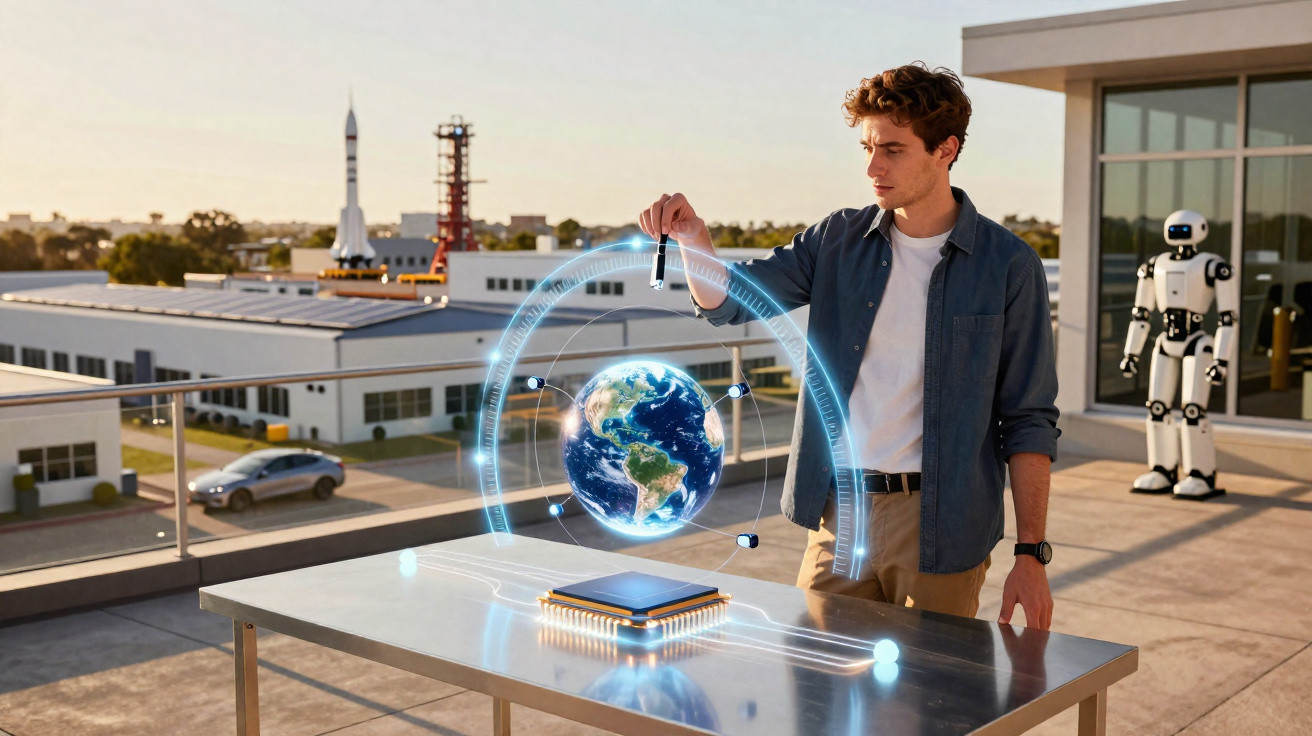
In Austin, a vast industrial campus is taking shape that is intended to bring together the semiconductor ambitions of Tesla, SpaceX and Musk’s AI plans. Called “Terafab”, the entrepreneur intends to build two high-tech factories designed specifically for demanding AI applications and use in space.
What lies behind Musk’s Terafab project
At an event in Austin, Musk made it clear that, in his view, global chip production is no longer sufficient to support his ambitions. Autonomous driving, humanoid robots, enormous data centres on Earth and in orbit all require specialised, exceptionally powerful semiconductors.
Terafab is intended to supply Tesla, SpaceX and xAI with proprietary AI chips – from the road to Earth orbit.
The Texas complex is set to consist of two distinctly separate divisions:
- Factory 1: chips for vehicles and humanoid robots such as Tesla’s “Optimus”
- Factory 2: high-performance chips for data centres, with orbital deployment also planned
This would see Musk move, at least in part, away from being a conventional customer of contract manufacturers such as TSMC or Samsung. Rather than merely placing orders, his group of companies aims to handle development, manufacturing and packaging itself in future.
Vertical integration: everything under one roof in Texas
What stands out in particular is the uncompromising plan to concentrate as much of the entire value chain as possible at one location. Terafab is intended to be more than an ordinary factory; it is planned as a fully integrated semiconductor site.
Under the plans known so far, the following functions would be brought together in Austin:
- chip design tailored to AI, autonomous systems and spaceflight
- lithography for extremely fine feature sizes down to 2 nanometres
- production lines for different chip types, including edge and high-performance chips
- memory manufacturing or close integration of memory solutions
- on-site packaging and testing
Analysts put the investment at US$20 to US$25 billion. That scale illustrates the level at which Musk intends to compete: Terafab is meant to operate at the very top of the semiconductor industry.
One terawatt of computing power each year
The name reflects the objective: Terafab is targeting annual computing capacity of around one terawatt across the chips it produces. This is not simply a marketing claim, but a clearly defined strategic aim.
If Terafab operates as planned, it will create dedicated energy and computing infrastructure for AI – effectively a Musk-specific ecosystem.
In practical terms, this could mean:
- greater AI capacity for Tesla’s Full-Self-Driving systems
- more capable control computers for the humanoid robot Optimus
- bespoke chips for SpaceX rockets, satellites and spacecraft
- specialised processors for xAI’s AI models
Instead of relying on off-the-shelf standard chips, the companies could therefore use components designed precisely around their respective products. That improves performance while making it more difficult for competitors to develop similar systems with comparable efficiency.
AI in space: data centres in orbit
The second part of the proposal appears particularly futuristic: one of the two factories is expected to make chips developed specifically for use in space. They would need to withstand vacuum conditions, radiation and extreme temperature fluctuations while operating reliably over the long term.
Over time, this could produce an entirely new form of cloud infrastructure. SpaceX plans to use Starship to transport large data centres into Earth orbit. Servers there could run on constant solar power and be cooled using radiator surfaces. As a result, expensive cooling systems and fluctuating energy prices on the ground would become less significant.
The merger of SpaceX with Musk’s AI company xAI, valued at around US$1.25 trillion, is directly connected to this approach. The intention is to shift computing workloads from Earth into space in order to bypass constraints in electricity grids and conventional data centres.
Why orbit is attractive for AI
From Musk’s perspective, space-based data centres offer several advantages:
- an almost constant energy supply from sunlight
- efficient cooling by radiating heat into space
- theoretically extensive scalability through additional modules in orbit
- strategic independence from national power grids and physical locations
At the same time, the concept raises questions. How safely can such systems be operated? What part will space debris play? And how can data be transferred to and from Earth with minimal latency? So far, only partial answers are available.
Pressure on TSMC, Samsung and others
Terafab sends a clear message to the established semiconductor industry. Major technology companies such as Apple, Google and Microsoft also invest heavily in their own chip design, but they continue to use contract manufacturers for production. Musk is taking the approach a step further by seeking to keep both design and manufacturing as far as possible under his own control.
Whoever controls their own chip factory also sets the technical standards for their AI infrastructure.
For industry leaders such as TSMC and Samsung, this means that a significant customer is building at least part of its own manufacturing base away from their facilities. It may have little immediate impact on the market, but over the longer term it could become a trend, particularly among companies that depend heavily on AI hardware.
Opportunities and risks of this strategy
Moving into in-house manufacturing offers opportunities, but it also involves enormous risks.
| Aspect | Opportunity | Risk |
|---|---|---|
| Control | complete control over supply chains and the technology roadmap | heavy dependence on one site and an in-house factory |
| Costs | lower unit costs over the long term at high volumes | enormous initial investment, with an uncertain payback period |
| Innovation | bespoke AI architectures become possible | development failures directly affect the company’s own balance sheet |
| Competition | technological lead over rivals | political and regulatory risks, such as export controls |
What Terafab means for Tesla drivers and robotics
For Tesla vehicle users, Terafab is initially an abstract piece of industrial news. Over the longer term, however, the chip initiative is likely to have a direct impact on products seen on the road.
Proprietary AI processors in cars could enable the Full-Self-Driving system to process more sensor and camera data in real time. This computing capacity is crucial in city centres, poor weather and complex traffic situations.
Tesla’s humanoid robot Optimus also requires powerful, energy-efficient chips to combine visual processing, language and movement. In this area, Tesla is indirectly competing with other robotics projects that likewise rely on specialised AI hardware.
Explainer: what makes an AI chip so special?
AI chips differ from conventional processors in laptops or mobile phones. Rather than using a small number of highly powerful cores, they rely on many thousands of small computing units working in parallel. This structure is ideally suited to neural networks.
Typical characteristics of modern AI chips include:
- an exceptionally high number of parallel computing operations per second
- optimised memory connectivity for moving large volumes of weight data
- specialised instructions for matrix and vector operations
- adapted numerical formats, such as 8-bit or 16-bit representations
In practice, this means that a well-designed AI chip can run a substantially larger model than a conventional processor while consuming the same amount of power. This is precisely the level of efficiency Musk needs to equip cars, robots and space systems with AI.
What the industry can learn from Terafab
Terafab demonstrates how profoundly the semiconductor and AI market is changing. Rather than developing only software and relying on standard hardware, some companies are now creating their own deeply integrated systems, from chip architecture through to the application.
For other businesses, this creates two central questions: is a similar move towards proprietary hardware worthwhile? And how dependent do they want to be on a small number of large contract manufacturers supplying the entire industry? The answers will determine who sets the pace in AI hardware in the years ahead – and who simply has to buy whatever is available.










Comments
No comments yet. Be the first to comment!
Leave a Comment