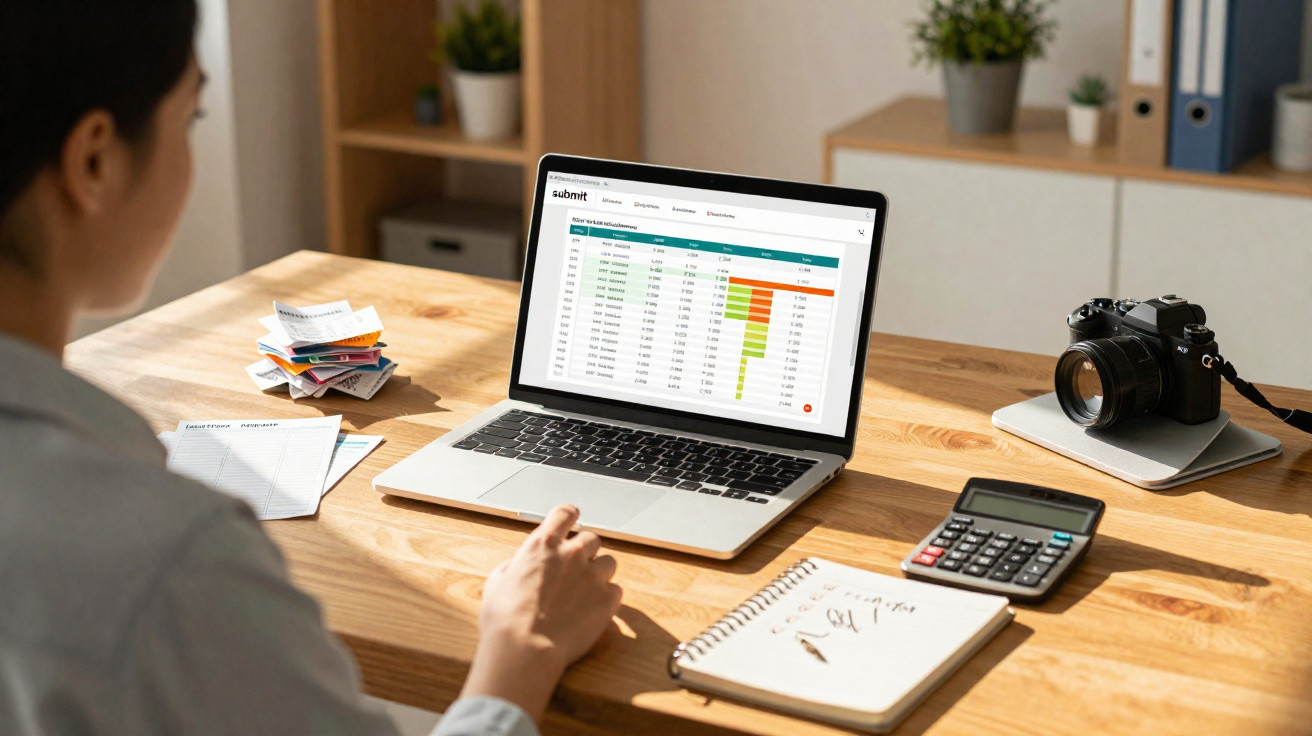
Receipts with the crisp texture of dried leaves, PDF bank statements, and a business card for an accountant I never rang. The tax year has a habit of sneaking up like that friend who promises to “pop by” before turning up with a suitcase. Most of us know the moment: you discover you have paid for things you never claimed, and money has slipped away not because you did anything wrong, but because you were exhausted, busy and human. So I started a new spreadsheet, gave it the determinedly chilly name Tax Overhaul 2024–25, and put the kettle on again. The secret, I had been told, was not to hunt down deductions at the last minute, but to map them out from the beginning. Then, rather quietly, something interesting began to happen.
The decision you genuinely feel in your body
Every overhaul starts with one small, firm choice. For me, it meant clearing an area just large enough for a laptop and saying aloud, “Right.” It is odd how a little ritual can bring practical clarity. Mine comes with the sound of browser tabs opening, a blinking cursor and fingernails tapping lightly on the keyboard. You do not need some miraculous new mindset. You need a folder, a spreadsheet and a commitment you can honour for twelve months.
Let us be truthful: nobody really keeps this up every day. We toss receipts into a shoebox and insist the box counts as a system. That is all right. This overhaul is not about flawlessness; it is about creating a straightforward tool that allows for the fact that you have a life. Begin modestly and begin today, before panic takes hold.
Step 1: Map the money before dealing with the figures
Before trying to maximise anything, make a list of what is there. Create one tab named Income Map. As the UK tax year runs from 6 April to 5 April, place those dates at the top of the sheet as a permanent prompt. Next, enter every source of income: your main employment, a side hustle, freelance invoices, rent, the Etsy shop quietly funding your coffee habit, dividends if you own a company, plus any interest or royalties.
Add columns for the date, source, gross amount, tax already deducted (PAYE or CIS), and status (paid, pending, disputed). If you are self-employed, add a column identifying late payers; it is not there to shame anyone, but to help you see the delay in your cash flow. A single afternoon spent mapping things honestly will often show why you have been overpaying, under-claiming or compensating with guesswork. The aim is an accurate, mildly dull view of how your money really comes in.
Step 2: Create the Deduction Maximiser tab
This is the centre of the overhaul: a tab that captures, sorts and assesses every pound that might legally reduce your tax bill. Treat it as a compassionate but clear-eyed friend. Its categories should align with HMRC’s way of viewing expenses, making the move to Self Assessment easier: travel, subsistence when travelling to a temporary workplace, home office costs, phone and internet, professional fees and subscriptions, training that keeps your skills current, marketing, equipment, software, protective clothing, bank charges, and the inevitable miscellaneous costs that still qualify.
Set up columns for date, supplier, description, amount, VAT position, category, business percentage, net allowed, receipt link and notes. Apply a simple formula so that “net allowed” is the amount multiplied by the business percentage, rounded to the nearest penny. Connect every item to evidence you can find again, whether that is a photograph, PDF or folder location. Few things feel more empowering than reviewing your expenses fairly yourself, with proof to support them.
Columns that genuinely make a difference
Your future self will appreciate three useful additions: an “evidence” tick box, a “recurring” drop-down (monthly, quarterly, annual, one-off), and a “review in” date. The evidence tick box makes you attach supporting proof. Recurring lets you prepare the following month in advance. Review in reminds you to renegotiate a subscription you dislike or cancel software that no longer serves a purpose. This is not merely administration; it is a health check for your business.
Step 3: Keep work and personal life apart without tears
Apportionment is the point at which people either save correctly or create a muddle. Phone and broadband costs? Use one column for the entire bill and another for the reasonable business proportion. If 60% of your mobile use is for work, record that and apply it consistently. Put your reasoning in the notes so that, when the next bill arrives at 2 a.m., you can remember why you selected 60%.
Working from home while self-employed? You may claim simplified expenses according to the number of monthly hours worked at home, or claim a share of actual costs such as heating, electricity and mortgage interest. Many people make this so complicated that they stop altogether. Pick one approach, record the reason for it and use it consistently. For employees, the pandemic-era flat rate is no longer the broad opportunity it once was, so check what your employer repays before making assumptions.
Step 4: Mileage, rail journeys and the uncertain sandwich
Travel rules can make it seem as though you are relocating with your receipts. Maintain a mileage log in its own tab, including the date, journey from/to, purpose, miles and rate. HMRC’s approved mileage allowance is 45p per mile for the first 10,000 business miles in the tax year, then 25p per mile after that. It may look insignificant in the short term, but once the totals appear, your shoulders can finally relax.
A train ticket to visit a client? You can claim it where the destination is a temporary workplace rather than your ordinary commute. The sandwich issue is more straightforward: reasonable subsistence is allowed when you are travelling for work away from your usual base. When you are at your normal office and simply fancy an expensive wrap, it is lunch rather than a deduction. Keep both your receipts and your peace of mind.
Step 5: The major levers that people overlook
Not every tax relief belongs in the expenses drawer. Pensions may have a greater effect than your stationery spend. Contributions to a personal pension receive basic rate relief at source, while higher or additional rate relief can be claimed through your return. Record contributions in a separate tab, including grossed-up totals, and identify any carry-forward from the previous three tax years where your earnings permit it. This is an adult sort of tab: the one that gets future you smiling ahead of time.
Gift Aid quietly does its work in the background. Where you have selected Gift Aid for donations, the charity handles basic rate relief, but if you pay higher rates, you can extend your basic rate band and claim additional relief. Record the dates and sums; the spreadsheet will gently direct you towards money you had intended to give away in any case. If you’re married or in a civil partnership and one of you earns below the personal allowance, the Marriage Allowance transfer can be worth a neat saving for ticking one box.
Step 6: Capital expenditure: kit, cameras, laptops and costly purchases
Equipment is an area people tend either to fear or throw everything into without thought. For sole traders, the Annual Investment Allowance is generous for most standard business kit. Keep a simple capital log showing the date, asset, supplier, cost, whether it is solely for business use, and whether it qualifies fully for the allowance. Include a photograph of the item or its serial number. It is boring, admittedly, but usefully boring.
Where you buy something that is partly for enjoyment, such as a laptop, be truthful about the business percentage and write down your reasoning. If it is entirely for work, state that and guard the receipt as though it were a passport. The aim is not to look impressive. It is to turn hazy recollection into a firm, defensible line on a tax return.
Step 7: For limited company owners, model the dividend dance first
Company directors operate to a different rhythm: a salary at an appropriate threshold, dividends where profits permit, and perhaps a pension contribution made by the company. Build the model in your spreadsheet before doing anything in real life. Create a small tab comparing options: a salary at the primary threshold for National Insurance, or slightly more to protect state benefit records, alongside dividend amounts, corporation tax on profits and your personal tax under the dividend bands.
This is the moment when the spreadsheet becomes more than admin and begins to feel like theatre. You can see when a £1,000 dividend crosses a band and decide whether postponing it until the next tax year is worthwhile. You need no crystal ball, only a line that turns red as a band changes. Your cash will be grateful that you tested it in cells before testing it in life.
Step 8: Losses, payments on account and other unpleasant matters
Losses occur: a slow quarter, a client who disappears, or a substantial investment that will pay off later. Record losses clearly, then deliberately select your relief method: carry them forward against future profits or set them against other income if the rules suit your circumstances. A notes column is particularly helpful here, since losses bring choices, and choices bring details that are easily forgotten.
Payments on account are what hit people in January like an unexpected wave. When your tax for the previous year exceeds a threshold, HMRC will often require half of the following year’s tax in advance, followed by the remaining half in July. Enter both dates and amounts in a calendar line on your sheet. If your income is falling, your spreadsheet can prompt you to request a reduction before the demand leaves you light-headed.
Step 9: Automate the tedious work so you can leave it alone
Your spreadsheet need not resemble a monastery. Connect a bank feed to a finance app if that suits you, but continue moving a weekly or fortnightly export into the Deduction Maximiser tab. Set rules: when the merchant is your mobile network, automatically apply the 60% business percentage; when it is your co-working space, label it recurring. Filter for entries without the receipts tick box, then clear those gaps before they pile up.
There is no need to be a spreadsheet wizard. A handful of basic functions will do the work: total by category, filter by date, and use conditional formatting to flag unusual entries. Pivot tables are a type of magic, capable of transforming disorder into a pie chart in seconds. Then password-protect it and back it up somewhere other than “desktop (final) FINAL.” You do not have to enjoy spreadsheets for them to look after you.
The 20-minute rule you may really follow
My preferred method is a repeating calendar appointment called “Money Maintenance”. It takes twenty minutes, rather than an entire day. I open the sheet, add that week’s receipts, reconcile anything highlighted in red, and then have a biscuit as a reward. Moving from dread of a backlog to a small routine changes more than your tax return. It changes how you hold yourself.
Step 10: Make the sheet into a year-end checklist
As April draws nearer, the spreadsheet becomes a checklist. Use one tab with tick boxes for bank interest statements, pension contribution confirmations, Gift Aid totals, dividend vouchers, P60 and P11D documents if you are employed, CIS statements if you work in construction, rental statements and all foreign income. Add the Self Assessment deadlines - 31 January for filing and payment, 31 July for the second payment on account if required - and label anything you need from someone else with their name. Handle requests as assignments with deadlines. People answer clarity more quickly than “when you get a minute”.
If you are joining the Making Tax Digital wave next year, add a reminder to review your software and sign-up date. It is not the monster beneath the bed that people have suggested. With this overhaul, most of the task has already been completed. The sheet is now your second brain: irritatingly courteous and permanently available.
What a genuine Tax Overhaul 2024–25 looks like in everyday life
After three months, the kitchen table has not changed. The work itself is calmer. I can see the year taking shape in a graph that does not criticise my fondness for stationery. An entry called “train to Leeds” still carries the scent of coffee whenever I open its receipt. The cash cushion grows not through grand acts of self-discipline, but through fifty small choices made visible.
There is a brief list of habits I have left behind. Receipts no longer live in my coat pocket. I no longer guess expense categories. A payment on account no longer catches me unprepared. And I do not allow April to arrive and define me. Deadlines are guardrails, not traps.
Small, specific gains that accumulate
If you trade on a modest scale alongside other work, keep the trading allowance in mind: the first £1,000 of self-employed income may be covered without expenses if you take that option. Your sheet lets you compare the kinder choice for you: actual costs or the allowance. If you let out a room in your home, record the rent-a-room scheme figures and establish whether the allowance is better than your real costs. Nothing elaborate is needed, only decisions made on paper before they become fixed in real life.
For subscriptions and tools, the “review in” column is a small gold mine. So far, I have cancelled two duplicate apps and negotiated a discount by presenting usage figures. The assurance to ask comes from figures rather than courage. People react more readily to a screenshot than to a plea.
The instant you press send
On the night I submitted the return, rain began falling again, softly against the window. I could hear my neighbour’s washing machine through the wall and, oddly, felt as if I had opened a window. The return was not clever; it was orderly. The money I kept had not come from some dramatic twist. It emerged through a sequence of prompts and a few rules made simple enough to follow.
There is a reason these spreadsheets feel both dull and personal. They record the way you spend your days, which is another way of saying they record your life. The entries are the places you visited, the coffees you drank before meetings, and the train you almost missed but did not. Your tax is not a judgement. It is a story told through receipts. And now you are holding the pen.

















Comments
No comments yet. Be the first to comment!
Leave a Comment