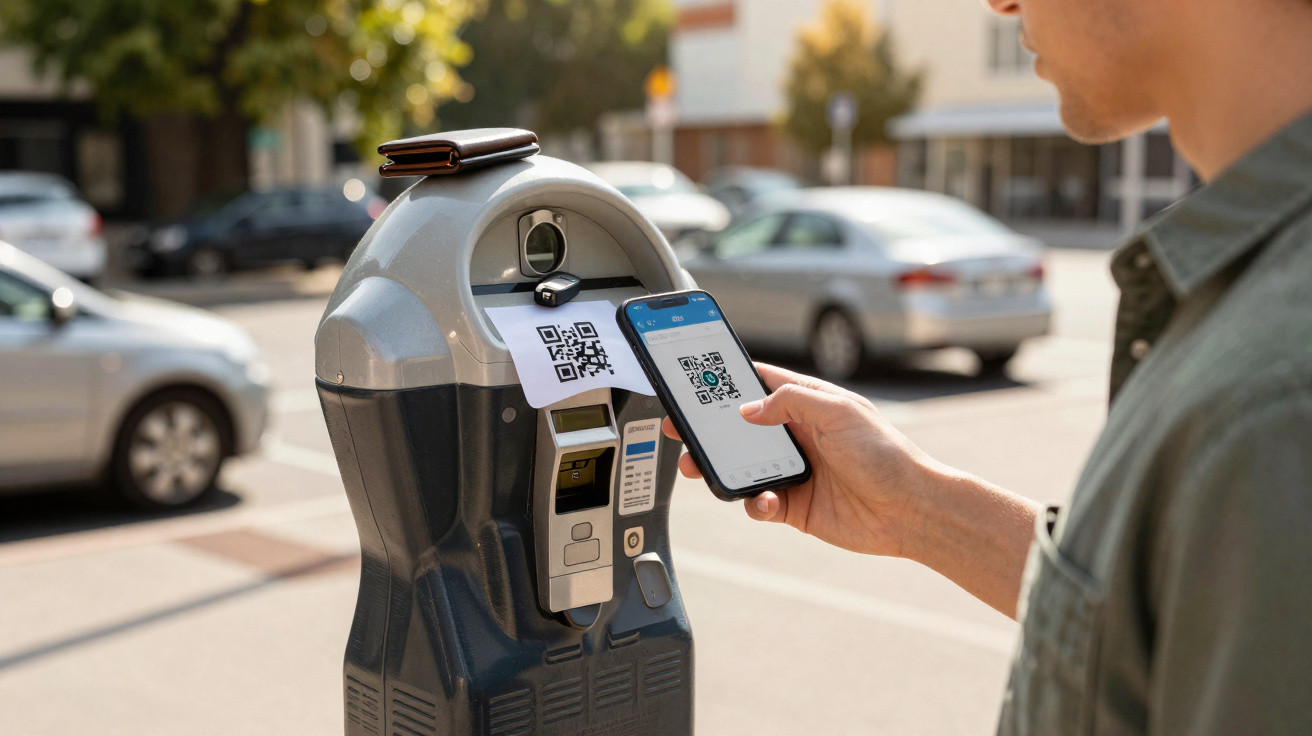
The man in the navy suit is running late. He gets out of his car with his phone in his hand and scans the QR code on the parking meter without properly checking the display. After two taps, he feels briefly reassured and rushes towards the glass-fronted office block.
An hour later, an alert from his bank reveals three online payments he does not recognise. The “parking app” was not operated by the council. It was a fraudulent payment form on a cloned website, supplied through a QR-code sticker that looked almost identical to the genuine one.
There was no security warning and no glaring red pop-up.
Only money quietly draining away beneath a small square of black-and-white pixels.
How QR code parking went from clever convenience to quiet trap
Scan, pay, leave: that is the promise displayed on thousands of parking meters along busy streets. There is no need for coins or to wait at machines that never accept your card on the first attempt. You take out your phone, scan the code and feel unusually efficient.
That routine reaction is precisely what fraudsters rely on.
They are not breaking into parking meters with laptops in darkened streets. Their approach is far more straightforward: they print counterfeit QR-code stickers and carefully place them over the official labels.
Police in several US cities have warned motorists about fake QR codes attached to meters and payment stations. Reports from Texas described drivers being sent to polished-looking sites requesting card information “to pay for parking”. The payment was processed, but no parking ticket was issued.
Accounts on Reddit and local Facebook groups are disturbingly alike: a busy car park, a new QR sticker that “looks more modern”, and a website copying legitimate parking pages, including their logos and colour schemes. By the time people spot unfamiliar charges, the fraudsters’ website has disappeared, ready to be replaced with a new one.
The scam succeeds because QR codes seem ordinary and harmless. We regard them as barcodes rather than clickable links, although that is exactly what they are: direct shortcuts to the internet’s wild west.
After you scan one, your phone translates it into a URL and passes it quietly to your browser. You are unlikely to inspect the address bar when sunlight is glaring, you are carrying bags and you have a meeting in five minutes.
Fraudsters understand this fleeting moment of pressure. At a parking meter, they know you are not thinking about security; you are thinking, “just let me park and get out of here”. That small shift in attention gives them an opening.
How to safely use QR codes on parking meters without giving them up entirely
One straightforward habit can make all the difference: check the URL that appears before you open it. You do not need to examine every character like a solicitor; look at the essential part, the domain name.
Does it belong to the council’s official website or the genuine parking operator? Or is it an unfamiliar combination of words and numbers?
If your phone offers a link preview, as most camera apps do, take two seconds to look at it. That brief pause is one of the best street-level firewalls available.
Council parking arrangements are generally consistent. Signs commonly state the official app’s name, provide a text-message short code or show a .gov address or a familiar company domain. If a QR code sends you somewhere that does not quite correspond, consider it a warning sign.
In practical terms, download the official parking app once, either at home or while sitting in your car, then use that instead. Find it through the app store rather than placing trust in whatever destination a QR code provides.
Let’s be honest: nobody really does this every day. You may be in a rush, the children may be in the back and your boss may be sending messages. Even so, having the app installed already removes one stressful decision when you are standing in the street.
There is another protective step: inspect the QR code itself. Is it a little crooked? Does it look glossy while the rest of the meter is matt? Are its edges coming away when you run a fingernail around them? Such details can indicate that someone has simply stuck a false label over the original.
If anything seems wrong, do not use that code and choose another payment method, however inconvenient it may be. An extra minute costs less than cancelling a bank card and spending days pursuing refunds.
“The best scam is the one that looks like the normal way of doing things,” a cybersecurity expert told me. “Criminals don’t need to be technically brilliant. They just need you to be in a hurry.”
- Check the domain first – if it does not match the operator named on the sign, stop.
- Use the official app or website that you located yourself, rather than one offered by a sticker.
- Trust discomfort – a misaligned label, a supposedly “new system” that seems too good to be true, or a meter that suddenly “only works by QR” should all prompt a second look.
- Where possible, pay with a credit card or virtual card rather than by direct debit from your bank account.
- Take screenshots of unusual pages – they can help if you later report a scam to the council or your bank.
Rethinking the small moments when we hand over our data
We tap cards in coffee shops, permit apps to follow our location and scan unknown codes for restaurant menus or Wi-Fi passwords. On a good day, it all appears to be progress: no coins, no paper and no bother.
On a bad day, it can seem as though we have made wagers out of everyday actions.
The parking-meter scam sits directly within that tension. It feels too small to seem dramatic, but it is close enough to our bank accounts to cause genuine harm.
At a human level, losing money is only part of the experience. People speak about the embarrassment of “falling for it”, as though being misled by a convincing sticker reflects their intelligence. It does not.
These QR codes are created for smooth, effortless use rather than careful scrutiny. The entire system favours speed over reflection. If you make a mistake, you are acting exactly as its designers expect. The only question is who designed it that day: the council, or a fraudster with a printer and glue stick.
There is also reason for optimism, because habits carry over. The simple response developed at a parking meter - checking the URL and listening to that slight feeling of doubt - can follow you into other situations, including online shopping and late-night emails asking you to “update your delivery details”.
On a crowded street, while managing bags and a packed schedule, it is easy to feel defenceless against invisible fraudsters. But that is not the whole reality. You do not need to become suspicious of everything or stop using QR codes altogether. You only need one or two practical, street-smart responses that work in everyday life.
On a busy Tuesday beneath a grey sky, that could be the difference between a routine parking ticket and a week spent calling your bank.
| Key point | Detail | Why it matters to the reader |
|---|---|---|
| QR codes can be replaced with fake stickers | Fraudsters print their own codes and attach them over legitimate parking-meter labels | Helps you view parking meters as possible fraud locations rather than neutral objects |
| Checking the URL is your quickest defence | A two-second look at the domain often reveals fake websites | Provides a simple, realistic habit that can prevent most QR-code scams |
| Use official apps and more than one payment option | Downloading the genuine app and favouring credit or virtual cards limits potential harm | Reduces both financial exposure and the inconvenience if something goes wrong |












Comments
No comments yet. Be the first to comment!
Leave a Comment