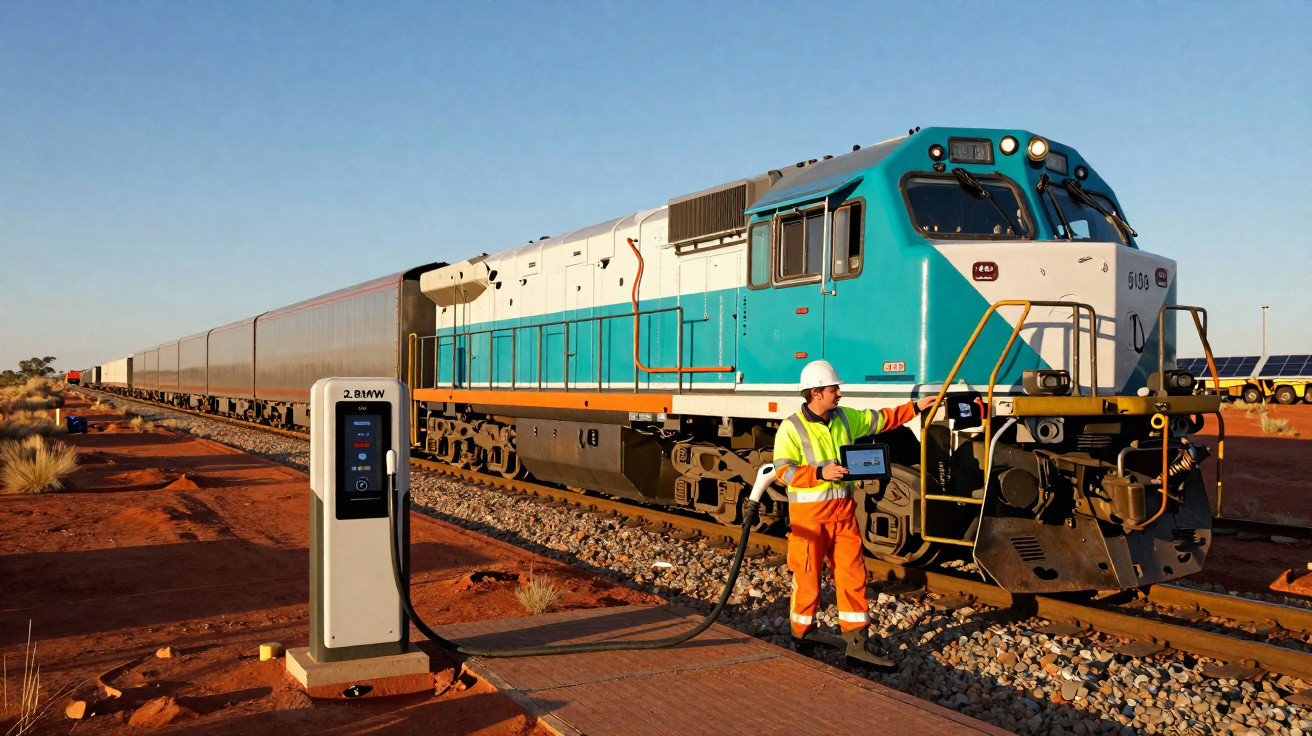
Far from urban stations and conventional overhead electrification, Fortescue is placing its faith in a battery-electric freight locomotive so immense that it sits somewhere between a train and a travelling power station.
The world’s largest land-based mobile battery inside a mining train
Fortescue, among Australia’s largest iron ore mining companies, has started running two electric locomotives fitted with 14.5 MWh battery packs apiece. This capacity makes each one the largest mobile battery ever installed in a land vehicle, surpassing every truck, train and construction machine now operating.
For perspective, 14.5 MWh is broadly equivalent to the annual electricity consumption of several dozen average European homes. Rather than powering household appliances, however, the stored energy moves heavily loaded ore trains over hundreds of kilometres of remote track, where neither overhead wires nor grid connections are available.
With 14.5 MWh on board, each locomotive carries around 200 times the energy capacity of a standard electric family car.
The trains work in Western Australia’s Pilbara, a demanding, open region centred on mining exports. Diesel locomotives have traditionally been the only viable choice there. Installing high-voltage transmission lines through uninhabited desert for just a few daily freight movements seldom adds up economically.
By replacing diesel fuel tanks with vast battery packs, Fortescue intends to show that remote, high-intensity rail routes can move away from fossil fuels without reducing productivity.
Why batteries are more practical than wires in the outback
Railways in Europe and Japan commonly use overhead-line electrification. The situation in Western Australia is markedly different: routes are exceptionally long, passenger services are almost absent, and infrastructure expenditure rises sharply away from the coast.
Building catenary across hundreds of kilometres for dedicated mining trains would demand billions in initial spending, as well as complicated maintenance, while offering little adaptability should routes alter as new ore deposits are developed.
Large-capacity batteries provide a modular alternative:
- They remove the requirement for uninterrupted infrastructure along the route.
- They can be charged at a limited number of industrial hubs rather than along the entire line.
- They support phased deployment, allowing operators to begin with a smaller fleet.
- They work well with renewable generation plants located on site and owned by the miner.
Fortescue calculates that operating these two locomotives alone will reduce diesel use by approximately one million litres annually. That delivers direct fuel-cost savings, while also lowering greenhouse-gas emissions and local air pollution.
For a sector built on thin margins and massive volumes, meeting decarbonisation targets with lower operating costs is a rare double win.
Engineering a rolling power station
Batteries more like grid assets than vehicle packs
Progress Rail, a Caterpillar subsidiary, designed the locomotives, which were assembled in Sete Lagoas, Brazil. Each locomotive has eight axles, helping distribute its mass while providing the substantial tractive effort required for lengthy, heavy iron ore trains.
At the centre of each machine sits the 14.5 MWh battery system. Fortescue has not disclosed every technical specification, but battery packs of this scale present important engineering issues, including temperature control, fire protection, resistance to vibration and the ability to service equipment quickly in isolated locations.
In contrast with a 60–80 kWh electric-car battery, the energy held here must be managed more like that of a fixed grid-scale storage system. Engineers require durable cooling for severe heat, multiple redundant safety measures and a battery-management system capable of enduring repeated high-power charging and discharging without rapid deterioration.
| Vehicle type | Typical battery capacity | Relative to Fortescue locomotive |
|---|---|---|
| Electric car (family saloon) | 60–80 kWh | ≈ 1/200 of 14.5 MWh |
| Heavy electric truck | 500–900 kWh | ≈ 1/15 to 1/25 |
| Fortescue battery locomotive | 14,500 kWh (14.5 MWh) | Baseline |
Regenerative braking: turning gravity into a charger
Mining railways frequently have uneven operating profiles. Loaded trains travel uphill from the mine towards the port, before returning with lighter loads or empty wagons. This arrangement means regenerative braking can form a key element of the energy strategy.
During descents, traction motors operate as generators. Rather than dissipating surplus kinetic energy as heat through brake pads or resistors, the system returns it to the battery. Fortescue says that, in favourable circumstances, as much as 60% of energy used during certain stages can be recovered in this manner.
As a result, the terrain itself becomes an energy resource. Each downhill run supplies a partial recharge, cutting the amount of grid or renewable electricity needed at the terminal and enabling locomotives to make additional journeys between full charges.
2.8 MW charging matched to industrial schedules
The locomotives can receive charging power of up to 2.8 MW. At this level, a significant recharge can take place during normal loading and unloading stops, without imposing extra downtime. Charging opportunities are therefore set by the mining timetable rather than requiring the timetable to change.
Instead of drawing electricity from a remote network, Fortescue intends to power the chargers from its own renewable installations. Large solar arrays and wind farms on, or close to, mining leases will supply electricity directly to rail operations, protecting the business from fuel-price fluctuations and, to some extent, grid limitations.
Pairing giant batteries with on-site solar and wind turns an isolated mine into a self-contained, low-carbon logistics hub.
A late arrival that still achieves a first
The locomotives had originally been expected in 2023. The first eventually reached Port Hedland in June 2025, followed by the second in December 2025, before both travelled inland to Pilbara operations. For a first-of-its-kind high-power battery-locomotive platform, this delay is comparatively limited.
Fortescue chief executive Dino Otranto presented the locomotives not as futuristic experimental vehicles, but as practical machines already changing expectations for heavy rail freight. This is significant because the mining industry has seen numerous one-off demonstrators in the last decade that never progressed beyond publicity photographs.
These locomotives, in comparison, are integrated into daily iron ore movements that cannot accommodate unreliable machinery. Their operation over the coming years will generate real-world evidence on maintenance requirements, battery ageing and lifecycle emissions in harsh desert environments.
Mining rail as a proving ground for decarbonising heavy transport
Other mining companies are testing the approach
Fortescue is not the sole participant. Its rival, mining giant BHP, has received battery-electric locomotives from Wabtec, equipped with battery packs closer to 7 MWh. The underlying proposition is much the same: remove diesel from dedicated mine-to-port routes, retain high availability and reduce fuel costs.
Mining rail provides an almost ideal test environment for this transition:
- Routes are permanent and predictable.
- Freight movements are heavy and frequent, supporting investment in purpose-built chargers.
- Operations take place on private land, making approval processes for new power systems easier.
- Businesses can coordinate rail, trucks and fixed machinery through one energy strategy.
Should battery systems demonstrate reliability amid the continuous vibration and heat of Pilbara operations, the case for them becomes stronger on other long-distance routes, including North American freight railways and European industrial branches where full catenary upgrades encounter opposition.
A sector under pressure to demonstrate climate progress
Mining’s climate impact reaches well beyond blast furnaces. Research in Nature Geoscience indicates that, when extraction, processing and transport are considered together, the industry may be responsible for roughly 10% of global CO₂ emissions. Investors, regulators and customers are now pushing companies to demonstrate measurable action.
Rail is just one element of the challenge. Large off-road trucks, excavators and supporting equipment also consume enormous amounts of diesel each day. Electrification is beginning to advance in this area too. Chinese manufacturer XCMG, for instance, has field-tested the XDE240 electric mining truck, which can carry up to 250 tonnes of ore and has a gross vehicle weight exceeding 380 tonnes.
Fortescue has already ordered 200 of these trucks, which are intended to work on duty cycles similar to those of their diesel equivalents. Together, battery locomotives and electric haul trucks could transform the overall energy budget of a mine site.
The narrative is shifting from “can heavy mining go electric?” to “how fast can mines rewire their whole value chain around electricity?”
What Fortescue’s battery locomotives suggest for heavy-duty batteries
Installing a 14.5 MWh battery on railway vehicles raises wider questions extending beyond mining. Grid operators, port authorities and long-haul logistics organisations are all observing how systems of this kind age and how effectively they connect with existing electricity infrastructure.
Engineers often discuss one possible application: using large mobile batteries for two purposes. In principle, a fleet of battery locomotives or trucks could act as flexible storage, absorbing surplus solar generation while trains are idle and assisting the grid at periods of peak demand. Mines already use microgrids; introducing mobile storage on this scale creates further balancing possibilities, but also additional coordination difficulties.
Potential risks must also be assessed carefully. High-energy lithium-based packs bring the dangers of fire and thermal runaway. Operators need to train staff, fit sophisticated detection systems and prepare emergency procedures appropriate for isolated rail sections, where public emergency services may be several hours away. Insurance requirements and regulation will develop as these machines become more widespread.
For policymakers, the Fortescue project provides a practical benchmark for developing decarbonisation policies for rail and heavy vehicles. Rather than depending solely on theoretical modelling, they can review actual figures covering fuel savings, maintenance intervals, component replacements and grid effects over several years of service.
For engineers and energy-systems students, the scheme is a real-world lesson in whole-system design: aligning battery capacity with route characteristics, sizing chargers around loading periods, integrating renewables, and weighing initial capital spending against fuel and carbon savings over decades of operation.











Comments
No comments yet. Be the first to comment!
Leave a Comment