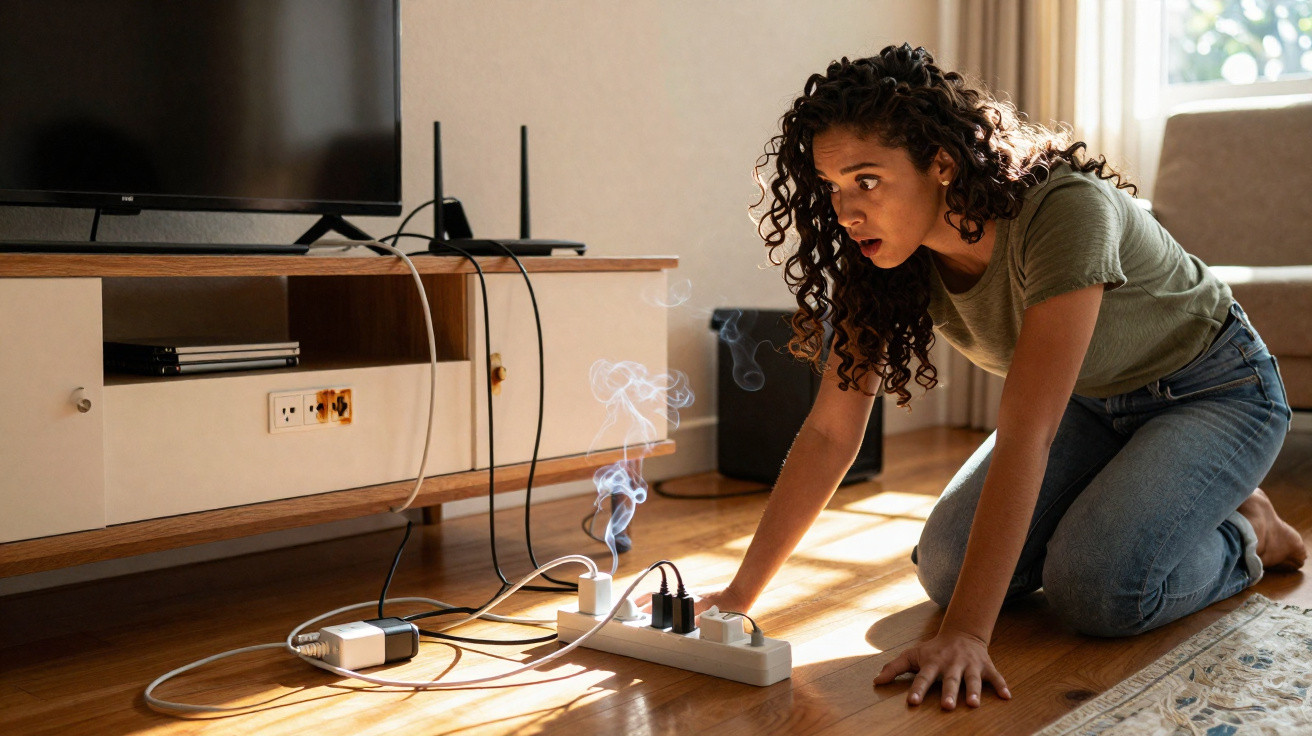
Someone did what millions of people do without a second thought: they took another power strip, connected it to the first one, and freed up sockets for a games console and Bluetooth speaker.
Nothing blew up. The lights stayed steady. The room seemed properly sorted. Hours later, a slight smell of hot plastic drifted into the hall. A narrow wisp of smoke started rising from behind the television cabinet. Before anybody spotted it, the carpet had begun to darken and melt.
There was no storm, defective appliance or spectacular lightning strike. It was simply an ordinary habit with an innocent-sounding label: “daisy chaining”. There is a reason firefighters dislike it so intensely.
Why daisy chaining power strips is playing with fire
Connecting one power strip to another can initially seem ingenious. You appear to beat the wall socket, multiply the available outlets and avoid scrambling beneath desks. It is the sort of easy workaround that becomes common in offices and student flats without anybody questioning it.
Electricity, however, does not respond to clever workarounds. An ordinary outlet is built to supply a set amount of power, not to support a cluster of inexpensive plastic bars buzzing away beneath a desk. Daisy chaining does not merely offer added convenience; it quietly increases the danger.
During a demanding day, that danger becomes heat rather than an abstract possibility.
Fire investigators repeatedly encounter the same aftermath: a scorched section of flooring, charred power strips melted into one another, and softened plastic at the points where cables joined. In one US study, the National Fire Protection Association associated thousands of house fires each year with extension leads and power strips, with daisy chaining appearing repeatedly in its reports.
Imagine a home office containing a computer, monitor, printer, router, phone charger and ring light. A single wall outlet sits in the corner, so a power strip is plugged in. Once that is full, another strip is attached. Then an inexpensive fan heater gets added “just for today”. Nobody hears the precise moment when the cables inside the wall begin to overheat.
On a cold night, while you are concentrating on work or your children are watching a cartoon, that unseen overheating is the genuine threat. Fires caused by this type of overload do not necessarily begin with sparks. More often, they start as a gradual, concealed burn.
To see why daisy chaining is so hazardous, ignore the plastic bars and view the arrangement as a series of weak points. The wall outlet, wiring within the wall, first strip, second strip, leads and plugs all have their own limit. Plugging one strip into another does not create extra power; it makes the same circuit carry more than it was designed to bear.
Most power strips are rated for a maximum load, often 1,500 to 1,875 watts on a 15-amp circuit in North America. That figure is not advisory; it is the red line. Two or three high-demand devices can readily reach it: a fan heater, hair dryer or gaming PC. Put them through daisy-chained strips and the weakest point begins to heat up like a phone left beneath a pillow.
Even more concerning, the built-in “surge protection” or reset button on a strip can give people misplaced confidence. That small switch is treated as though a firefighter were standing by. It’s not. Under pressure, it is often the first component to fail.
How to power your life without turning your floor into a tinderbox
There is a straightforward, unexciting and decidedly low-tech answer that electricians repeat constantly: return to the wall outlet. Where possible, connect major appliances directly to wall outlets rather than through daisy-chained strips. If additional sockets are genuinely necessary, use one good-quality power strip or, preferably, a UL-listed power bar with integrated overload protection.
Check the rear or underside of the strip for its rating, shown in amps or watts. Total the devices connected to that strip: each plug or charger label states its wattage. Where the combined figure approaches the strip’s maximum, divide the equipment between separate wall outlets, preferably on different circuits.
It is not especially elegant. You may need to move furniture or give up an otherwise perfect cable arrangement. Yet that minor inconvenience is insignificant beside having to explain to an insurance investigator why three melted strips had been connected in a chain.
At a human level, daisy chaining usually springs from the same impulse as leaving washing-up in the sink. You tell yourself it is only for one evening: one more charger, one more device, one more adaptor added on top. Everyone is busy, while homes and workplaces were not planned for a world in which every object needs electricity.
On a particularly bad day, that “just this once” attitude meets a cheap, unbranded strip picked up years earlier from a bargain bin. Perhaps dust has gathered beneath the bed. Perhaps the strip is partly hidden under a rug to prevent people tripping over it. This is how everyday convenience can gradually become a collection of ideal fuel.
Let’s be honest: hardly anybody truly reads labels, adds up watts and checks every socket every day. That is precisely why the habits you establish once-such as never daisy chaining-are so important.
“When we investigate a house fire,” a veteran firefighter in London told me, “we almost never find just one bad decision. We find layers of them. Daisy-chained power strips are one of those quiet layers people forget about until it’s too late.”
What does a safer arrangement look like in everyday life? It does not mean making your home resemble a laboratory. It means following several clear rules automatically. Never connect one power strip to another. Dispose of old, discoloured or warm-to-the-touch strips. Keep them away from carpets and bedding. For garages, workshops or high-power equipment, ask a qualified electrician about fitting more outlets or dedicated circuits.
- Use one power strip for each wall outlet; never connect them in a chain.
- Keep high-wattage devices (heaters, microwaves, hair dryers) on separate outlets.
- Replace strips older than 5–7 years, or those with wear, discolouration or frayed leads.
- Never place power strips beneath rugs, behind curtains or anywhere heat may accumulate.
- Select UL- or CE-listed products from reputable manufacturers rather than untested imitations.
Living with more plugs than walls: choosing safety over shortcuts
We live at a time when the average kitchen worktop resembles a small power station: coffee machines, air fryers, phone chargers, smart speakers and chargers for the chargers. On a hectic weekday morning, it is tempting to approach outlets like a game of Tetris, forcing in another strip wherever a space appears.
Oddly, the answer is not advanced technology but a change in thinking. Rather than asking, “Where can I physically plug this in?”, ask, “What’s this circuit already carrying?” That brief mental check changes the situation. It turns an invisible hazard-hot cables behind cool walls-into a decision you make knowingly.
When you walk through your home tonight and notice that second strip connected to the first behind the TV unit, you can regard it either as clutter or as kindling. One is inconvenient. The other can change lives.
| Key point | Detail | Why it matters to the reader |
|---|---|---|
| Daisy chaining overloads circuits | Several strips connected to one outlet can push wiring beyond its intended capacity | Helps you recognise that “more outlets” does not mean “more power” |
| Heat builds silently | Overloaded strips and leads can overheat well before sparks or flames become visible | Encourages early action rather than waiting for dramatic warning signs |
| Simple habits prevent fires | Using one strip per outlet, checking ratings and avoiding rugs greatly reduces the risk | Provides clear, practical measures to make your home and office safer today |
















Comments
No comments yet. Be the first to comment!
Leave a Comment