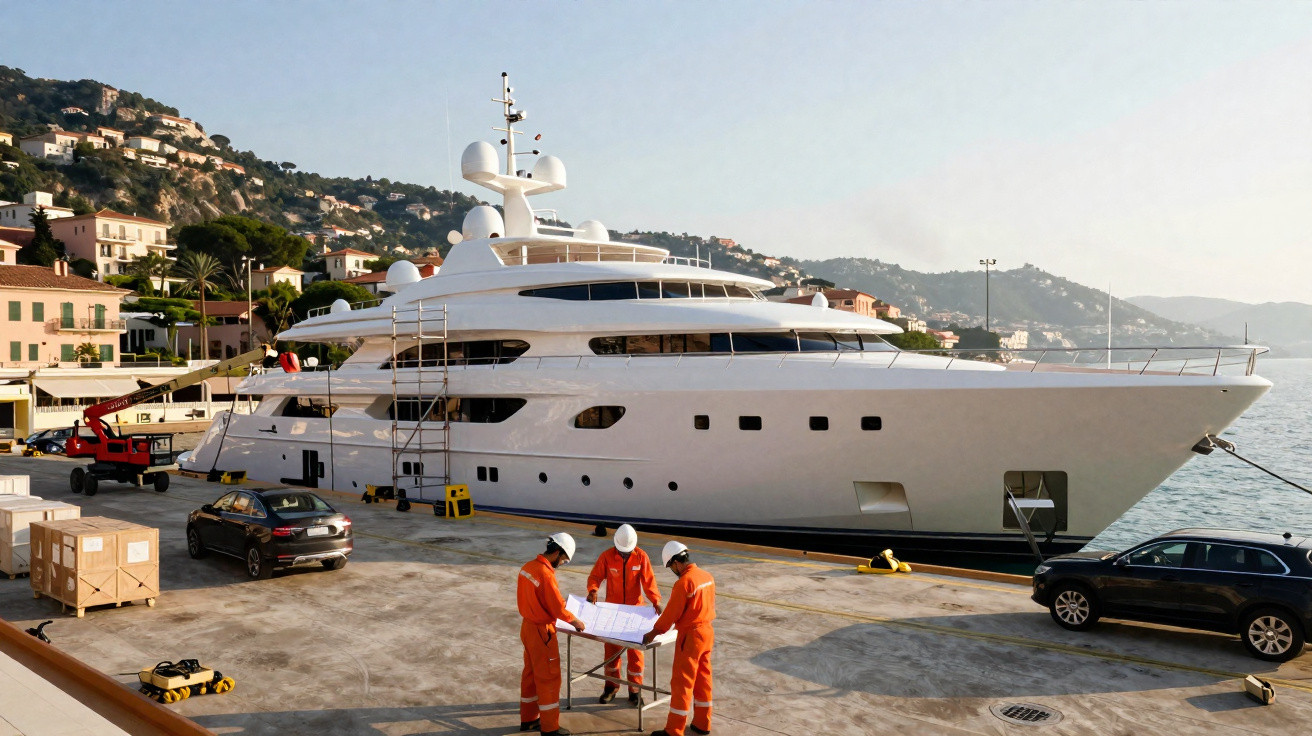
A floating palace of glass and steel, as large as an apartment block, sits beneath a cocoon of scaffolding. Sparks from welders fall towards the water like orange rain, while the air carries the scent of heated metal and diesel. Hard-hatted workers pedal by holding coffees in plastic cups; only metres away, tourists take photographs as though they have arrived at a motor show.
This is “Launchpad”, the Meta billionaire’s $300 million superyacht, discreetly moored on the Côte d’Azur for extensive repairs. France is providing the industrial welcome: dry-dock capacity, local employment and elite engineering, all to restore one exceptionally polluting luxury object to immaculate condition.
In a part of the world where billionaires seem as much a feature of the scenery as palm trees and seagulls, the sight can appear almost routine. But there is nothing routine about this vessel.
France, the Riviera and a billionaire’s floating palace in dry dock
From the quay, the divide is stark. Families sit on a bench eating inexpensive ice creams, while beside them stands a 118-metre superyacht for which one night’s fuel bill exceeds many residents’ annual rent. Its hull rises above the nearby fishing boats, casting a shadow like a skyscraper misplaced at sea.
The workers surrounding it treat the vessel like any other assignment. French, Italian and Romanian conversations overlap. A foreman studies a tablet, a painter grumbles about the wind, and an engineer curses an uncooperative valve. To them, Zuckerberg’s luxury vessel is not so much a symbol as a contract reference, a deadline and a great deal of overtime.
From the street, however, there is no doubt about whose wealth is sitting in the harbour. The name is spoken in near-whispers: “Zuckerberg’s yacht.”
Residents of La Ciotat and Marseille remember the old shipyards that nearly vanished before luxury refits revived them. In the 1990s, the docks represented industrial decline; now they accommodate the world’s floating mansions. Launchpad is simply the latest in a succession of oligarch and tech-billionaire boats to pass through, each pushing further the definition of a “yacht”.
Some estimates indicate that one large superyacht may produce thousands of tonnes of CO₂ each year. One climate report stated bluntly that the private fleets owned by only a few dozen billionaires can match the emissions footprint of small countries. Against that scale, an ordinary family holiday can seem like a drop of water in an oil slick.
France has invested substantially in making these yards a worldwide centre for mega-yacht repair, keen to retain high-value maritime work. Towering cranes, specialist lifts and enormous dry docks are infrastructure available in only a small number of locations worldwide. At the UN, the country promotes a green transition; at dock level, it welcomes some of the planet’s most extravagant fossil-fuel machines.
The rationale is straightforward: let billionaires fund the work, safeguard employment and demonstrate technical excellence. Politicians celebrate “know-how” and “industrial excellence”. The awkward issue of who is permitted to pollute, and who is instructed to take shorter showers, is kept politely out of sight.
How a $300 million yacht becomes France’s quiet “service to luxury”
Beyond the polished photographs, refitting a yacht is a highly choreographed operation. Launchpad did not merely arrive at the yard. Its entry is planned to the centimetre, with tugs steering the hull into dry dock, divers inspecting the blocks and teams waiting to respond to an error that could cost millions. The dock doors then shut, the water is drained and the vessel settles on steel cradles, exposed and vulnerable.
Once it is secured, hundreds of specialists begin work. Engines are overhauled and the hull is inspected. Paintwork requires carefully controlled humidity and temperature. Bespoke interiors are renewed to satisfy the latest preferences. Satellite equipment is upgraded so Zuckerberg can stay connected at sea as though he had never left Menlo Park. It resembles a luxury hospital, except its patient consumes heavy fuel oil rather than calories.
Every component comes with a bill, and every hour in dry dock produces income for French industry.
On paper, the arrangement appears to be an economic success. Each superyacht project channels money into wages, restaurants, hotels and transport locally. Regional officials discreetly welcome every contract: fewer redundancies, additional apprenticeships and more prestige. Some locals simply say, “If it’s not here, it’ll be in Italy or Spain.”
They are not mistaken. Superyacht owners can choose from the entire world, seeking out the best yards and the most discreet authorities. France is doing more than repairing Mark Zuckerberg’s boat; it is sending a message to every billionaire with a floating palace: bring your money here and everything will be handled.
The environmental contradiction remains difficult to overlook. France promotes low-emission-zone legislation, speaks firmly about restraint and asks citizens to reduce consumption. Simultaneously, the state supports the upkeep of ultra-luxury assets that consume fuel as if it were still 1973. Let us be honest: nobody really does this every day, but for the ultra-rich, travelling across the Mediterranean on a vessel such as Launchpad is nearer to a weekend routine than an exceptional indulgence.
There is also a more personal response. For many French people dealing with rent increases, inflation or stagnant pay, the sight of a tech billionaire’s $300 million toy receiving attention in an advanced facility can feel like passing a VIP lounge to which they will never be invited. On a hot summer’s day, inequality seems almost tangible in the air.
What Launchpad reveals about climate, money and “success”
One point is clear: France is not simply powerless. It deliberately chose to specialise in precisely this area of extreme-luxury maintenance. The country created docks capable of receiving these enormous vessels, trained workforces able to keep them operating for decades, and established tax and legal arrangements that allow such projects to run smoothly. This is a strategy, not an accidental outcome.
If France wanted to send a different signal, it could require higher environmental standards from superyachts entering its yards. During refits, it could promote hybrid propulsion, cleaner fuels and compulsory carbon audits. Instead, political debate commonly ends with “jobs” and “competitiveness”, as though the only options were economic self-destruction or unrestricted excess.
That is where the cognitive dissonance becomes striking. People are told to turn down their heating in winter, avoid flying too often and rethink cheap weekend breaks. Then they open their feeds and find a 300-million-dollar yacht receiving a complete spa treatment, enabling it to continue cruising the Riviera while using more fuel in a day than some people do in a year. The message feels skewed, to say the least.
At a human level, envy exists, although it is seldom acknowledged openly. From a Marseille rooftop or a Nice balcony, people watch these yachts pass at sunset and wonder what is happening aboard. Champagne? VR headsets? Meetings about the next social-network feature that will bind us even more tightly to our screens, while the engines thunder beneath the deck?
At policy level, the figures are unforgiving. The lifestyles of billionaires, including their yachts and private jets, shatter climate targets. A study of “super-emitters” shows that the richest 1% account for a proportion of emissions that modest adjustments to daily behaviour cannot counterbalance. Recycling yoghurt pots will not offset a private Boeing crossing the Atlantic or a month-long Mediterranean cruise.
After a long shift, a dock worker might put it this way: “We’re not the ones who decide.” They repair the vessel, earn their wages and return home with aching backs and marked gloves. The meaningful choices are made elsewhere, between governments and ultra-wealthy owners, in a world where a $300 million yacht is merely a portfolio entry rather than an ethical problem.
The French Riviera has always provided a stage on which inequality appears in high definition. Launchpad’s refit is the 2020s edition of the same story: technology money replacing oil barons, Instagram replacing glossy postcards, and climate anxiety sharing the water with effortless luxury.
And now?
At nearly every major dock, there is a small scene worth observing: the day the yacht departs. The doors open, water returns and the hull floats once more. Tugs take position alongside it. Workers take out their phones to record the moment, while a few residents stop with their hands on their hips to watch hundreds of millions of dollars glide back to sea as if it were entirely unremarkable.
Launchpad will soon travel along the coast, passing beaches where children make sandcastles soon claimed by the tide. People ashore will photograph it and post the images with equal measures of fascination and irony. Some will object, others will fantasise, and most will move on to the next story within seconds.
But the image stays with those who are paying attention: a nation that claims climate leadership while quietly serving as a luxury repair workshop for the world’s most polluting toys. A technology billionaire whose company influences how society discusses the future uses very traditional fuel to enjoy the present.
The issue is not whether Mark Zuckerberg is entitled to own a mega-yacht. That ship has literally sailed. The more significant question is how long societies will continue to accept these floating palaces as ordinary background scenery instead of recognising them as enormous bright-red warnings of what is collectively tolerated.
Perhaps one day these scenes will be viewed as we now view black-and-white photographs of people cheerfully smoking on aeroplanes: obvious, casual, strange and almost absurd. On an increasingly hot planet, a refitted superyacht leaving a French dry dock may reveal more about this era than any speech at the next climate summit.
| Key point | Detail | Why it matters to readers |
|---|---|---|
| France as a luxury service hub | High-tech Riviera shipyards refit mega-yachts such as Zuckerberg’s Launchpad | Helps explain how public industry discreetly supports extreme wealth |
| The climate contradiction | Ultra-polluting yachts thrive while citizens are urged to “consume less” | Provides context for personal climate anxiety and feelings of unfairness |
| What it reveals about power | Decisions favour billionaires’ comfort over systemic climate action | Encourages readers to question the type of “success” society celebrates |














Comments
No comments yet. Be the first to comment!
Leave a Comment