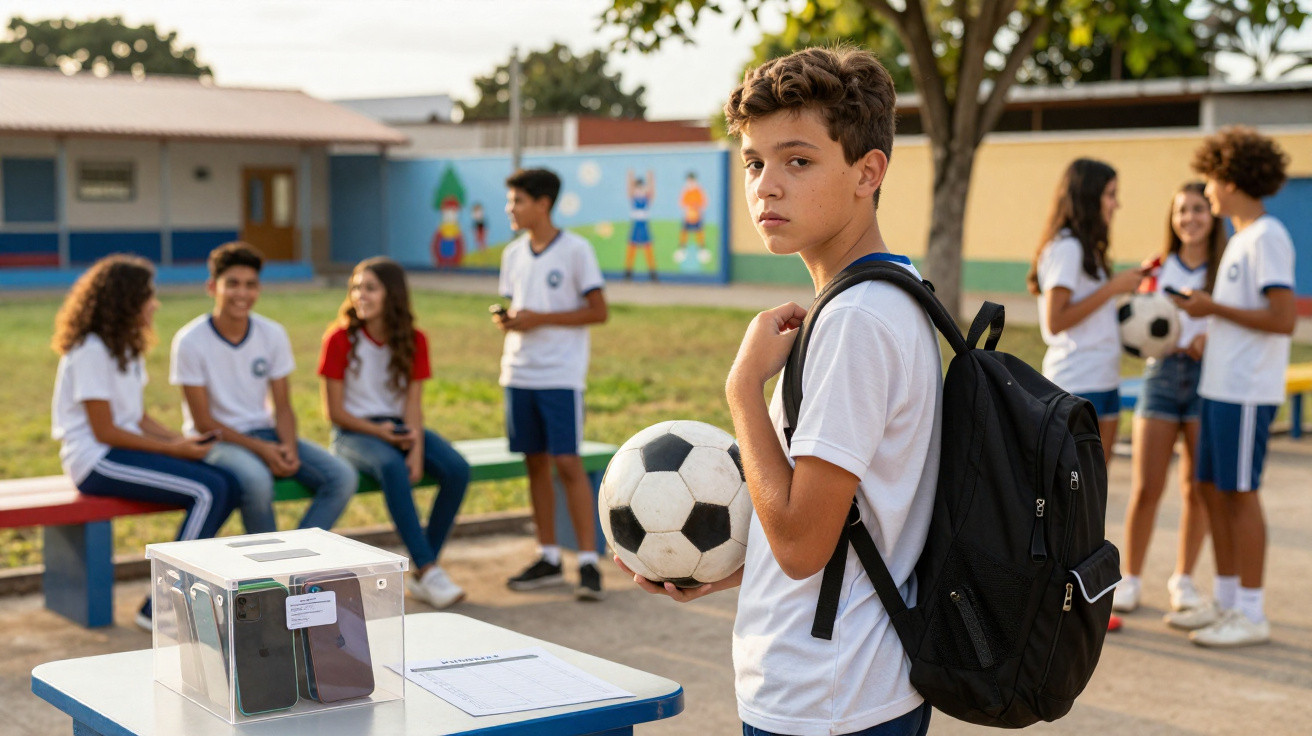
When the bell goes, the courtyard bursts into life. Not through yelling or the sound of running feet, but in a sudden, recognisable glow. At the picnic tables, half the pupils tilt their heads at the same angle, thumbs moving fast and faces illuminated by blue screens rather than the winter daylight. Nearby, a circle of girls is not quite having a conversation; they are recording a TikTok, silently practising the same dance for the fifth time. On the bench by the gym, one boy sits alone with his hood up, scrolling and fading into his screen as classmates pass him by.
Now picture that same break with every phone put away and locked out of reach.
That is the scene schools are beginning to draw up quietly.
Why schools suddenly want phones gone from break time
Across Europe, the US and Australia, an increasing number of headteachers are proposing a new policy: no smartphones during breaks as well as during lessons. For parents, it can feel particularly sensitive. Those ten or fifteen minutes between classes are often when children message home, check their bus, or send a frantic “I forgot my PE kit.”
School leaders, however, make a straightforward case. They argue that corridors have turned into digital tunnels, playgrounds are “too quiet”, and that each new piece of drama seems to begin – or escalate – on a screen. One UK principal told me that supervising break now resembles “supervising hundreds of tiny media companies”.
A secondary school in the north of England tested a partial ban last term. Pupils had to switch phones off in lessons, but could use them at lunch. Within a few weeks, staff spotted a pattern: in the canteen, roughly a third of pupils ate with one hand while holding a phone in the other. There was very little eye contact.
Then a fight broke out. It was not about football or seating arrangements, but a Snapchat story: a photograph, a caption and an insult that spread through half the year group within minutes. By the time a teacher reached the scene, half the onlookers were filming on their phones. When the headteacher later spoke with parents, many were more upset by the online public humiliation than by the punch itself.
From a school’s perspective, the reasoning is uncomplicated: if the fiercest social conflicts now begin on screens, remove the screens. Leaders raise concerns about attention spans, loneliness in the playground, and children who genuinely do not know how to open a conversation without holding a device.
Child psychologists add a further concern. They highlight studies connecting heavy phone use with anxiety, disrupted sleep and the continual low-level strain created by group chats that never “switch off”. In their view, break time is a valuable chance to reset the nervous system: to run about, laugh too loudly and be bored. The worry is that notifications are swallowing childhood one at a time.
What a no-phone break really looks like for teenagers
One French middle school introduced a full-day phone ban with no gradual transition. From the first bell until the final one, phones had to be switched off and locked in small pouches. The first week was chaotic. Pupils said they had “nothing to do”. Some simply stood staring ahead, as though they had been placed in an empty room.
Then, quietly, the atmosphere changed. Footballs that had been left gathering dust were brought out again. Card games emerged. Under the stairs, a group of shy Year 7s created a sketching circle. Teachers described more noise, more activity and more traditional “messing about”. It was not flawless: some pupils still remained at the edges. Yet the courtyard started to sound like… a school courtyard.
Parents had more mixed feelings. One mother I spoke to said the ban initially made her panic. She depended on quick WhatsApp messages to arrange collection or reassure her child before a maths exam. Another parent worried about her daughter, who has social anxiety and uses her phone as a shield in crowded settings.
Others, though, found the change unexpectedly reassuring. They no longer felt pressure to reply immediately to “Mum, I forgot my homework” messages, and dreaded less the possibility of midday drama erupting in the family chat. One father said the rule gave him an excuse: “I can finally tell my son, ‘I literally can’t text you during school. Talk to your teacher.’” It may sound severe, but some parents felt that the invisible link between them and their children had become overly tight.
Behind every meeting about phone policy sits a simple but complicated reality: adults are frightened. They fear bullying travelling from the locker room into the bedroom, mental-health crises beginning with a late-night group chat, and losing their children to a world they do not entirely understand.
Under pressure to “do something,” schools view a ban as an obvious action that can be measured. It means fewer phones visible around school, fewer disputes over confiscation and less recording of incidents. Parents can look at precisely the same policy and see what may be lost: quick contact, digital literacy and the way teenagers genuinely form bonds today. Both sides are holding on to the same aim – a version of safety – but pulling in opposite directions. That tension is why this debate feels so raw right now.
How families can survive (and even use) a school phone ban
A practical option that many families are testing is the “two-phone” approach: a basic handset that only calls and texts for school hours, plus a smartphone at home. It may sound extreme until it is clear that many children mainly require one function during the day: the ability to call home.
This option alters the device’s emotional significance. The inexpensive phone becomes a tool rather than an identity. Parents retain the reassurance of being contactable, schools see fewer bright screens in corridors, and teenagers may notice something once they stop rolling their eyes: without apps available to check, the impulse to keep reaching into a pocket can disappear surprisingly quickly.
If your child’s school is heading towards a ban, the least helpful response is to frame it as a personal criticism of your parenting. Your child will sense that defensiveness immediately. Instead, ask how they really use their phone at break: are they chatting, gaming, hiding, or merely filling quiet moments?
Be candid about your own behaviour too. Do you message them too much in the day? Do you demand instant responses? Let’s be honest: nobody really does this every single day, but a brief family “phone pact” for school hours can give everyone room to breathe. It could be: “Emergencies only, no mid-day drama, talk in person first when possible.” This is not about control; it is about creating a little mental space for both of you.
A secondary-school teacher in Dublin told me: “The first week without phones at break, kids said they were ‘bored out of their minds’. By week three, they were laughing that they’d forgotten how loud the yard could be. One girl said, ‘I didn’t realise how anxious my phone was making me until it wasn’t there.’”
- Talk to the school early
Find out how firmly the ban will be enforced, where phones will be stored and what procedures apply in emergencies. - Prepare your child socially
Practise simple “small talk” or ways to enter a group, especially if they usually retreat behind a screen. - Create a simple tech routine at home
Keep rules more relaxed after homework, but set clear points when every phone is put away – including adults’ phones. - Watch for real distress, not just complaints
Complaining is to be expected. Ongoing stomach aches, tears or isolation may show that extra support is needed. - Stay curious, not combative
Ask your teenager what they notice about phone-free breaks. They may tell you things they would never otherwise admit.
Are we saving childhood or rewriting teenage social life?
Removing phones from break times changes more than a school rule: it changes the feel of the entire day. The quiet interval between lessons, when a teenager checks a meme, lets off steam in a group chat or catches a glimpse of the wider world, is reduced again to the physical reality of the corridor and playground. For some pupils, that is a relief. For others, it can feel as if part of their social life has been switched off.
This is the point at which the debate becomes awkward. Adults like to imagine a clear divide between “real life” and “online life”, but teenagers do not experience it in that way. Their closest friendships, jokes, crushes and disagreements constantly flow between both spaces. Therefore, when schools speak about “bringing kids back to reality”, teenagers hear a different message: you are banning the place where my life actually happens.
At the same time, another reality exists. A generation of teachers says it has never witnessed such fragile eye contact, such anxiety about awkwardness or such a strong fixation on recording every moment instead of simply experiencing it. When phones are absent, they see children return to familiar, unremarkable pleasures: playing tag, drawing, gossiping face to face and even just looking at the sky. These are small acts, but they are the grains from which childhood is made.
The blunt truth that few people want to say openly is this: we do not fully understand what phones permanently attached to teenagers’ hands throughout the day are doing to their brains – and we will not know for years. Schools are therefore experimenting in real time, while families are left to respond. Perhaps the most honest view, for now, is to hold both sides of the contradiction. Smartphones can strengthen teenage connection while quietly weakening it. A ban can protect children while also unfairly limiting their social world. The real task is not to choose one account over the other, but to listen to how our own children are experiencing this change, day after day and break after break.
| Key point | Detail | Value for the reader |
|---|---|---|
| Phone bans are expanding | More schools are considering no-smartphone rules during all breaks, not just in class | Helps parents anticipate and understand changes that may hit their own child’s school |
| Impact is mixed | Less visible bullying and more playground interaction, but also anxiety about losing contact and social status | Gives a realistic picture of benefits and drawbacks instead of a one-sided argument |
| Families can adapt | Options like basic “school phones”, family phone pacts, and open conversations with teens and schools | Offers concrete ways to stay connected while supporting healthier phone habits |















Comments
No comments yet. Be the first to comment!
Leave a Comment