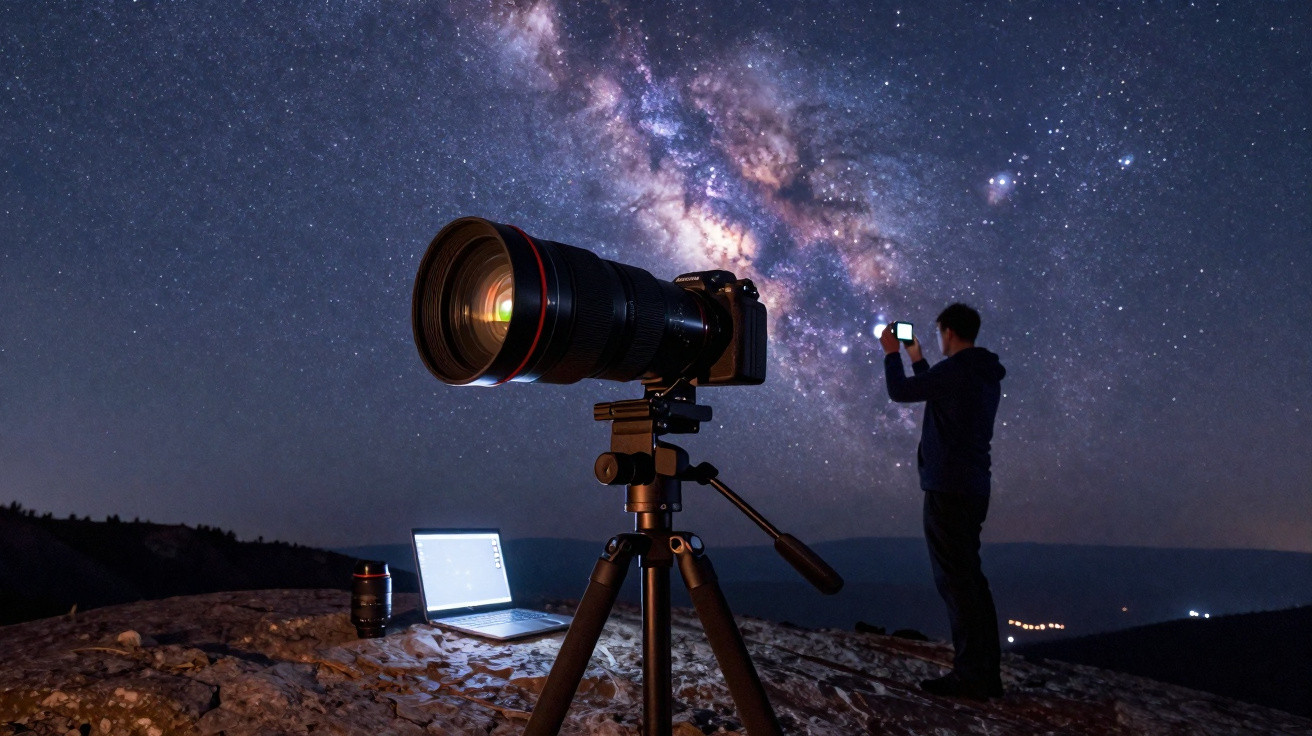
Astrophotographers need a fast 35mm lens that keeps stars sharp in the corners, adds depth to the foreground and does not force the ISO too high. The Viltrox AF 35mm f1.2 LAB FE delivers in a way that makes Sony’s 35mm lenses seem slightly conservative.
I was crouching beside a basalt boulder with numb fingers, the Viltrox AF 35mm f1.2 LAB FE mounted on a Sony camera like a head torch for the sky. A single press brought live view to life, while the horizon quietly resolved into focus. At f/1.2, the histogram rose without the usual worry that the stars would smear.
At 35mm, the sky is expansive without becoming impersonal, while the land still has a story to tell. A goat path, an isolated juniper and lights from a distant hamlet all become characters within the composition. Reviewing the image, I looked at the edges: sharp, restrained and assured. That was the moment it made sense.
The instant I opened the aperture to f/1.2, it felt as though exposure had room to breathe.
Why the Viltrox AF 35mm f1.2 LAB FE suits night photography
For night landscapes, 35mm is a sweet spot: wide enough to hold the galactic core, yet narrow enough to give the foreground a meaningful role. At f/1.2, this Viltrox is more than simply “bright”; it is accommodating. That additional stop can mean a cleaner ISO setting, a shorter shutter speed for pin-point stars, or a balance of both.
What caught me off guard was not its light-gathering ability but its rendering. Near the edge of the frame, stars remained neat sooner than expected, with sagittal smear controlled in the areas where many fast 35mm lenses begin to struggle. Manual focus was positive and repeatable, and the focus throw made it possible to reach genuine infinity without searching for it.
In contrast, the Sony 35mm options I have used have always demanded small night-time trade-offs: stopping down slightly for tidier corners or accepting more noise to retain detail. In practical use, it produces cleaner stars at the frame edges than the Sony 35mm options I have used. This is not a claim based on laboratory charts; it is what becomes apparent during a dawn edit, when you inspect an image at 200% and choose whether it is worth keeping.
I brought it to a high-desert plain, where airglow drifted across the scene like faint green smoke. I made one set at f/1.2, 10 seconds, ISO 6400, then another at f/1.8, 8 seconds, ISO 8000, to check whether the corners improved further. Both sets of files remained convincing, although the f/1.8 image brought a touch more micro-contrast to the outer field.
At that same location last summer, my Sony 35mm f/1.4 had required f/2 to settle the rooftop lights near the edge and keep star points under control. Here, the Viltrox provided an extra stop and more precisely where astrophotography benefits from it: timing and signal. Those modest advantages become substantial when images are stacked or blended.
Foregrounds are important too. A 35mm lens at f/1.2 offers an unusual night-time combination: unstreaked stars and a subject several metres away that does not turn to mush. At f/1.2, the Viltrox provides a stop of creative headroom that reshapes your night workflow. It marks the difference between a hurried concession and a carefully composed image with space to breathe.
The reasoning is straightforward. Opening by one stop lets you halve the shutter time, reducing star movement while preserving a strong signal. That results in a cleaner sky before any noise reduction is applied. In real-world files, it appears as sparkle rather than smearing, along with texture in the dust lanes.
Depth is the other advantage. With a fast 35mm lens, you can position a foreground subject close to the camera while preserving a crisp sky through a brief star exposure and a separate frame for the landscape. The Viltrox rendering gives edges a clear snap, which is valuable when the images are blended.
I also found its colour neutrality more truthful than overly rich. This reduces the work needed to manage green-magenta balance when airglow becomes prominent. Such details are minor at midday; at midnight, they can separate a clean grade from an odd patchwork of colour casts.
How to get the best night files from the Viltrox AF 35mm f1.2 LAB FE
Focus with a watchmaker’s care. Magnify live view on a star around the middle of the frame, disable focus peaking, then turn the ring slowly from soft to sharp until the diffraction ring becomes tight. Ease it back fractionally to find the cleanest point. If the lens has a distance scale, treat it as a reference rather than an absolute; complete the adjustment by eye.
Use a two-pass approach: capture the sky at f/1.2–f/1.8 with a shutter speed short enough to maintain round stars, then take a longer, lower-ISO landscape exposure to blend at the horizon. Disable long-exposure noise reduction when using a tripod and set a two-second self-timer. Everyone has experienced the moment when ideal alignment arrives while the camera is still “processing.”
Realistically, nobody follows an elaborate routine every night. Use a straightforward recipe that still works when you are half-asleep.
“The 35/1.2 LAB FE is the first fast 35 I’ve kept in the bag for Milky Way season,” a night-shooter friend messaged me. “It buys time, and time is the currency at 2 a.m.”
- Starting point: f/1.2–f/1.8, 6–12s, ISO 6400–12800 for star points.
- Landscape pass: f/2.8–f/4, 30–120s, ISO 800–1600.
- Disable IBIS on a tripod; focus manually; turn peaking off.
- Set white balance to around 3800–4200K to keep the sky natural.
- Bracket when city glow begins to intrude; keep horizons simple for blending.
Common pitfalls and understated advantages
Pursuing perfection at f/1.2 can become a trap. If the extreme corners look unsettled in a complicated composition, move to f/1.8 and exchange a small amount of light for cleaner geometry. With an aperture this fast, that stop is effectively available for free, and the gain can be immediate.
Exposure rules are guidance rather than law. The traditional “500 rule” is generous for modern sensors; at 35mm, try the 200–300 range if you want sharply defined points in large prints. Remember that ISO is a gain control, not a magic solution. Raise it enough to preserve the stars, then allow a modern denoiser to do its job.
Think of your future self when framing the scene. Leave a clean horizon for blending, and avoid placing the foreground awkwardly over the Milky Way core. For astrophotographers seeking sharpness and depth, this lens sets the standard to beat. It removes exposure anxiety from the compositional process, leaving you free to explore form, scale and shadow.
Where it surpasses Sony - and why that matters
This is where the argument becomes more provocative. Sony’s 35mm lenses are excellent general-purpose options, but after dark the Viltrox AF 35mm f1.2 LAB FE feels designed with a specific purpose. Its extra stop, its retention of star shape towards the edges and its crisp micro-contrast on rock and bark combine to create night files with more life.
Cost matters in this specialist category. Receiving stronger night performance for less money overturns the usual logic of camera equipment. That value can welcome people into astrophotography who assumed they would need to hire equipment or make do with less. It also encourages established brands to reconsider what a fast 35mm lens should achieve beneath the Milky Way.
There is a quieter creative change here too. A fast 35mm lens allows you to engage with the foreground instead of using it merely as a silhouetted backdrop. The camera can move closer, the narrative becomes more intimate and the sky feels earned instead of pasted into place. The resulting file holds up in a way that makes you want to share it rather than defend it.
| Key point | Detail | Why it matters to the reader |
|---|---|---|
| Fast f/1.2 aperture | Shorter shutter speed or cleaner ISO without sacrificing star points | Sharpened skies, less noise and more keepers |
| Edge control | Stars remain neater in the outer field at wide apertures | Print-ready corners without heavy stopping down |
| 35mm storytelling | Sky context and foreground depth within one image | More cinematic night scenes with a sense of place and scale |
















Comments
No comments yet. Be the first to comment!
Leave a Comment