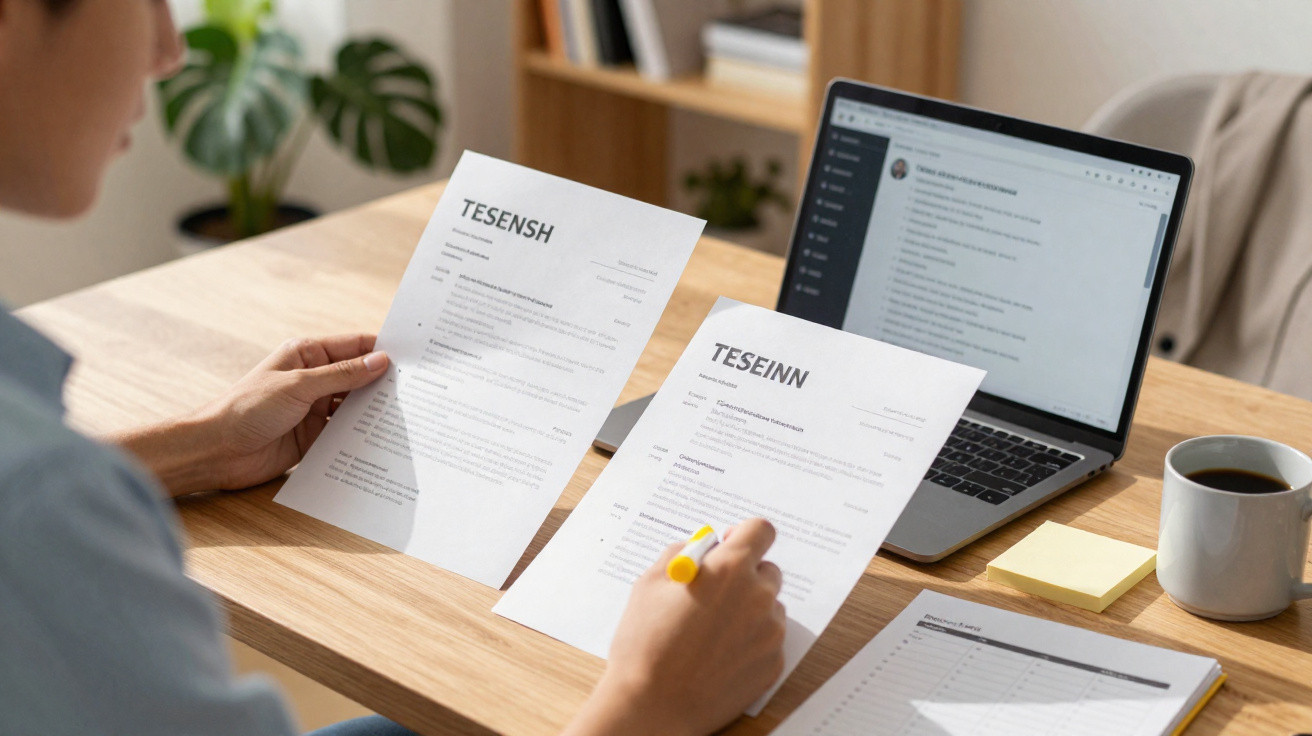
AI offers an appealing shortcut: a CV that presents you at your best in minutes rather than months. The real question is not “Should AI write my CV?” but “How do I use it without losing me in the process?”
The café was noisy, a job advert had just appeared, and my friend’s laptop was covered in competing tabs. LinkedIn. A partly completed CV in Word. A prompt window blinking expectantly. With a sigh, she pasted a few untidy bullet points into an AI tool and saw them become polished statements containing numbers that carried real weight. As her profile began to describe someone who achieved outcomes rather than simply completed tasks, her anxiety eased slightly. Then the cursor started blinking again.
AI is your co-author, not your ghostwriter
Everyone knows the feeling of facing an empty page, only for their mind to erase every achievement they have ever had. AI can end that impasse, producing a first draft within seconds and giving you several versions to consider. That is not where the magic lies. The useful part comes afterwards: refining, cutting and selecting wording that sounds like you on a particularly good day. AI drafts, you decide.
Take a marketing manager who can describe her campaigns but finds it difficult to put a figure on their results. She gives the AI a few fragments: “led email launch, improved click-through, worked with sales.” It returns a sharper statement: “Led a 4-week email relaunch across 3 segments, lifting CTR from 2.1% to 3.8% and adding 127 sales-qualified leads.” Those figures were already in her records; AI simply gave them an effective structure. She did not turn into somebody different. She became more precise.
There is a clear reason this approach works. Recruiters often scan a CV within seconds, while Applicant Tracking Systems search for signals that match the role. Straightforward wording is more effective than empty padding. Strong action verbs draw the reader’s attention, and figures support your claims. AI is good at spotting patterns and imposing structure, converting rough duties into accomplishment statements that combine action, impact and context. Your role is to use judgement: decide which examples belong and recognise the boundary between confident and inaccurate. This is not about handing over your voice.
The AI CV method that actually gets interviews
Begin with a “truth dump”. Write down your responsibilities, tools, projects and unfiltered metrics; it does not need to be neat. Add this material and the job description to your AI tool with a request such as: “Rewrite my bullets using action-impact-metric, mirror the job’s keywords, keep tone human and concise, and suggest 2 alternatives per bullet.” Request a brief professional summary that reflects the position while remaining true to your experience. Afterwards, set it beside your original version and mark anything that has been left out.
The usual pitfalls are straightforward to avoid. Never allow AI to make up figures or qualifications. Where information is missing, it may hallucinate. Maintain a separate evidence document containing links, dashboards and emails that you would feel comfortable discussing. Have AI produce three forms of each bullet point-technical, business and cross-functional-then select the one best suited to the advert. Realistically, no one rewrites a CV entirely from the beginning for every vacancy. Build a core CV, then adapt the top third and several bullet points for each application.
You can also ask the AI to assess your CV as a recruiter would: “Score this CV against the job. Which five keywords are missing? Where is it vague?” This produces a quick action list to work through. Follow it with a clarity check: “Condense without losing impact. Remove buzzwords. Keep verbs varied.”
“Proof beats polish,” a senior recruiter told me. “If I can picture what you did and why it mattered, I’m calling you.”
- Prompt template 1: “Turn these tasks into results bullets using action-impact-metric. Keep 18–22 words each.”
- Prompt template 2: “From this job description, extract top 10 keywords and map them to my experience below.”
- Prompt template 3: “Rewrite bullets to be credible for a career changer, highlighting transferables and outcomes.”
- Prompt template 4: “Write a 2-line summary tailored to this role. Avoid clichés. Use verbs from the JD.”
- Prompt template 5: “Format UK vs US CV style difference for this section. Keep spelling consistent.”
What changes once you try it
A subtle shift takes place. Rather than viewing your CV as a permanent monument, you begin to see it as a prototype. You test small variations in tone, ordering and the emphasis placed on metrics, before sending the strongest version out into the world. Your interview conversations are shaped by your bullet points, and you have examples ready because they were built from evidence rather than filler. Your CV is a trailer, not the whole movie.
| Key point | Detail | Benefit for the reader |
|---|---|---|
| Use AI for structure | Action-impact-metric bullets, keyword mapping, clear summaries | Faster drafts that pass both humans and ATS |
| Stay verifiable | Keep an evidence file, never invent numbers or roles | Confidence in interviews and zero risk of credibility damage |
| Tailor the top third | Adjust headline, summary, and 3–5 bullets per role | Higher relevance with minimal time spent |












Comments
No comments yet. Be the first to comment!
Leave a Comment