
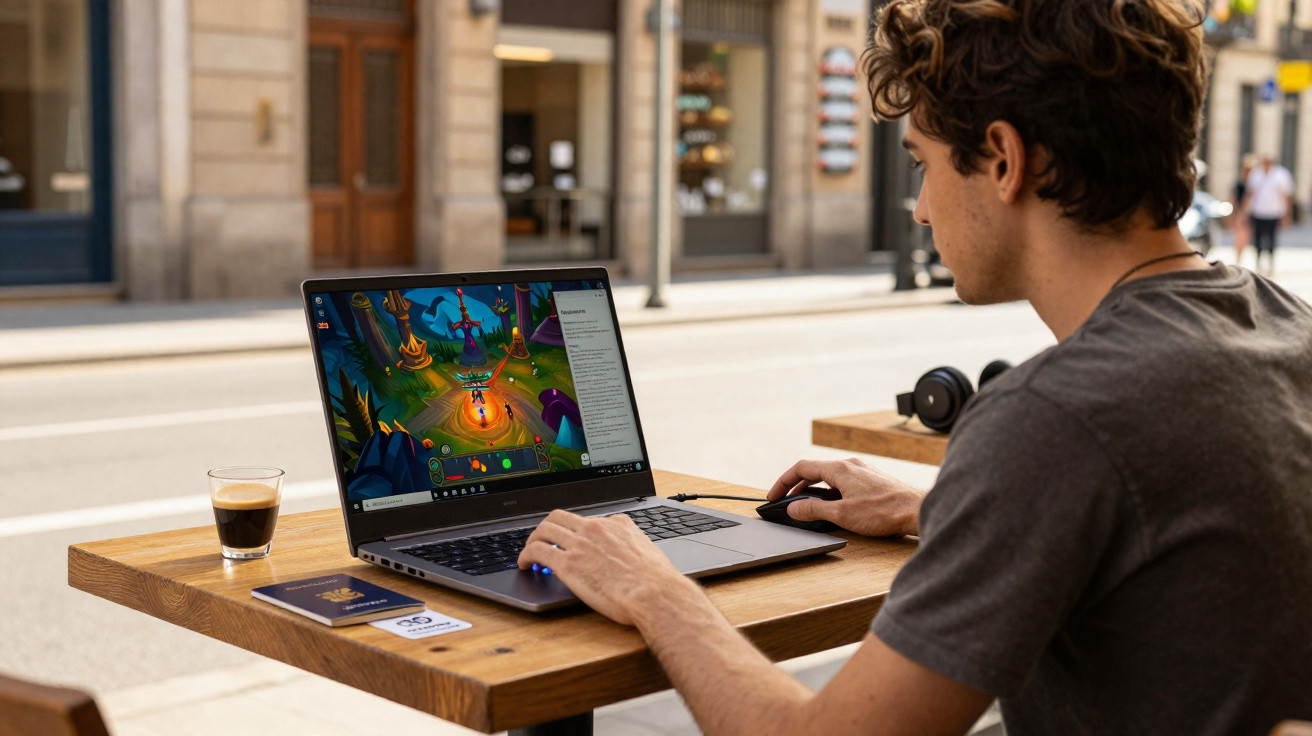
For PC gamers who travel, what are the options? The most obvious choice is still the Steam Deck and similar devices, but compact 14-inch gaming PCs should not be overlooked either. I have never been keen on this format, yet I made myself use one for a month and now I cannot do without it. Here is what I found.
I am a serious PC player: the kind of gamer who happily spends hours in MMORPGs or obscure management games dredged up from the depths of Steam. Above all, I value comfort, with a gaming tower fitted with a GeForce RTX 5090 and two side-by-side 21:9 monitors. There is one major issue, though: my work for Presse-citron means I am constantly travelling around the world. As a result, I get far fewer opportunities to enjoy my setup.
How can I play my favourite games anywhere, whether I am on the move, in a hotel room, or even at home on the sofa or in bed? The obvious answer is a Steam Deck or an equivalent handheld, such as the ROG Xbox Ally. There are other possibilities too, including GeForce Now on a smartphone or tablet. Yet, honestly, none of them delivers the comfort of a “proper” PC, whether in performance, ergonomics or versatility. That leaves one final option: a 14-inch gaming laptop.
This was never a format that appealed to me. I have tested plenty of them and was occasionally impressed, but I had never felt any regret at not owning one. Fourteen inches is harsh, particularly for a player used to a certain level of comfort. I already feel cramped on a 16-inch laptop, so 14 inches? Still, for Presse-citron, I gave it a go: one month using nothing but an ultra-compact gaming PC. I found a Razer Blade 14 2025 for the job, a premium gaming laptop. It was a strong configuration, with an AMD Ryzen 9 365 processor and an RTX 5070, offering performance comparable to a desktop RTX 5060, although any model would have done. Is this form factor genuinely a viable solution? This is my experience.
One month with a compact gaming PC
The rules were straightforward: I was not allowed to use my desktop tower at home, switch on another PC at the office, or take an ultraportable out for work while travelling. Every minute of my screen time had to be spent on the Razer Blade 14. I would be lying if I said the first few days were easy. The display is tiny and comfort is reduced. Working on a machine this size is possible, but gaming on it?
I soon got into it, though, to the point that I started to embrace it. Working outdoors on a bench or in a café is entirely practical, particularly as gaming laptops have improved dramatically in battery life, reaching between 8 and 10 hours in power-saving mode, and in portability, weighing under 2 kg. Gaming does require a little more preparation, however. You need to carry the power supply, often adding another 500 g, along with a mouse or controller. It all fits in a backpack, but it is still extra kit. Playing at the office also means subjecting colleagues to the cooling fans, which regularly exceed 50 decibels on a gaming PC. At home, a simple £20 Amazon stand makes gaming comfortably on the sofa or in bed possible. Lovely.
The Razer Blade 14 at MWC Barcelona
The experiment became a real test as MWC Barcelona approached. A tech trade show not only involves walking countless kilometres every day with a PC in your backpack, but the new World of Warcraft expansion, Midnight, also launched at exactly that time - and I have never missed an expansion launch. How could I manage both? This is where the Razer Blade 14 proved its worth. It stayed in my bag, ready to last a full day in the press room, whether I was writing, sending videos or running an instance while files uploaded. At night, I could set up more comfortably and enjoy the new expansion. My Steam Deck and my Switch? Forgotten.
You do not need to empty your savings for a 14-inch gaming PC
Of course, playing on a premium 14-inch gaming PC is hardly the worst situation to be in. But you do not need to empty your savings on a high-end product to benefit from the format. Brands offer affordable, capable models that are not overly flashy: Asus TUF, Acer Nitro, Dell G Series, Lenovo LOQ and so on. They still cost more than €1,000, certainly, but they are versatile machines suited to both gaming and work. Investing in a tool with that much day-to-day flexibility is not unreasonable.
DLSS and Intel Arc make modest gaming PCs more practical
Better still, it is becoming increasingly easy to play anywhere on a machine with moderate power. Nvidia, for instance, has introduced a whole range of game-integrated tools designed to improve performance without placing additional strain on the GPU. This includes DLSS, which uses AI to boost frame rates, either by creating “fake” frames between two “real” ones through frame generation, or through upscaling, where a low-resolution image is converted into a high-resolution one. These tools are available on Nvidia RTX cards, including the least expensive models. On top of that, a RAM shortage is forcing the developers of our favourite games to lower their requirements. As a result, smaller configurations are not only relevant for gaming: they are also less likely to become obsolete quickly, since the memory shortage looks set to continue. We are talking about Nvidia cards here, but the latest Intel processors, Panther Lake models with an Intel Arc GPU, are also increasingly viable options. Their gaming results are impressive, with even the latest blockbusters reaching 60 fps at maximum graphics settings, albeit with ray tracing switched off.
After a month of use, I am now handing back my 14-inch gaming PC. Is that a relief? Not really. It is undeniably enjoyable to return to my gaming setup when I am at home, but what about life on the move? The Steam Deck now seems like a fairly limited option to me, although it costs less, while using my ultraportable without a graphics card leaves me wanting to launch a game but constrained by its performance. Will I buy a 14-inch gaming PC in the future? There is a very good chance I will.




Comments
No comments yet. Be the first to comment!
Leave a Comment